Chillers
The best cold plunge chiller for the money
Value in this category is decided after you buy it. A 600 W chiller adds about $723 of electricity over three years; a 190 W one adds about $229. That gap outruns most of the price differences.
By Scooter M. · Published · Last updated
How we are paid: the buy links on this page are affiliate links. If you buy through one, we earn a commission from the retailer at no extra cost to you. It does not change what we rank or what we tell you to skip - the full FTC disclosure is here.

| # | Product | Rated draw | Best for | Score | Price |
|---|---|---|---|---|---|
| 1 | 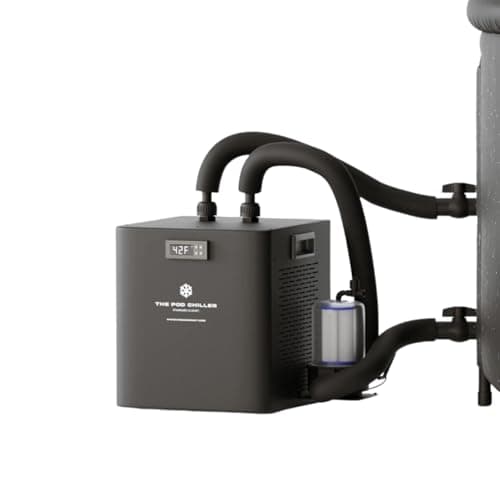 The Pod Company Standard Water Chiller, 1/3 HP 280 watts, a published 41 F floor and a 20-micron filter. It is less than half the draw of every other chiller here, and the listing volunteers the comparison. | 280 W | Cheapest to run | 7.2 | $568.99 - Amazon |
| 2 | 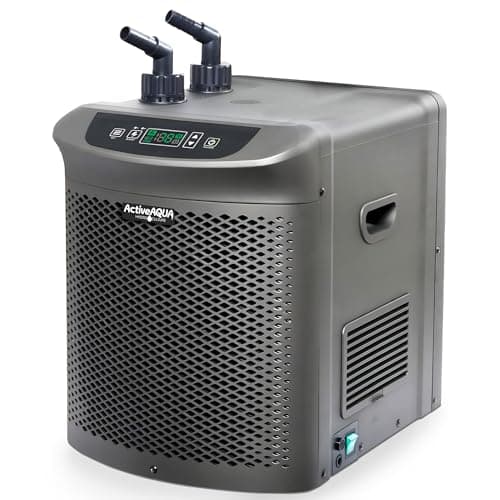 Active Aqua Water Chiller, 0.25 HP, Titanium A hydroponics chiller with a pure titanium evaporator and a published 190 W draw, repurposed for cold plunges long before cold plunges were a product category. | 190 W | Longest-serving design | 6.5 | $627.27 - Amazon |
| 3 | 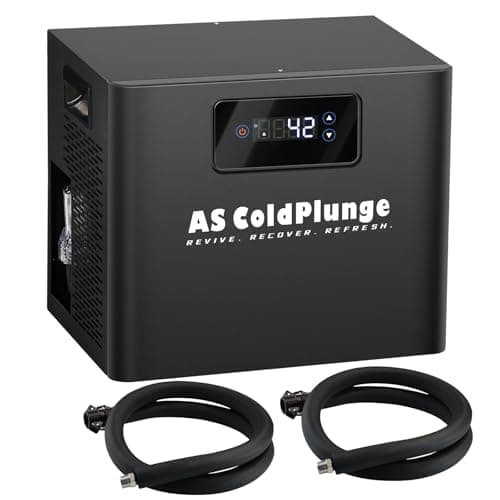 AS ColdPlunge 1/3 HP Cold Plunge Chiller 600 W, a 42 F floor, a reusable metal filter instead of cartridges, and a submersible pump in the box so it works with a bathtub that has no ports. | 600 W | Best for a bathtub | 7.7 | $399.00 - Amazon |
| 4 | 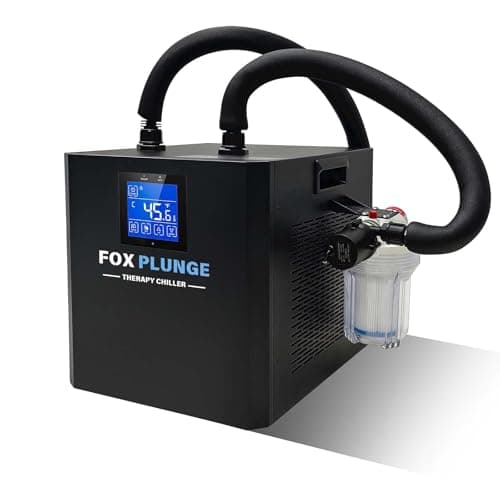 FOXPLUNGE Cold Plunge Chiller, 1/2 HP 1,200 W with a published 41 to 55 F range and a stated 30 to 40 dB noise level - the only chiller here that puts a number on how loud it is. | 1200 W | Published noise figure | 6.4 | $449.95 - Amazon |
| 5 | 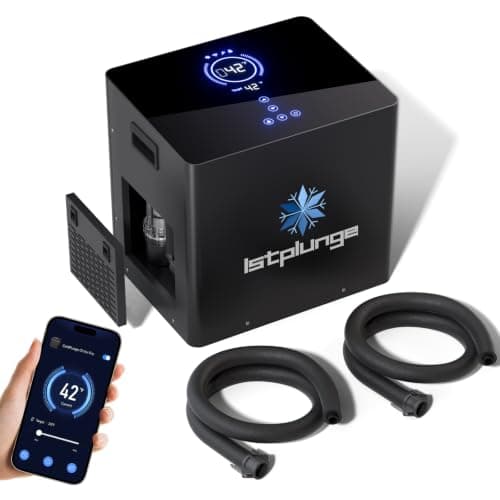 1stplunge 1/3 HP WiFi Cold Plunge Chiller A 42 F floor, a built-in pump and a rinsable metal filter, with app control and a top-mounted touchscreen - but no published wattage and no published gallon rating. | Not published | App and schedule control | 3.8 | $435.00 - Amazon |
How we judged value here
Three criteria, applied in this order:
- Three-year electricity, computed from the published wattage. Same rate, same assumed hours, for every unit. No estimates.
- Whether it publishes enough to be judged at all. A chiller with no published draw cannot be costed, and we will not guess one.
- What the money also buys. Gallon rating, cooling floor, filtration type and warranty - because the cheapest running cost is a bad deal if the unit is too small for your tub.
The three-year electricity table
Computed at 18.34 cents per kWh, at six hours a day for three years. Six hours is an illustration, not a measurement - it is the same illustration for every row, which is what makes the column comparable.
Read the first and third rows together. The difference between a 190 W chiller and a 600 W chiller is about $494 over three years. The difference between a 280 W unit and a 1,200 W unit is about $1,109. Now look at the live prices in the table above: in this category those electricity gaps are usually larger than the price gaps they sit behind, which is the whole argument of this page. We do not print prices in copy - they move, and the figures beside each pick are the live ones - so do that comparison with the numbers on screen rather than a number we typed months ago.
Why the cheapest sticker is usually the worst deal
The 600 W and 1,200 W units in this roundup tend to carry the lower purchase prices, and the 190 W and 280 W units the higher ones. That is not a coincidence: a more efficient compressor and a better heat exchanger cost more to build. What the listing never does is put the two numbers next to each other, so the buyer compares prices and ignores a running cost that is several hundred dollars over the life of the unit.
This is the same argument we make for tubs in best cold plunge for the money, except that with a chiller the ongoing cost is far larger, because a chiller runs for hours rather than minutes. The full category table is on what a chiller costs to run.
The two you cannot judge at all
Two chillers on this site publish no rated wattage. One of them is in the list above, and it is there deliberately rather than quietly omitted: it is a perfectly normal-looking listing at a normal-looking price, and there is no way to work out what owning it costs. Both computed cost components score zero for it, which is why it ranks last here.
That is not a claim the unit is inefficient. It might be excellent. It is a statement that the seller has not given you the one number that decides the largest ongoing cost of the purchase, and that on a page about value, an unknown is a mark against.
Value is not only electricity
Two things can undo a good running cost:
- Undersizing. A cheap-to-run chiller matched to a tub larger than its published gallon rating will run continuously and never reach setpoint, which costs more than the right unit would have. How to size a chiller has the bands.
- Consumables. A cartridge filter is a recurring purchase; a rinsable metal mesh is not. Over three years that difference is real money that never appears in a price comparison - which chillers publish their filtration sets out who uses which.
Duty cycle: the uncertainty that does not change the answer
A chiller does not draw its rated power continuously. It runs until the water reaches setpoint, then cycles to hold it, and how much of each hour that takes depends on four things no listing publishes: how well the tub is insulated, whether the lid is on, how warm the room is, and how far below ambient you are asking the water to sit. A well-insulated, covered tub in a cool garage might hold at a fraction of full draw; an uncovered tub on a hot patio might run almost continuously.
That is a real limit on what anyone can tell you about absolute cost, and it is why the table above is labelled as a ceiling. What it does not do is disturb the ranking. Duty cycle is a multiplier that applies to every unit in the same conditions, so if a 190 W chiller and a 600 W chiller are both cycling at forty percent in your garage, the 600 W unit still costs roughly three times as much to hold the same water. The ratio is the durable finding; the dollar figure is the illustration.
The one case where that breaks down is undersizing. A chiller too small for its tub never reaches setpoint, so it never gets to cycle - it runs at full draw indefinitely, which is the one way a cheap-to-run unit becomes the expensive one. That is the practical reason sizing and value are the same question.
Buying more chiller than the tub needs
The opposite error is quieter and more common. Published gallon ratings across the chillers on this site run from about 79 to 230 gallons, and the instinct when in doubt is to buy up. On a tub well inside a unit’s rating the compressor reaches setpoint sooner and then cycles, so the penalty is not as large as the wattage difference suggests - but you have still paid for capacity you are not using, and on a 1,200 W unit you are paying the higher rated draw every hour it does run.
The honest rule is to match the published rating to your measured volume with modest headroom, and to add a band only if the tub lives somewhere unconditioned. A chiller sized two bands up is not insurance; it is a higher purchase price and a higher ceiling on the running cost.
Check the arithmetic yourself
Nothing on this page needs to be taken on trust. The formula is:
kWh  = watts / 1000 x hours
cost = kWh x your rate per kWh
So a 600 W chiller running six hours is 3.6 kWh, and at 18.34 cents per kWh that is about 66 cents a day, or roughly $241 a year. Substitute your own tariff from your own bill and the ranking will not move, because every unit is multiplied by the same number. Our full method, including the source and date of the rate we use, is on the methodology page.
One more line item belongs in a value judgment and never appears in a price comparison: what happens when the unit fails. Three of the five picks here publish a warranty term and the other two publish nothing at all, and on a sealed refrigeration system a failure outside warranty is usually a replacement rather than a repair. A published term is not a guarantee of quality, but an unpublished one tells you the seller was not willing to commit to a number, which on a purchase you expect to run for years is part of the price.
What we would buy
If your tub is at or under the published rating of a low-wattage unit, buy the low-wattage unit and accept the higher sticker: over three years it is the cheaper object, and the arithmetic above is the reason. If your tub is large enough to need a half-horsepower or full-horsepower chiller, then the running cost is simply the price of cooling that much water - but buy the one that publishes its draw, so you know what you have agreed to.
And if you are still deciding between a chiller and bags of ice, the break-even is worked through here with the formula rather than a headline figure.
Every pick, in full
Each write-up below shows the score broken into its six components, the specs the listing actually publishes, and the running-cost arithmetic where a wattage exists to compute it from.
#1 - Cheapest to run
The Pod Company Standard Water Chiller, 1/3 HP
280 watts, a published 41 F floor and a 20-micron filter. It is less than half the draw of every other chiller here, and the listing volunteers the comparison.
| Small-space fit | 12 / 20 |
|---|---|
| Electrical fit | 20 / 20 |
| Cost to run | 20 / 20 |
| Key-number disclosure | 12 / 15 |
| Spec completeness | 8 / 15 |
| Warranty | 0 / 10 |
| Total | 72 / 100 |
| Rated watts | 280 Seller’s listing, read 2026-09-07 |
|---|---|
| Water capacity | Not published Not published |
| Dimensions | 13 x 13 x 21 in Seller’s listing, read 2026-09-07 |
| Weight | 40 lb Seller’s listing, read 2026-09-07 |
| Cooling floor | 41 Fno cooling rate published Seller’s listing, read 2026-09-07 |
| Material | Not published Not published |
| Warranty (months) | Not published Not published |
| Rated draw | 280 W |
|---|---|
| Cost per hour at full draw | 5.1 cents |
| Upper bound, running continuously | $37.47 per month |
A chiller cycles. It draws its rated power while the compressor runs and almost nothing while it does not, and how often it runs depends on ambient temperature, insulation, lid use and setpoint. We do not measure duty cycle, so we publish the two figures that need no assumption and no figure in between. Computed at 18.34 cents per kWh (June 2026). The method.
Two hundred and eighty watts is the number that decides this category. At the current US residential average it costs about five cents an hour at full draw, and even running continuously for a month - which no chiller does - the absolute ceiling is around thirty-eight dollars. The 1,200 W units in this roundup are four times that.
The listing's own comparison is a good one: about the same as a home freezer. That is a useful mental model, because a chiller works the same way and cycles the same way. It draws its rated power while the compressor is running and almost nothing while it is not, and how often it runs depends on your lid discipline, your room temperature and how well your tub is insulated.
The published floor is 41 F, which is warmer than the 37 to 39 F claimed by the bigger units. For most people that is irrelevant - the commonly recommended starting band is 50 to 59 F and experienced plungers usually settle around 45 to 50 F - but if you specifically want to get below 40, this will not do it.
Buy it if
Anyone whose plunge is a daily habit rather than an occasional event, where running cost compounds.
Skip it if
You want water below 41 F. This unit does not claim to go there.
#2 - Longest-serving design
Active Aqua Water Chiller, 0.25 HP, Titanium
A hydroponics chiller with a pure titanium evaporator and a published 190 W draw, repurposed for cold plunges long before cold plunges were a product category.
| Small-space fit | 12 / 20 |
|---|---|
| Electrical fit | 20 / 20 |
| Cost to run | 20 / 20 |
| Key-number disclosure | 5 / 15 |
| Spec completeness | 8 / 15 |
| Warranty | 0 / 10 |
| Total | 65 / 100 |
| Rated watts | 190 Seller’s listing, read 2026-09-07 |
|---|---|
| Water capacity | 92 Seller’s product title, read 2026-09-07 |
| Dimensions | 19 x 14 x 19 in Seller’s listing, read 2026-09-07 |
| Weight | 44.9 lb Seller’s listing, read 2026-09-07 |
| Cooling floor | Claim, no figure “ideal for hydroponic systems, aquaponic reservoirs, and even cold plunge baths with a large refrigeration capacity of 40-92 gallons” |
| Material | Not published Not published |
| Warranty (months) | Not published Not published |
| Rated draw | 190 W |
|---|---|
| Cost per hour at full draw | 3.5 cents |
| Upper bound, running continuously | $25.42 per month |
A chiller cycles. It draws its rated power while the compressor runs and almost nothing while it does not, and how often it runs depends on ambient temperature, insulation, lid use and setpoint. We do not measure duty cycle, so we publish the two figures that need no assumption and no figure in between. Computed at 18.34 cents per kWh (June 2026). The method.
This is an aquarium and hydroponics chiller, and that is the case for it rather than against. Aquarium chillers have been made to the same job for decades, they are expected to run unattended for years, and the titanium evaporator exists because someone else's fish were going to be swimming in the water. That is a longer track record than the cold-plunge-specific category has existed for.
At 190 W it is the second-cheapest to run here, about three and a half cents an hour at full draw. The rated volume range of 40 to 92 gallons is the constraint - this is not enough compressor for a 216-gallon tub, and it will run continuously trying.
The one thing it does not publish is a floor temperature. Aquarium chillers are specified by cooling capacity and volume rather than by a target temperature, which is a different but perfectly reasonable convention, and it means you are sizing by gallons instead of by degrees. Match it to a tub under 92 gallons and it is the right tool.
Buy it if
Someone with a tub under 92 gallons who wants a design with a long service history.
Skip it if
Your tub is over 92 gallons, or you want a published temperature floor. Neither fits.
#3 - Best for a bathtub
AS ColdPlunge 1/3 HP Cold Plunge Chiller
600 W, a 42 F floor, a reusable metal filter instead of cartridges, and a submersible pump in the box so it works with a bathtub that has no ports.
| Small-space fit | 12 / 20 |
|---|---|
| Electrical fit | 20 / 20 |
| Cost to run | 16 / 20 |
| Key-number disclosure | 12 / 15 |
| Spec completeness | 11 / 15 |
| Warranty | 6 / 10 |
| Total | 77 / 100 |
| Rated watts | 600 Seller’s listing, read 2026-09-07 |
|---|---|
| Water capacity | 79 Seller’s listing, read 2026-09-07 |
| Dimensions | 11.8 x 14.9 x 12.6 in Seller’s listing, read 2026-09-07 |
| Weight | 35 lb Seller’s listing, read 2026-09-07 |
| Cooling floor | 42 Fno cooling rate published Seller’s listing, read 2026-09-07 |
| Material | Not published Not published |
| Warranty (months) | 12 Seller’s listing, read 2026-09-07 |
| Rated draw | 600 W |
|---|---|
| Cost per hour at full draw | 11.0 cents |
| Upper bound, running continuously | $80.29 per month |
A chiller cycles. It draws its rated power while the compressor runs and almost nothing while it does not, and how often it runs depends on ambient temperature, insulation, lid use and setpoint. We do not measure duty cycle, so we publish the two figures that need no assumption and no figure in between. Computed at 18.34 cents per kWh (June 2026). The method.
The submersible pump is what makes this the bathtub answer. A chiller normally needs a tub with inlet and outlet ports; a bathtub has neither. Dropping a pump into the water and running two hoses over the rim is inelegant and it works, and it is the cheapest route to a cold plunge for anyone who cannot give up floor space for a tub at all.
Six hundred watts is eleven cents an hour at full draw, comfortably mid-range here. The 79-gallon rating is a good match for a standard bathtub, which holds somewhere between 40 and 80 gallons at plunge depth.
The reusable metal mesh filter rather than disposable cartridges is a genuine running-cost detail that gets ignored because it is not electricity. Cartridge filters are a recurring purchase; a rinsable metal screen is not, and over a year that difference is larger than the difference in power draw between two chillers.
An availability note, because we said we would keep it current: this listing went to "Currently unavailable" on 2026-09-09 and we routed its buy link to a search rather than to a product nobody could add to a cart. Re-checked on 2026-09-12, it is back in stock with a buy-box offer, so the link points at the listing again.
Buy it if
Anyone plunging in an existing bathtub rather than buying a tub.
Skip it if
Your tub is over 79 gallons.
#4 - Published noise figure
FOXPLUNGE Cold Plunge Chiller, 1/2 HP
1,200 W with a published 41 to 55 F range and a stated 30 to 40 dB noise level - the only chiller here that puts a number on how loud it is.
| Small-space fit | 12 / 20 |
|---|---|
| Electrical fit | 15 / 20 |
| Cost to run | 8 / 20 |
| Key-number disclosure | 12 / 15 |
| Spec completeness | 11 / 15 |
| Warranty | 6 / 10 |
| Total | 64 / 100 |
| Rated watts | 1200 Seller’s listing, read 2026-09-07 |
|---|---|
| Water capacity | 105 Seller’s listing, read 2026-09-07 |
| Dimensions | 13 x 13 x 14.5 in Seller’s listing, read 2026-09-07 |
| Weight | 53 lb Seller’s listing, read 2026-09-07 |
| Cooling floor | 41-55 Fno cooling rate published Seller’s listing, read 2026-09-07 |
| Material | Not published Not published |
| Warranty (months) | 12 Seller’s listing, read 2026-09-07 |
| Rated draw | 1200 W |
|---|---|
| Cost per hour at full draw | 22.0 cents |
| Upper bound, running continuously | $160.57 per month |
A chiller cycles. It draws its rated power while the compressor runs and almost nothing while it does not, and how often it runs depends on ambient temperature, insulation, lid use and setpoint. We do not measure duty cycle, so we publish the two figures that need no assumption and no figure in between. Computed at 18.34 cents per kWh (June 2026). The method.
Every chiller listing in this category says 'quiet' and exactly one publishes a figure. Thirty to forty decibels is genuinely quiet - roughly a library, well under a household refrigerator - and whether or not the figure is generous, publishing a number you can be held to is a different act from printing an adjective.
This matters more than it sounds in a small space. A chiller sitting next to a balcony door in a one-bedroom apartment runs for hours, often overnight, and a unit that turns out to be as loud as a window air conditioner is one you stop using.
The published range of 41 to 55 F is a range rather than a floor, which is a slightly weaker claim than the single-figure floors elsewhere. At 1,200 W and a 105-gallon rating it is otherwise a conventional half-horse unit: twenty-two cents an hour at full draw, same as the PlungeFit.
Buy it if
Anyone putting a chiller in or next to a room they sleep in.
Skip it if
You want a firm floor temperature rather than a range.
#5 - App and schedule control
1stplunge 1/3 HP WiFi Cold Plunge Chiller
A 42 F floor, a built-in pump and a rinsable metal filter, with app control and a top-mounted touchscreen - but no published wattage and no published gallon rating.
| Small-space fit | 12 / 20 |
|---|---|
| Electrical fit | 0 / 20 |
| Cost to run | 0 / 20 |
| Key-number disclosure | 12 / 15 |
| Spec completeness | 8 / 15 |
| Warranty | 6 / 10 |
| Total | 38 / 100 |
| Rated watts | Not published Not published |
|---|---|
| Water capacity | Not published Not published |
| Dimensions | 11.4 x 14.9 x 14.2 in Seller’s listing, read 2026-09-13 |
| Weight | 50 lb Seller’s listing, read 2026-09-13 |
| Cooling floor | 42 Fno cooling rate published Seller’s listing, read 2026-09-13 |
| Material | Not published Not published |
| Warranty (months) | 12 Seller’s listing, read 2026-09-13 |
No running cost can be computed. The listing does not publish a rated wattage, so there is no honest way to tell you what a session costs. We will not estimate one. How we compute running costs
Four of eight checklist items, and the two missing ones are the two that cost the most: there is no rated wattage and no gallon rating on this listing. Both computed cost components therefore score zero, and the total reflects that rather than working around it.
The unit this replaced published 600 W and a 79-gallon rating. We have not carried either figure across. A 1/3 HP compressor is not an unknown quantity - the two other 1/3 HP chillers here that do publish a draw sit at 280 W and 600 W - but attributing one manufacturer's number to another manufacturer's product is how a spec sheet becomes fiction, so the cells stay empty.
What it adds over the unit it replaced is control rather than cooling: 2.4 GHz WiFi with app scheduling and a top-mounted HD touchscreen, so the setpoint and the run schedule are reachable without crouching behind the unit. The filtration argument is unchanged and still a good one - a built-in pump and a reusable metal mesh element you rinse and refit, with no cartridges to buy.
Buy it if
Someone who wants the chiller on a schedule from a phone and accepts buying without a published draw.
Skip it if
You need to size by gallons or budget by watts. This listing publishes neither.
Questions people actually ask
What is the best value cold plunge chiller?
Judged over three years rather than at the till, the low-wattage units win. A 280 W chiller adds about $337 of electricity over three years at six hours a day; a 1,200 W one adds about $1,446. That $1,109 difference is far larger than any price gap in this category, so the cheapest unit on the shelf is rarely the cheapest to own.
How much electricity does a cold plunge chiller use?
It depends entirely on the published draw, which runs from 190 W to 1,200 W across the chillers we read. At the US residential average of 18.34 cents per kWh that is between 3.5 and 22 cents an hour at full draw. A chiller cycles once it holds temperature, so those are ceilings rather than predictions.
Is a cheap cold plunge chiller worth it?
Only if it publishes what it draws. Two of the chillers we read publish no wattage at all, which means no running cost can be computed for them and no value judgment is possible - you are buying on the sticker and hoping. A chiller that will not tell you its draw is asking you to budget blind for the largest ongoing cost it will create.
Does a bigger chiller cost more to run?
Usually, but not always in proportion. The 1 HP unit here draws 1,030 W and the 1/2 HP units draw 1,200 W - the half-horsepower units draw more than the full-horsepower one. Horsepower rates the compressor, not the cooling or the consumption, which is why we rank on published watts instead.
Sources
- U.S. Energy Information Administration, Electric Power Monthly, Table 5.6.A - Average Price of Electricity to Ultimate Customers by End-Use Sector - U.S. Total, Residential: 18.34 cents per kWh, June 2026. Retrieved 2026-09-07.