Chillers
What a cold plunge chiller costs to run
This is where the arithmetic bites. A chiller runs for hours, not minutes, and the published draws span more than six to one.
By Scooter M. · Published · Last updated
How we are paid: the buy links on this page are affiliate links. If you buy through one, we earn a commission from the retailer at no extra cost to you. It does not change what we rank or what we tell you to skip - the full FTC disclosure is here.

| # | Product | Rated draw | Best for | Score | Price |
|---|---|---|---|---|---|
| 1 | 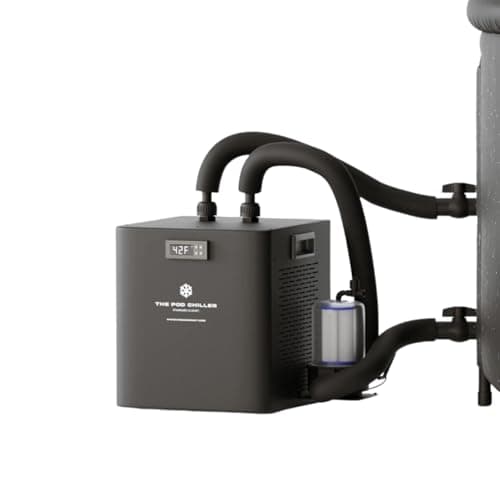 The Pod Company Standard Water Chiller, 1/3 HP 280 watts, a published 41 F floor and a 20-micron filter. It is less than half the draw of every other chiller here, and the listing volunteers the comparison. | 280 W | Cheapest to run | 7.2 | $569.00 - Amazon |
| 2 | 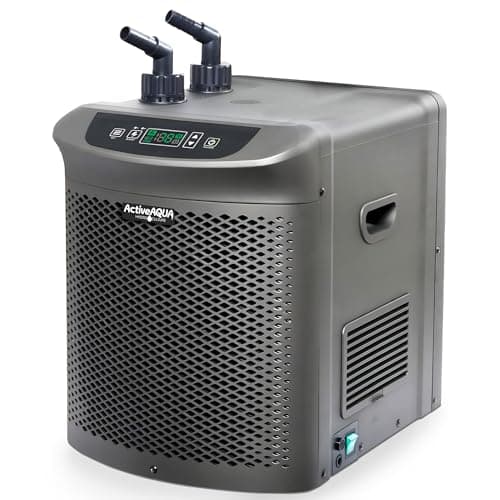 Active Aqua Water Chiller, 0.25 HP, Titanium A hydroponics chiller with a pure titanium evaporator and a published 190 W draw, repurposed for cold plunges long before cold plunges were a product category. | 190 W | Longest-serving design | 6.5 | $592.11 - Amazon |
| 3 | 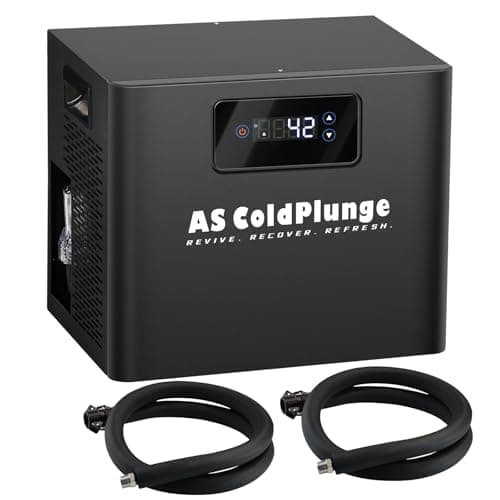 AS ColdPlunge 1/3 HP Cold Plunge Chiller 600 W, a 42 F floor, a reusable metal filter instead of cartridges, and a submersible pump in the box so it works with a bathtub that has no ports. | 600 W | Best for a bathtub | 7.7 | $399.00 - Amazon |
| 4 | 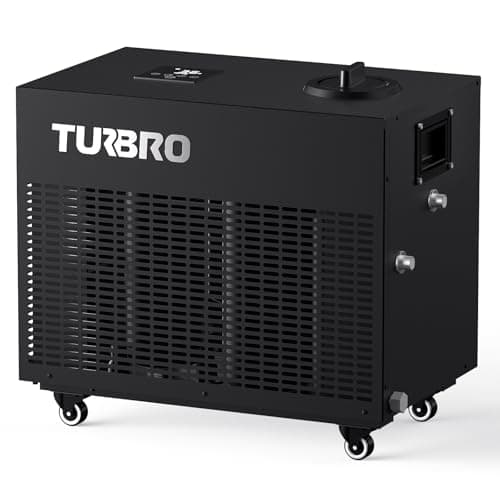 TURBRO FrostCore F85, 1 HP Cold Plunge Chiller The only chiller here that publishes a rated power, a BTU figure, a supply voltage, a temperature range and a cooling time - and it names its filtration in microns. | 1030 W | Most complete spec sheet | 5.9 | $1,399.00 - Amazon |
The two honest figures
Every published chiller wattage, costed
The arithmetic
cost per hour at full draw ($) = (rated watts / 1000) x rate per kWh
continuous upper bound ($/month) = cost per hour x 24 x 30.4
Worked example on the 600 W AS ColdPlunge: 600 / 1000 x 0.1834 = $0.110 an hour. Continuous for a month: 0.110 x 24 x 30.4 = $80.31. That upper bound assumes the compressor never stops, which it never does in practice unless the unit is undersized.
Why we will not give you a single monthly number
A chiller is refrigeration. It draws its rated power while the compressor runs and almost nothing while it does not, and the ratio between those two states is the duty cycle. Duty cycle depends on:
- How warm the room or the outdoors is
- How well the tub is insulated
- Whether the lid is on between sessions - the largest single factor
- How low you set the temperature
- How much water there is to hold
None of those is knowable from a listing, and we do not measure any of them. Two brands we looked at do publish a single daily cost figure - roughly fifty cents to a dollar fifty a day - and both publish it without a wattage, a rate or a duty-cycle assumption, which makes it unfalsifiable rather than useful. That is discussed on the Titan page and the Vital page.
Four ways to cut the number
- Keep the lid on. Most heat gain comes through the open surface, so a clamped insulated lid is the highest-leverage thing you own.
- Do not over-chill. Holding 50 F is meaningfully cheaper than holding 39 F, and most people plunge at the warmer end anyway - see cold plunge temperature.
- Buy less water. An 84-gallon tub is a third less thermal mass to hold than a 129-gallon one.
- Size it right. An undersized chiller runs continuously and costs more than a correctly sized larger one - the sizing arithmetic is here.
Two follow-ons if this is the number that decides your purchase. The single unit whose published figures let you predict all of this in advance is covered in our review of the one that publishes BTU. And if the tub lives in a garage or on a patio, ambient heat is the largest input to duty cycle and therefore to this whole table - sizing for a hot climate is here. To turn this table into a purchase decision, the best chiller for the money adds three years of this arithmetic to each unit and ranks them on what they cost to own. The lowest published draw in this table belongs to an aquarium chiller, with a caveat worth reading first - why one 190 W figure appears twice.
Every pick, in full
Each write-up below shows the score broken into its six components, the specs the listing actually publishes, and the running-cost arithmetic where a wattage exists to compute it from.
#1 - Cheapest to run
The Pod Company Standard Water Chiller, 1/3 HP
280 watts, a published 41 F floor and a 20-micron filter. It is less than half the draw of every other chiller here, and the listing volunteers the comparison.
| Small-space fit | 12 / 20 |
|---|---|
| Electrical fit | 20 / 20 |
| Cost to run | 20 / 20 |
| Key-number disclosure | 12 / 15 |
| Spec completeness | 8 / 15 |
| Warranty | 0 / 10 |
| Total | 72 / 100 |
| Rated watts | 280 Seller’s listing, read 2026-09-07 |
|---|---|
| Water capacity | Not published Not published |
| Dimensions | 13 x 13 x 21 in Seller’s listing, read 2026-09-07 |
| Weight | 40 lb Seller’s listing, read 2026-09-07 |
| Cooling floor | 41 Fno cooling rate published Seller’s listing, read 2026-09-07 |
| Material | Not published Not published |
| Warranty (months) | Not published Not published |
| Rated draw | 280 W |
|---|---|
| Cost per hour at full draw | 5.1 cents |
| Upper bound, running continuously | $37.47 per month |
A chiller cycles. It draws its rated power while the compressor runs and almost nothing while it does not, and how often it runs depends on ambient temperature, insulation, lid use and setpoint. We do not measure duty cycle, so we publish the two figures that need no assumption and no figure in between. Computed at 18.34 cents per kWh (June 2026). The method.
Two hundred and eighty watts is the number that decides this category. At the current US residential average it costs about five cents an hour at full draw, and even running continuously for a month - which no chiller does - the absolute ceiling is around thirty-eight dollars. The 1,200 W units in this roundup are four times that.
The listing's own comparison is a good one: about the same as a home freezer. That is a useful mental model, because a chiller works the same way and cycles the same way. It draws its rated power while the compressor is running and almost nothing while it is not, and how often it runs depends on your lid discipline, your room temperature and how well your tub is insulated.
The published floor is 41 F, which is warmer than the 37 to 39 F claimed by the bigger units. For most people that is irrelevant - the commonly recommended starting band is 50 to 59 F and experienced plungers usually settle around 45 to 50 F - but if you specifically want to get below 40, this will not do it.
Buy it if
Anyone whose plunge is a daily habit rather than an occasional event, where running cost compounds.
Skip it if
You want water below 41 F. This unit does not claim to go there.
#2 - Longest-serving design
Active Aqua Water Chiller, 0.25 HP, Titanium
A hydroponics chiller with a pure titanium evaporator and a published 190 W draw, repurposed for cold plunges long before cold plunges were a product category.
| Small-space fit | 12 / 20 |
|---|---|
| Electrical fit | 20 / 20 |
| Cost to run | 20 / 20 |
| Key-number disclosure | 5 / 15 |
| Spec completeness | 8 / 15 |
| Warranty | 0 / 10 |
| Total | 65 / 100 |
| Rated watts | 190 Seller’s listing, read 2026-09-07 |
|---|---|
| Water capacity | 92 Seller’s product title, read 2026-09-07 |
| Dimensions | 19 x 14 x 19 in Seller’s listing, read 2026-09-07 |
| Weight | 44.9 lb Seller’s listing, read 2026-09-07 |
| Cooling floor | Claim, no figure “ideal for hydroponic systems, aquaponic reservoirs, and even cold plunge baths with a large refrigeration capacity of 40-92 gallons” |
| Material | Not published Not published |
| Warranty (months) | Not published Not published |
| Rated draw | 190 W |
|---|---|
| Cost per hour at full draw | 3.5 cents |
| Upper bound, running continuously | $25.42 per month |
A chiller cycles. It draws its rated power while the compressor runs and almost nothing while it does not, and how often it runs depends on ambient temperature, insulation, lid use and setpoint. We do not measure duty cycle, so we publish the two figures that need no assumption and no figure in between. Computed at 18.34 cents per kWh (June 2026). The method.
This is an aquarium and hydroponics chiller, and that is the case for it rather than against. Aquarium chillers have been made to the same job for decades, they are expected to run unattended for years, and the titanium evaporator exists because someone else's fish were going to be swimming in the water. That is a longer track record than the cold-plunge-specific category has existed for.
At 190 W it is the second-cheapest to run here, about three and a half cents an hour at full draw. The rated volume range of 40 to 92 gallons is the constraint - this is not enough compressor for a 216-gallon tub, and it will run continuously trying.
The one thing it does not publish is a floor temperature. Aquarium chillers are specified by cooling capacity and volume rather than by a target temperature, which is a different but perfectly reasonable convention, and it means you are sizing by gallons instead of by degrees. Match it to a tub under 92 gallons and it is the right tool.
Buy it if
Someone with a tub under 92 gallons who wants a design with a long service history.
Skip it if
Your tub is over 92 gallons, or you want a published temperature floor. Neither fits.
#3 - Best for a bathtub
AS ColdPlunge 1/3 HP Cold Plunge Chiller
600 W, a 42 F floor, a reusable metal filter instead of cartridges, and a submersible pump in the box so it works with a bathtub that has no ports.
| Small-space fit | 12 / 20 |
|---|---|
| Electrical fit | 20 / 20 |
| Cost to run | 16 / 20 |
| Key-number disclosure | 12 / 15 |
| Spec completeness | 11 / 15 |
| Warranty | 6 / 10 |
| Total | 77 / 100 |
| Rated watts | 600 Seller’s listing, read 2026-09-07 |
|---|---|
| Water capacity | 79 Seller’s listing, read 2026-09-07 |
| Dimensions | 11.8 x 14.9 x 12.6 in Seller’s listing, read 2026-09-07 |
| Weight | 35 lb Seller’s listing, read 2026-09-07 |
| Cooling floor | 42 Fno cooling rate published Seller’s listing, read 2026-09-07 |
| Material | Not published Not published |
| Warranty (months) | 12 Seller’s listing, read 2026-09-07 |
| Rated draw | 600 W |
|---|---|
| Cost per hour at full draw | 11.0 cents |
| Upper bound, running continuously | $80.29 per month |
A chiller cycles. It draws its rated power while the compressor runs and almost nothing while it does not, and how often it runs depends on ambient temperature, insulation, lid use and setpoint. We do not measure duty cycle, so we publish the two figures that need no assumption and no figure in between. Computed at 18.34 cents per kWh (June 2026). The method.
The submersible pump is what makes this the bathtub answer. A chiller normally needs a tub with inlet and outlet ports; a bathtub has neither. Dropping a pump into the water and running two hoses over the rim is inelegant and it works, and it is the cheapest route to a cold plunge for anyone who cannot give up floor space for a tub at all.
Six hundred watts is eleven cents an hour at full draw, comfortably mid-range here. The 79-gallon rating is a good match for a standard bathtub, which holds somewhere between 40 and 80 gallons at plunge depth.
The reusable metal mesh filter rather than disposable cartridges is a genuine running-cost detail that gets ignored because it is not electricity. Cartridge filters are a recurring purchase; a rinsable metal screen is not, and over a year that difference is larger than the difference in power draw between two chillers.
An availability note, because we said we would keep it current: this listing went to "Currently unavailable" on 2026-09-09 and we routed its buy link to a search rather than to a product nobody could add to a cart. Re-checked on 2026-09-12, it is back in stock with a buy-box offer, so the link points at the listing again.
Buy it if
Anyone plunging in an existing bathtub rather than buying a tub.
Skip it if
Your tub is over 79 gallons.
#4 - Most complete spec sheet
TURBRO FrostCore F85, 1 HP Cold Plunge Chiller
The only chiller here that publishes a rated power, a BTU figure, a supply voltage, a temperature range and a cooling time - and it names its filtration in microns.
| Small-space fit | 12 / 20 |
|---|---|
| Electrical fit | 15 / 20 |
| Cost to run | 8 / 20 |
| Key-number disclosure | 15 / 15 |
| Spec completeness | 9 / 15 |
| Warranty | 0 / 10 |
| Total | 59 / 100 |
| Rated watts | 1030 Seller’s listing, read 2026-09-07 |
|---|---|
| Water capacity | 132 Seller’s listing, read 2026-09-07 |
| Dimensions | 21 x 24 in Seller’s listing, read 2026-09-07 |
| Weight | Not published Not published |
| Cooling floor | 36-86 F, 110 F to 36 F in about 5-6 hours Seller’s listing, read 2026-09-07 |
| Material | Not published Not published |
| Warranty (months) | Not published Not published |
| Rated draw | 1030 W |
|---|---|
| Cost per hour at full draw | 18.9 cents |
| Upper bound, running continuously | $137.82 per month |
A chiller cycles. It draws its rated power while the compressor runs and almost nothing while it does not, and how often it runs depends on ambient temperature, insulation, lid use and setpoint. We do not measure duty cycle, so we publish the two figures that need no assumption and no figure in between. Computed at 18.34 cents per kWh (June 2026). The method.
This is what a complete chiller spec sheet looks like: 1,030 W rated power, 9,553 BTU/h maximum cooling capacity, AC 110 to 120 V at 60 Hz, a 36 to 86 F range, and a stated cooling time with the starting temperature named. Every one of those is checkable, and together they let you predict what the unit will do in your room rather than hope.
The BTU figure is the one nobody else publishes and the one that actually lets you size a chiller properly. Horsepower is a compressor rating, not a cooling rating, and the relationship between the two varies by design. BTU per hour is the heat actually removed, which is the number that matters when you are deciding whether it can hold 132 gallons at 40 F in a warm garage.
At 1,030 W it is nineteen cents an hour at full draw - lower than both 1,200 W half-horse units here despite being a full horsepower, which is either better efficiency or a difference in how the figures were derived. The three-stage filtration is named by micron rating rather than described, and the ozone generator is a real sanitation method rather than a marketing word.
Buy it if
Someone who wants to size a chiller by arithmetic instead of by horsepower.
Skip it if
You want the smallest footprint. At 21 by 24 inches this is the largest unit here.
Questions people actually ask
How much does a cold plunge chiller cost to run per month?
It depends on duty cycle, which nobody measures, so the honest answer is a range with its assumptions named. At the US residential average of 18.34 cents per kWh, a 280 W chiller costs $9.37 a month running six hours a day and $37.49 as an absolute continuous upper bound. A 1,200 W unit costs $40.15 and $160.62 on the same two assumptions.
Do cold plunge chillers use a lot of electricity?
Compared with a sauna, yes - because they run for hours rather than minutes. Compared with household appliances, no: the smallest here draws about the same as a home freezer and the largest about the same as a portable air conditioner. The variable that dominates is not the chiller, it is how well your tub is insulated and whether the lid is on.
Why don't you publish a single monthly cost for chillers?
Because a chiller's real consumption depends on duty cycle - how often the compressor runs - and that depends on ambient temperature, insulation, lid discipline and setpoint. We do not measure duty cycle. Publishing one monthly figure as though it were measured would be inventing the most important input.
How can I reduce my chiller's running cost?
Keep the lid on, because most heat enters through the open water surface. Put the tub somewhere cooler. Do not set the temperature lower than you actually use. And size the chiller correctly - an undersized unit runs continuously and costs more than a larger one that cycles.
Sources
- U.S. Energy Information Administration, Electric Power Monthly, Table 5.6.A - Average Price of Electricity to Ultimate Customers by End-Use Sector - U.S. Total, Residential: 18.34 cents per kWh, June 2026. Retrieved 2026-09-07.