Chillers
The best cold plunge chiller for hot climates
A chiller rated for 79 gallons in a cool basement is not rated for 79 gallons in a 95-degree garage. Here is how to size for the heat instead of against it.
By Scooter M. · Published · Last updated
How we are paid: the buy links on this page are affiliate links. If you buy through one, we earn a commission from the retailer at no extra cost to you. It does not change what we rank or what we tell you to skip - the full FTC disclosure is here.

| # | Product | Rated draw | Best for | Score | Price |
|---|---|---|---|---|---|
| 1 | 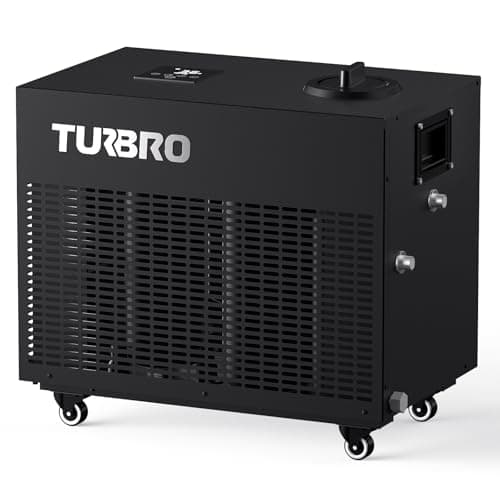 TURBRO FrostCore F85, 1 HP Cold Plunge Chiller The only chiller here that publishes a rated power, a BTU figure, a supply voltage, a temperature range and a cooling time - and it names its filtration in microns. | 1030 W | Most complete spec sheet | 5.9 | $1,399.00 - Amazon |
| 2 | 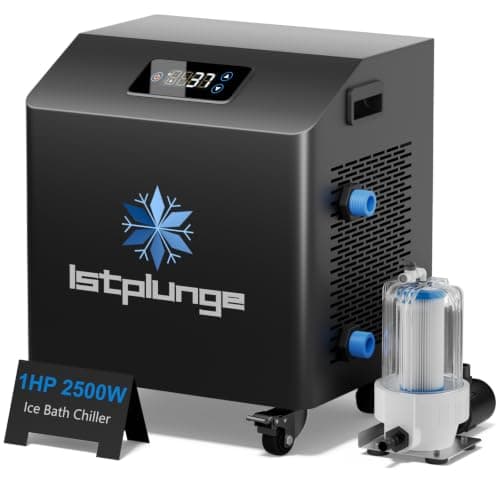 1stplunge 1 HP Ice Bath Chiller Rated to 230 gallons at 37 F with a 20-micron external filter and caster wheels, which is the only chiller here that can hold a full 216-gallon oval. | Not published | Largest tubs | 3.9 | $829.00 - Amazon |
| 3 | 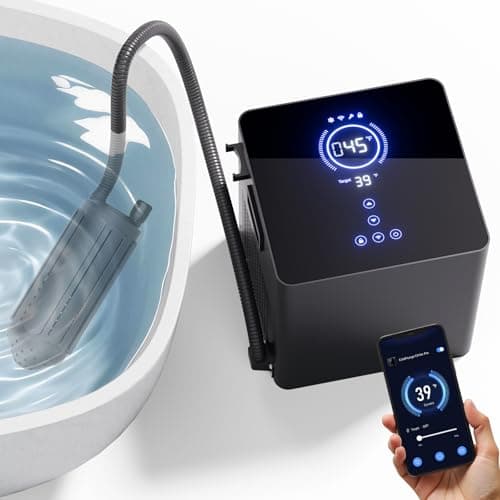 PlungeFit Cold Plunge Chiller Pro, 1/2 HP Drop-In A drop-in unit that cools directly in the water with no hoses or circulation loop, rated to 39 F for tubs up to 150 gallons at 1,200 W. | 1200 W | No plumbing at all | 6.4 | $549.00 - Amazon |
| 4 | 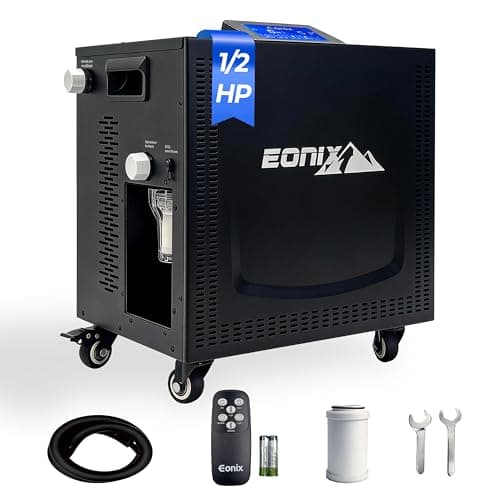 EONIX 1/2 HP Ice Bath Chiller The only chiller here that publishes a recommended operating band as well as a ceiling - 79 to 105 gallons, 132 maximum - with a 42 F floor, its dimensions and its weight. It publishes no wattage at all, so nobody can cost it. | Not published | Published sizing band | 3.2 | $449.99 - Amazon |
| 5 | 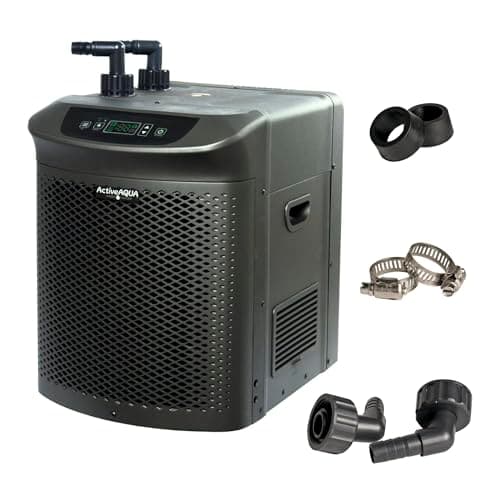 Active Aqua Water Chiller with Boost, 0.5 HP The 1/2 HP version of the titanium chiller, rated to 172 gallons - and published at the same 190 W as the quarter-horse unit, which cannot be right for both. | 190 W | Bigger tubs, same design | 7.2 | $817.99 - Amazon |
Ambient temperature is a sizing input
Refrigeration does not create cold, it moves heat from the water into the air around the condenser. The hotter that air is, the less gradient the unit has to push against, and the longer it runs to hold the same temperature. That is why the same chiller that holds 42 F effortlessly in a basement in March can fail to reach it on a patio in July.
How we ranked for heat
Three criteria, stated before the ranking:
- Cooling headroom. Published capacity well above the volume you intend to hold, so the unit cycles rather than runs flat out. The rating band is the only proxy we have, since one manufacturer publishes a BTU figure and eight do not.
- A published floor temperature with margin. A unit that claims 41 or 42 F is claiming it somewhere cool. If you want 45 F reliably in the heat, you want a unit rated well below that, not exactly at it.
- Build for the environment. Casters so a heavy unit can be moved into shade, an external filter you can service without shifting the whole thing, and a case that will live outdoors.
The one unit you can size by arithmetic
Exactly one chiller on this site publishes a BTU figure: 9,553 BTU per hour at 1,030 W rated power, with a supply voltage, a 36 to 86 F range and a stated cooling time from a stated starting temperature. Every other unit is sold on horsepower, which describes the compressor motor rather than the heat actually removed.
For a hot climate that distinction stops being academic. BTU per hour is the number that tells you whether a unit can out-pace the heat leaking into your tub. Horsepower does not, and the relationship between the two varies with refrigerant and heat-exchanger design - which is why the sizing page tells you to match the published gallon rating rather than the horsepower badge.
What actually cuts your run time in the heat
Before you size up, do the free things. In rough order of effect:
The last one on that list is the one people reach for first and it is the most expensive. An oversized chiller in a shaded, lidded, correctly-sized tub is a luxury; an undersized one in a sunlit uncovered tub is a machine that runs continuously and never gets there - which, as the running-cost page works through, costs more than the right unit would have.
The freeze question, for the other half of the year
If the tub lives outdoors in a hot climate it probably also lives outdoors in whatever winter that climate has. Water left in a chiller and its hoses can freeze and split them, so drain the loop if you shut down for the season. Not one tub on this site publishes a material temperature tolerance any more - the only listing that did, at minus 4 F to 140 F, has gone dead - so every tub on sale here is silent on it.
For a tub selection built around the outdoor case, the inflatable roundup covers which ones publish UV-resistant fabric and which name their port thread size. And for the room most of these end up in, the garage case is worked through here.
Every pick, in full
Each write-up below shows the score broken into its six components, the specs the listing actually publishes, and the running-cost arithmetic where a wattage exists to compute it from.
#1 - Most complete spec sheet
TURBRO FrostCore F85, 1 HP Cold Plunge Chiller
The only chiller here that publishes a rated power, a BTU figure, a supply voltage, a temperature range and a cooling time - and it names its filtration in microns.
| Small-space fit | 12 / 20 |
|---|---|
| Electrical fit | 15 / 20 |
| Cost to run | 8 / 20 |
| Key-number disclosure | 15 / 15 |
| Spec completeness | 9 / 15 |
| Warranty | 0 / 10 |
| Total | 59 / 100 |
| Rated watts | 1030 Seller’s listing, read 2026-09-07 |
|---|---|
| Water capacity | 132 Seller’s listing, read 2026-09-07 |
| Dimensions | 21 x 24 in Seller’s listing, read 2026-09-07 |
| Weight | Not published Not published |
| Cooling floor | 36-86 F, 110 F to 36 F in about 5-6 hours Seller’s listing, read 2026-09-07 |
| Material | Not published Not published |
| Warranty (months) | Not published Not published |
| Rated draw | 1030 W |
|---|---|
| Cost per hour at full draw | 18.9 cents |
| Upper bound, running continuously | $137.82 per month |
A chiller cycles. It draws its rated power while the compressor runs and almost nothing while it does not, and how often it runs depends on ambient temperature, insulation, lid use and setpoint. We do not measure duty cycle, so we publish the two figures that need no assumption and no figure in between. Computed at 18.34 cents per kWh (June 2026). The method.
This is what a complete chiller spec sheet looks like: 1,030 W rated power, 9,553 BTU/h maximum cooling capacity, AC 110 to 120 V at 60 Hz, a 36 to 86 F range, and a stated cooling time with the starting temperature named. Every one of those is checkable, and together they let you predict what the unit will do in your room rather than hope.
The BTU figure is the one nobody else publishes and the one that actually lets you size a chiller properly. Horsepower is a compressor rating, not a cooling rating, and the relationship between the two varies by design. BTU per hour is the heat actually removed, which is the number that matters when you are deciding whether it can hold 132 gallons at 40 F in a warm garage.
At 1,030 W it is nineteen cents an hour at full draw - lower than both 1,200 W half-horse units here despite being a full horsepower, which is either better efficiency or a difference in how the figures were derived. The three-stage filtration is named by micron rating rather than described, and the ozone generator is a real sanitation method rather than a marketing word.
Buy it if
Someone who wants to size a chiller by arithmetic instead of by horsepower.
Skip it if
You want the smallest footprint. At 21 by 24 inches this is the largest unit here.
#2 - Largest tubs
1stplunge 1 HP Ice Bath Chiller
Rated to 230 gallons at 37 F with a 20-micron external filter and caster wheels, which is the only chiller here that can hold a full 216-gallon oval.
| Small-space fit | 12 / 20 |
|---|---|
| Electrical fit | 0 / 20 |
| Cost to run | 0 / 20 |
| Key-number disclosure | 12 / 15 |
| Spec completeness | 9 / 15 |
| Warranty | 6 / 10 |
| Total | 39 / 100 |
| Rated watts | Not published Not published |
|---|---|
| Water capacity | 230 Seller’s listing, read 2026-09-07 |
| Dimensions | 16 x 13 x 18.5 in Seller’s listing, read 2026-09-07 |
| Weight | 83 lb Seller’s listing, read 2026-09-07 |
| Cooling floor | 37 Fno cooling rate published Seller’s listing, read 2026-09-07 |
| Material | Not published Not published |
| Warranty (months) | 12 Seller’s listing, read 2026-09-07 |
No running cost can be computed. The listing does not publish a rated wattage, so there is no honest way to tell you what a session costs. We will not estimate one. How we compute running costs
Two hundred and thirty gallons at 37 F is the largest published capability in this roundup, and it is the only unit that plausibly pairs with the 216-gallon tubs elsewhere on this site. Sizing a chiller under its tub is the most common expensive mistake in this category: an undersized unit runs continuously, never reaches setpoint, and costs more in electricity than the right one would.
The wattage is not published, which on a 1 HP unit is a real gap. The TURBRO in this roundup is also 1 HP and publishes 1,030 W, so the order of magnitude is not a mystery - but we are not going to attribute another manufacturer's figure to this one, so the cost-to-run component scores zero and the score reflects it.
At 83 pounds this is by far the heaviest chiller here, which is why the caster wheels are a specification rather than a nicety. It is also why the external filter matters: a 20-micron cartridge you can change without moving the unit is the difference between maintaining it and not.
Buy it if
Anyone running a 150 to 230 gallon tub who needs a chiller that can actually hold it.
Skip it if
You want to compute a running cost. The draw is not published.
#3 - No plumbing at all
PlungeFit Cold Plunge Chiller Pro, 1/2 HP Drop-In
A drop-in unit that cools directly in the water with no hoses or circulation loop, rated to 39 F for tubs up to 150 gallons at 1,200 W.
| Small-space fit | 12 / 20 |
|---|---|
| Electrical fit | 15 / 20 |
| Cost to run | 8 / 20 |
| Key-number disclosure | 12 / 15 |
| Spec completeness | 11 / 15 |
| Warranty | 6 / 10 |
| Total | 64 / 100 |
| Rated watts | 1200 Seller’s listing, read 2026-09-07 |
|---|---|
| Water capacity | 150 Seller’s listing, read 2026-09-07 |
| Dimensions | 11.8 x 15.4 x 12.6 in Seller’s listing, read 2026-09-07 |
| Weight | 45 lb Seller’s listing, read 2026-09-07 |
| Cooling floor | 39 Fno cooling rate published Seller’s listing, read 2026-09-07 |
| Material | Not published Not published |
| Warranty (months) | 12 Seller’s listing, read 2026-09-07 |
| Rated draw | 1200 W |
|---|---|
| Cost per hour at full draw | 22.0 cents |
| Upper bound, running continuously | $160.57 per month |
A chiller cycles. It draws its rated power while the compressor runs and almost nothing while it does not, and how often it runs depends on ambient temperature, insulation, lid use and setpoint. We do not measure duty cycle, so we publish the two figures that need no assumption and no figure in between. Computed at 18.34 cents per kWh (June 2026). The method.
Direct-in-water cooling removes the entire plumbing problem: no ports, no hoses, no pump priming, no leak points. For a renter, that also removes the part of a cold plunge setup most likely to put water on a floor you do not own.
It costs you in power. At 1,200 W this is twenty-two cents an hour at full draw and, in the theoretical case of running continuously for a month, about a hundred and sixty dollars. It will not run continuously - it cycles to hold a setpoint like any refrigeration - but among the chillers here it is at the expensive end and the 280 W Pod Company unit is at the other.
The 150-gallon rating and the 39 F floor are both genuine capability. If you have a large tub and you want it properly cold rather than merely cool, this is a reasonable pairing, and the WiFi scheduling means you can have it chill overnight on a cheaper tariff if your utility has one.
Buy it if
A renter who wants no plumbing and is prepared to pay for it in electricity.
Skip it if
Running cost is your first concern. This is the highest published draw here.
#4 - Published sizing band
EONIX 1/2 HP Ice Bath Chiller
The only chiller here that publishes a recommended operating band as well as a ceiling - 79 to 105 gallons, 132 maximum - with a 42 F floor, its dimensions and its weight. It publishes no wattage at all, so nobody can cost it.
| Small-space fit | 12 / 20 |
|---|---|
| Electrical fit | 0 / 20 |
| Cost to run | 0 / 20 |
| Key-number disclosure | 12 / 15 |
| Spec completeness | 8 / 15 |
| Warranty | 0 / 10 |
| Total | 32 / 100 |
| Rated watts | Not published Not published |
|---|---|
| Water capacity | 132 Seller’s listing, read 2026-10-23 |
| Dimensions | 12.16 x 14.25 x 16.49 in Seller’s listing, read 2026-10-23 |
| Weight | 33.84 lb Seller’s listing, read 2026-10-23 |
| Cooling floor | 42 Fno cooling rate published Seller’s product title, read 2026-10-23 |
| Material | Not published Not published |
| Warranty (months) | Not published Not published |
No running cost can be computed. The listing does not publish a rated wattage, so there is no honest way to tell you what a session costs. We will not estimate one. How we compute running costs
The disclosure worth buying this for is the sizing band. Every other chiller here publishes one volume figure and leaves you to guess whether it is a comfortable rating or a ceiling; this listing publishes both, recommending 79 to 105 gallons and naming 132 gallons as the maximum limit. Size to the band rather than to the ceiling - a unit run at its stated maximum is a unit running continuously - and the sizing method is the same one we use everywhere else on this site.
It also arrives as a complete loop rather than a box that needs parts. The listing names a built-in filter pump, a submersible pump for tubs with no ports, insulated hoses, quick-connect fittings and sealing tape, and describes the filter as something you rinse once a week rather than a cartridge you replace. That is a recurring-cost detail rather than a feature, and it is the same distinction we draw across the whole category: a rinsable screen costs nothing ongoing, a cartridge is a subscription.
The gaps are real and they cost it points. No rated wattage is published anywhere on the listing, which means there is no honest running cost for this unit - not an estimate, not a range - and the electrical-fit and cost-to-run components of its score have no input and score zero. No warranty term is published either. And no decibel figure: the one listing in this category that published one has gone, so no chiller on this site publishes a noise figure at all, which is worth knowing if the box has to live near a bedroom.
Buy it if
Someone matching a chiller to a tub in the 79 to 105 gallon band who wants the footprint and the weight published before it arrives.
Skip it if
You are budgeting on electricity. No wattage is published, so there is no honest figure for what it costs to run.
#5 - Bigger tubs, same design
Active Aqua Water Chiller with Boost, 0.5 HP
The 1/2 HP version of the titanium chiller, rated to 172 gallons - and published at the same 190 W as the quarter-horse unit, which cannot be right for both.
| Small-space fit | 12 / 20 |
|---|---|
| Electrical fit | 20 / 20 |
| Cost to run | 20 / 20 |
| Key-number disclosure | 5 / 15 |
| Spec completeness | 9 / 15 |
| Warranty | 6 / 10 |
| Total | 72 / 100 |
| Rated watts | 190 Seller’s listing, read 2026-09-07 |
|---|---|
| Water capacity | 172 Seller’s listing, read 2026-09-07 |
| Dimensions | 19 x 14 x 19 in Seller’s listing, read 2026-09-07 |
| Weight | 48.5 lb Seller’s listing, read 2026-09-07 |
| Cooling floor | Claim, no figure “Built-in Boost Mode activates maximum cooling capacity to reach low temperatures faster” |
| Material | Not published Not published |
| Warranty (months) | 12 Seller’s listing, read 2026-09-07 |
| Rated draw | 190 W |
|---|---|
| Cost per hour at full draw | 3.5 cents |
| Upper bound, running continuously | $25.42 per month |
A chiller cycles. It draws its rated power while the compressor runs and almost nothing while it does not, and how often it runs depends on ambient temperature, insulation, lid use and setpoint. We do not measure duty cycle, so we publish the two figures that need no assumption and no figure in between. Computed at 18.34 cents per kWh (June 2026). The method.
The published wattage on this listing is 190 W, identical to the 0.25 HP model from the same brand. A half-horsepower compressor moving nearly twice the heat cannot draw the same power as a quarter-horsepower one. One of those two figures is wrong, and there is no way to tell which from the outside.
We report it as published and score it as published, because the alternative is substituting our own estimate for the manufacturer's number, and an estimate dressed as a spec is exactly what this site exists not to do. But you should treat the running-cost figure for this unit as unreliable in a way the others are not, and that is worth more to you than a confident number would be.
The rest is the same well-proven design as the quarter-horse: titanium evaporator, digital setpoint, a boost mode for pulling temperature down faster, and a published one-year manufacturer warranty, which is one of only two real warranty terms in this category.
Buy it if
Someone with a 90 to 172 gallon tub who wants the titanium design at the larger size.
Skip it if
You are budgeting on the published wattage. It is almost certainly a copy of the smaller unit's figure.
Questions people actually ask
What size chiller do I need in a hot climate?
Size up from the rating you would use indoors. A chiller's published gallon rating assumes an ambient temperature nobody states, and a unit rated for 79 gallons will struggle to hold that volume in a 95-degree garage. The practical rule is to pick the next rating band above your measured volume when the tub lives somewhere unconditioned.
Do cold plunge chillers work outside in summer?
Yes, but they work harder, which shows up as run time rather than as failure. Refrigeration moves heat from the water into the surrounding air, and the hotter that air is, the smaller the temperature gradient the unit has to work with. Expect longer cycles and a bigger bill in August than in February for exactly the same setpoint.
Does ambient temperature affect cold plunge running cost?
Considerably, and it is the single largest input we cannot compute for you. A chiller draws its rated power while the compressor runs and almost nothing while it does not, so cost is set by duty cycle, and duty cycle is set by how much heat is leaking into the tub. A hot room, thin insulation and a lid left off all push the same lever.
Should you put a cold plunge in the shade?
Yes, and it is the cheapest improvement available. Direct sun on a dark tub is a large heat input straight into the water, and it also degrades the fabric over time - only two tubs on this site publish UV-resistant construction. Shade plus a clamped insulated lid does more for your run time than a size up in chiller.