Cold Plunges
Can you put a cold plunge in a garage?
Yes, and for most houses it is the right room. The slab carries a thousand pounds of water, a spill costs nothing, and the tub never has to be put away. Two constraints decide which gear.
By Scooter M. · Published · Last updated
How we are paid: the buy links on this page are affiliate links. If you buy through one, we earn a commission from the retailer at no extra cost to you. It does not change what we rank or what we tell you to skip - the full FTC disclosure is here.
| # | Product | Capacity | Best for | Score | Price |
|---|---|---|---|---|---|
| 1 | 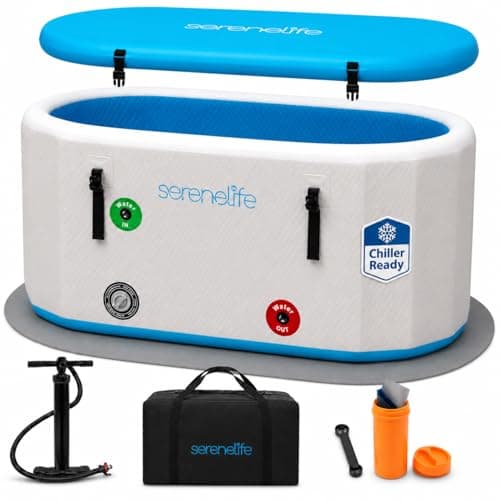 SereneLife XXL 216 Gallon Cold Plunge Tub The only tub here that publishes an interior dimension as well as an exterior one, with the port standard named three ways and a 3.15 in clamp-on insulated lid - and two external dimension sets on the same listing that do not agree. | 216 gal | Published interior size | 6.8 | $339.99 - Amazon |
| 2 | 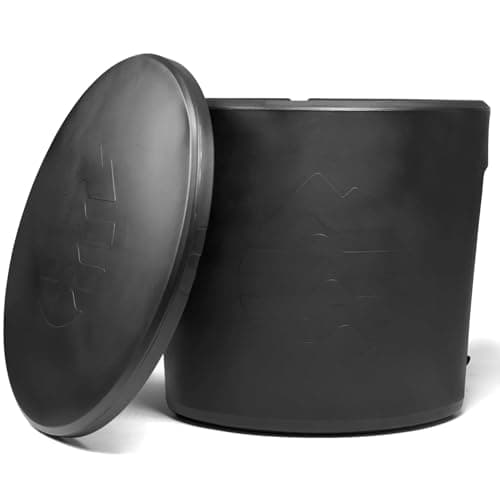 Ice Barrel 300 Insulated Cold Plunge Tub A rigid insulated barrel with built-in chiller ports and a published 77-gallon fill, from the only tub brand here that names its own material and country of manufacture - and publishes neither a weight nor a warranty term. | 77 gal | A tub that stays out | 6.3 | $1,149.99 - Amazon |
| 3 | 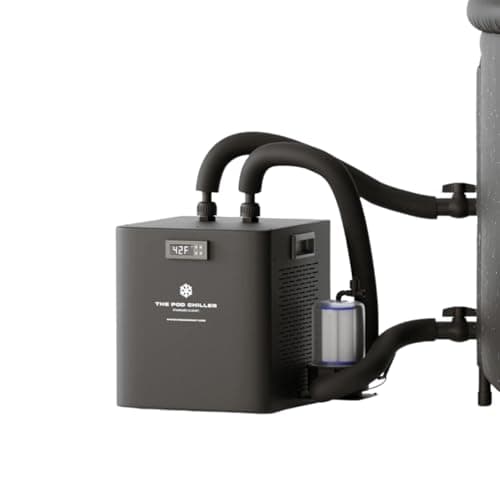 The Pod Company Standard Water Chiller, 1/3 HP 280 watts, a published 41 F floor and a 20-micron filter. It is less than half the draw of every other chiller here, and the listing volunteers the comparison. | Not published | Cheapest to run | 7.2 | $569.00 - Amazon |
| 4 | 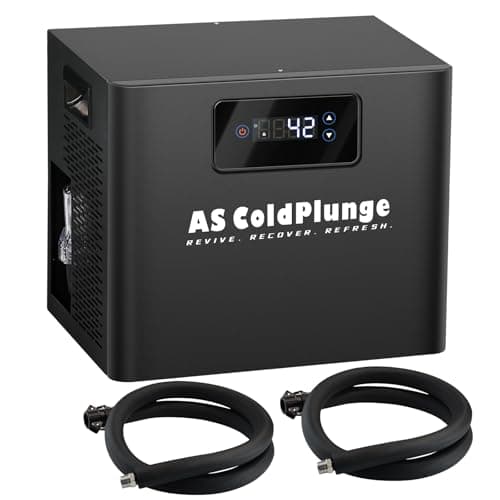 AS ColdPlunge 1/3 HP Cold Plunge Chiller 600 W, a 42 F floor, a reusable metal filter instead of cartridges, and a submersible pump in the box so it works with a bathtub that has no ports. | 79 gal | Best for a bathtub | 7.7 | $399.00 - Amazon |
| 5 | 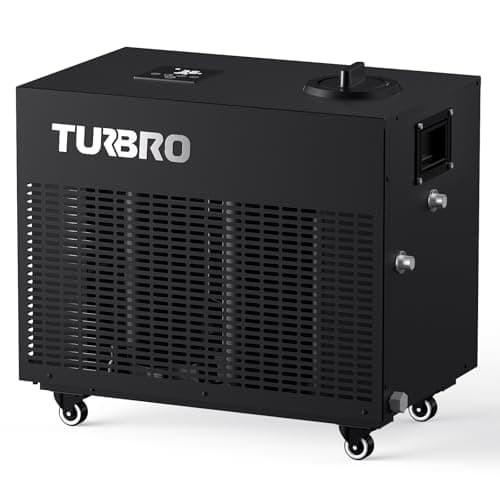 TURBRO FrostCore F85, 1 HP Cold Plunge Chiller The only chiller here that publishes a rated power, a BTU figure, a supply voltage, a temperature range and a cooling time - and it names its filtration in microns. | 132 gal | Most complete spec sheet | 5.9 | $1,399.00 - Amazon |
The short answer
Why the garage beats the spare room
We have an entire page on the three things that make an indoor plunge hard - weight, drainage and compressor noise - and a garage answers all three at once.
Weight. A full 100-gallon tub is about 834 lb of water, and a 216-gallon one is about 1,801 lb, before the tub or the person. On a ground-bearing concrete slab that is not a conversation. On a suspended timber floor or a balcony it is, and it is why the balcony page starts with weight rather than footprint.
Drainage. A plunge needs emptying every few weeks even with treatment and filtration. In a garage you run a hose to the drive and open the valve. Indoors, draining a hundred gallons is the chore that quietly ends the habit.
Permanence. A tub that lives where it is used gets used. Nothing on this site predicts long-term use better, and it is the reason we rate an inflatable that can stay inflated above a rigid tub that has to be moved.
The freeze question, which decides the tub
This is the constraint a garage adds that no indoor room does. An unheated garage in a cold state spends weeks below freezing, and there are two separate risks in it.
The tub wall. Not one tub we track publishes a material temperature range. The only listing that ever did quoted -4 F to 140 F on a drop-stitch wall, and it has since gone dead, so the category now publishes nothing at all on the question. That silence is a finding rather than a verdict - coated PVC does go brittle in a hard frost, and without a published figure you are guessing. A rigid rotomolded tub is more tolerant by construction, and the rigid options are reviewed here, though neither Ice Barrel publishes a cold rating either.
The plumbing, which is the real risk. A full tub freezing solid stresses seams. A chiller with water trapped in its pump housing, hoses or heat exchanger can split a fitting, and that is a repair rather than an inconvenience. The honest routine in a garage that freezes is binary: either keep the chiller running so the water never gets there, or drain the whole loop - tub, hoses and pump - and leave it empty until spring.
Summer, which decides the chiller
The other half of the year runs the opposite way. A chiller has to remove the heat leaking into the water, and that leak scales with the gap between the water and the air. A unit holding 45 F water in a 70 F basement is doing far less work than the same unit holding 45 F in a 95 F garage, which is why a published gallon rating quietly assumes an ambient temperature nobody states.
We worked that through in chillers for hot climates, including how to size against the heat rather than against it, and we are not going to re-derive it here. The short version for a garage: size up, or accept a higher setpoint in August.
The chiller heats the room it is cooling the water in
This one is physics that no listing mentions. A chiller is a heat pump. It moves heat out of the water and rejects it into the air through the condenser - plus the electrical energy it drew to do the work, which also ends up as heat. Run a 600 W chiller in a closed garage and you are adding something like 600 W of heat to that room continuously while the compressor runs.
In a large garage with the door opened daily, this is noise in the data. In a small, sealed garage it is a feedback loop: warmer room, warmer water, longer duty cycle, warmer room. Two practical consequences, neither of which costs anything:
- Leave clear air around the unit and never box it into a cupboard or push it against the tub. A condenser drawing in its own exhaust is the worst case.
- Prefer the lowest published draw that still covers your volume. A 280 W unit adds roughly a fifth of the heat of a 1,200 W one, as well as roughly a fifth of the electricity - the running-cost table is here.
The circuit, and what else is already on it
A garage circuit is rarely dedicated. It usually has a door opener on it, often a chest freezer, sometimes a bench full of tools - and unlike a sauna, a chiller is a long load rather than a short one, so it is the thing that is running when something else starts. The arithmetic to do before you buy is in what your circuit can carry, and if the same garage is getting a sauna too, the garage sauna page covers why most single-circuit garages end up running one at a time.
Ice in a garage, which is the cheap route
A garage is also the easiest place to run a plunge on ice, because the two things ice needs are somewhere to put a bag down and somewhere for water to go. The quantities are computable: about 103 lb of ice takes 100 gallons from a 70 F tap to 50 F, and a cold garage in winter does a chunk of that work for free before you open a bag.
That seasonal asymmetry is the argument for the staged setup: ice through the winter in an insulated tub with a clamped lid, a chiller added before summer when the tap and the room both warm up. Buy a tub with named ports so that upgrade does not mean buying the tub twice - the break-even is here.
What we cannot tell you
Whether your garage freezes hard enough to matter, and whether your slab is where you think it is. We also cannot tell you how any of these units behave below freezing, because no seller publishes a minimum ambient temperature. What we can tell you is which tub publishes a cold tolerance - one - and which chiller adds the least heat and cost to a closed room.
What we would buy for a garage
- Tub, ice route. The SereneLife XXL 216. It names its port standard three ways so a chiller can be added later, publishes an interior dimension as well as an exterior one, and ships a 3.15 in clamp-on insulated lid - which does more for a garage tub's ice bill than wall thickness does. The honest downsides are two: no tub on sale here publishes a cold tolerance, so a hard frost is unquantified for all of them, and 216 gallons is more water than one person needs and more than any chiller we track publishes a rating for, so if a chiller is the plan buy a smaller tub - which size, worked through here.
- Tub, permanent route. The Ice Barrel 300. Rigid, insulated, ports published, 8.8 sq ft of floor. Downside: no published weight, no warranty term, and it costs about three times the largest inflatable here.
- Chiller. The Pod Company 1/3 HP at 280 W - the least heat into the room and the cheapest to run on this site. Downside: it publishes no gallon rating at all, so you are matching it by horsepower rather than by arithmetic.
- Chiller, if your garage gets hot. The TURBRO FrostCore F85, the only unit here publishing a BTU figure, which is the only honest way to size against ambient heat. Downside: 1,030 W, so it wants the circuit to itself and adds the most heat back into the room.
Every pick, in full
Each write-up below shows the score broken into its six components, the specs the listing actually publishes, and the running-cost arithmetic where a wattage exists to compute it from.
#1 - Published interior size
SereneLife XXL 216 Gallon Cold Plunge Tub
The only tub here that publishes an interior dimension as well as an exterior one, with the port standard named three ways and a 3.15 in clamp-on insulated lid - and two external dimension sets on the same listing that do not agree.
| Small-space fit | 14 / 20 |
|---|---|
| Electrical fit | 20 / 20 |
| Cost to run | 20 / 20 |
| Key-number disclosure | 5 / 15 |
| Spec completeness | 9 / 15 |
| Warranty | 0 / 10 |
| Total | 68 / 100 |
| Rated watts | Not published Not published |
|---|---|
| Water capacity | 216 Seller’s product title, read 2026-10-25 |
| Dimensions | 59 x 32.2 x 26.3 in outer and 51.1 x 26 x 24.4 in inner per the description; 53.15 x 31.5 x 24.02 in in the spec table Seller’s listing, read 2026-10-25 |
| Weight | Not published Not published |
| Cooling floor | Claim, no figure “Inlet and outlet ports work with common 20 mm G1/2 DN15 1/2 in chiller tubes, so you can connect a compatible water chiller system or use ice directly” |
| Material | Double-wall drop-stitch PVC, reinforced sidewalls, dual-layer inner sealing Seller’s listing, read 2026-10-25 |
| Warranty (months) | Not published Not published |
No electrical load. This draws no power of its own. The running cost of a plunge lives in the chiller, or in the bag of ice.
The disclosure that earns this its place is the interior dimension: 51.1 by 26 by 24.4 inches, published alongside the exterior. Almost nothing in this category gives you that, and it is the figure that actually decides whether you fit - the gap between a 59-inch outside and a 51-inch inside is eight inches of wall you cannot sit in. If you are tall, measure your seated length against the inner figure rather than the headline one.
Two more things it publishes that matter more than they look. The port standard is named three ways - 20 mm, G1/2, DN15, half-inch - which is what lets you buy a fitting that seals before the chiller arrives. And the lid is specified as a 3.15 inch clamp-on: both the thickness and the fact that it clamps rather than rests, which is the single cheapest thing that reduces your ice bill, because most heat comes back in through the open water surface.
The gaps are real. The external dimensions appear twice and disagree - 59 by 32.2 by 26.3 inches in the description against 53.15 by 31.5 by 24.02 in the specification table - which is the same pattern we keep finding, and we print both rather than choosing the flattering one. No empty weight, no warranty term and no material temperature tolerance are published; on that last point it is now in company, because no tub on this site publishes a cold rating at all.
Buy it if
Someone buying the largest tub on this site who wants an interior dimension and a named port standard before ordering.
Skip it if
You need the external dimensions to agree with themselves, or a published weight. Neither is available here.
#2 - A tub that stays out
Ice Barrel 300 Insulated Cold Plunge Tub
A rigid insulated barrel with built-in chiller ports and a published 77-gallon fill, from the only tub brand here that names its own material and country of manufacture - and publishes neither a weight nor a warranty term.
| Small-space fit | 9 / 20 |
|---|---|
| Electrical fit | 20 / 20 |
| Cost to run | 20 / 20 |
| Key-number disclosure | 5 / 15 |
| Spec completeness | 9 / 15 |
| Warranty | 0 / 10 |
| Total | 63 / 100 |
| Rated watts | Not published Not published |
|---|---|
| Water capacity | 77 Seller’s listing, read 2026-10-17 |
| Dimensions | 35.5 x 35.5 x 30.5 in Seller’s listing, read 2026-10-17 |
| Weight | Not published Not published |
| Cooling floor | Claim, no figure “a rigid, fully insulated cold bath plunge tub built for years of ice baths; the insulation holds temperature longer between sessions” |
| Material | Recycled LLDPE, rotationally molded Seller’s listing, read 2026-10-17 |
| Warranty (months) | Not published Not published |
No electrical load. This draws no power of its own. The running cost of a plunge lives in the chiller, or in the bag of ice.
This is the tub the rest of this registry does not contain: a rigid, insulated vessel that is meant to stay where you put it. Thirty-five and a half inches square and thirty and a half tall is a barrel you sit upright in with your knees bent, not a bath you lie down in, and that is the trade for a footprint under nine square feet.
It publishes five of our eight checklist items, which is mid-table, and the two it names are the two that matter for a rigid tub: insulation in the wall and built-in chiller ports. Ports on a tub at this price are what stop the upgrade path from meaning a second tub. What it does not publish is a weight, which for a one-piece molded vessel that has to get through a doorway and up a path is the figure a buyer actually needs, and no warranty term at all.
One claim on the listing does not hold up. The maintenance bullet says that unlike other ice tubs there is "no need to spend money on ice" - but this tub has no cooling of its own, so ice or a chiller is exactly how the water gets cold. Insulation reduces how much ice you buy by holding yesterday's temperature; it does not remove the requirement. We read that as loose copywriting rather than a specification, and we are not going to repeat it.
Buy it if
Someone with a permanent spot - a garage, a deck, a yard - who wants an insulated tub that can take a chiller later.
Skip it if
The tub has to fold away, or you need to know what it weighs before it arrives. Neither is published.
#3 - Cheapest to run
The Pod Company Standard Water Chiller, 1/3 HP
280 watts, a published 41 F floor and a 20-micron filter. It is less than half the draw of every other chiller here, and the listing volunteers the comparison.
| Small-space fit | 12 / 20 |
|---|---|
| Electrical fit | 20 / 20 |
| Cost to run | 20 / 20 |
| Key-number disclosure | 12 / 15 |
| Spec completeness | 8 / 15 |
| Warranty | 0 / 10 |
| Total | 72 / 100 |
| Rated watts | 280 Seller’s listing, read 2026-09-07 |
|---|---|
| Water capacity | Not published Not published |
| Dimensions | 13 x 13 x 21 in Seller’s listing, read 2026-09-07 |
| Weight | 40 lb Seller’s listing, read 2026-09-07 |
| Cooling floor | 41 Fno cooling rate published Seller’s listing, read 2026-09-07 |
| Material | Not published Not published |
| Warranty (months) | Not published Not published |
| Rated draw | 280 W |
|---|---|
| Cost per hour at full draw | 5.1 cents |
| Upper bound, running continuously | $37.47 per month |
A chiller cycles. It draws its rated power while the compressor runs and almost nothing while it does not, and how often it runs depends on ambient temperature, insulation, lid use and setpoint. We do not measure duty cycle, so we publish the two figures that need no assumption and no figure in between. Computed at 18.34 cents per kWh (June 2026). The method.
Two hundred and eighty watts is the number that decides this category. At the current US residential average it costs about five cents an hour at full draw, and even running continuously for a month - which no chiller does - the absolute ceiling is around thirty-eight dollars. The 1,200 W units in this roundup are four times that.
The listing's own comparison is a good one: about the same as a home freezer. That is a useful mental model, because a chiller works the same way and cycles the same way. It draws its rated power while the compressor is running and almost nothing while it is not, and how often it runs depends on your lid discipline, your room temperature and how well your tub is insulated.
The published floor is 41 F, which is warmer than the 37 to 39 F claimed by the bigger units. For most people that is irrelevant - the commonly recommended starting band is 50 to 59 F and experienced plungers usually settle around 45 to 50 F - but if you specifically want to get below 40, this will not do it.
Buy it if
Anyone whose plunge is a daily habit rather than an occasional event, where running cost compounds.
Skip it if
You want water below 41 F. This unit does not claim to go there.
#4 - Best for a bathtub
AS ColdPlunge 1/3 HP Cold Plunge Chiller
600 W, a 42 F floor, a reusable metal filter instead of cartridges, and a submersible pump in the box so it works with a bathtub that has no ports.
| Small-space fit | 12 / 20 |
|---|---|
| Electrical fit | 20 / 20 |
| Cost to run | 16 / 20 |
| Key-number disclosure | 12 / 15 |
| Spec completeness | 11 / 15 |
| Warranty | 6 / 10 |
| Total | 77 / 100 |
| Rated watts | 600 Seller’s listing, read 2026-09-07 |
|---|---|
| Water capacity | 79 Seller’s listing, read 2026-09-07 |
| Dimensions | 11.8 x 14.9 x 12.6 in Seller’s listing, read 2026-09-07 |
| Weight | 35 lb Seller’s listing, read 2026-09-07 |
| Cooling floor | 42 Fno cooling rate published Seller’s listing, read 2026-09-07 |
| Material | Not published Not published |
| Warranty (months) | 12 Seller’s listing, read 2026-09-07 |
| Rated draw | 600 W |
|---|---|
| Cost per hour at full draw | 11.0 cents |
| Upper bound, running continuously | $80.29 per month |
A chiller cycles. It draws its rated power while the compressor runs and almost nothing while it does not, and how often it runs depends on ambient temperature, insulation, lid use and setpoint. We do not measure duty cycle, so we publish the two figures that need no assumption and no figure in between. Computed at 18.34 cents per kWh (June 2026). The method.
The submersible pump is what makes this the bathtub answer. A chiller normally needs a tub with inlet and outlet ports; a bathtub has neither. Dropping a pump into the water and running two hoses over the rim is inelegant and it works, and it is the cheapest route to a cold plunge for anyone who cannot give up floor space for a tub at all.
Six hundred watts is eleven cents an hour at full draw, comfortably mid-range here. The 79-gallon rating is a good match for a standard bathtub, which holds somewhere between 40 and 80 gallons at plunge depth.
The reusable metal mesh filter rather than disposable cartridges is a genuine running-cost detail that gets ignored because it is not electricity. Cartridge filters are a recurring purchase; a rinsable metal screen is not, and over a year that difference is larger than the difference in power draw between two chillers.
An availability note, because we said we would keep it current: this listing went to "Currently unavailable" on 2026-09-09 and we routed its buy link to a search rather than to a product nobody could add to a cart. Re-checked on 2026-09-12, it is back in stock with a buy-box offer, so the link points at the listing again.
Buy it if
Anyone plunging in an existing bathtub rather than buying a tub.
Skip it if
Your tub is over 79 gallons.
#5 - Most complete spec sheet
TURBRO FrostCore F85, 1 HP Cold Plunge Chiller
The only chiller here that publishes a rated power, a BTU figure, a supply voltage, a temperature range and a cooling time - and it names its filtration in microns.
| Small-space fit | 12 / 20 |
|---|---|
| Electrical fit | 15 / 20 |
| Cost to run | 8 / 20 |
| Key-number disclosure | 15 / 15 |
| Spec completeness | 9 / 15 |
| Warranty | 0 / 10 |
| Total | 59 / 100 |
| Rated watts | 1030 Seller’s listing, read 2026-09-07 |
|---|---|
| Water capacity | 132 Seller’s listing, read 2026-09-07 |
| Dimensions | 21 x 24 in Seller’s listing, read 2026-09-07 |
| Weight | Not published Not published |
| Cooling floor | 36-86 F, 110 F to 36 F in about 5-6 hours Seller’s listing, read 2026-09-07 |
| Material | Not published Not published |
| Warranty (months) | Not published Not published |
| Rated draw | 1030 W |
|---|---|
| Cost per hour at full draw | 18.9 cents |
| Upper bound, running continuously | $137.82 per month |
A chiller cycles. It draws its rated power while the compressor runs and almost nothing while it does not, and how often it runs depends on ambient temperature, insulation, lid use and setpoint. We do not measure duty cycle, so we publish the two figures that need no assumption and no figure in between. Computed at 18.34 cents per kWh (June 2026). The method.
This is what a complete chiller spec sheet looks like: 1,030 W rated power, 9,553 BTU/h maximum cooling capacity, AC 110 to 120 V at 60 Hz, a 36 to 86 F range, and a stated cooling time with the starting temperature named. Every one of those is checkable, and together they let you predict what the unit will do in your room rather than hope.
The BTU figure is the one nobody else publishes and the one that actually lets you size a chiller properly. Horsepower is a compressor rating, not a cooling rating, and the relationship between the two varies by design. BTU per hour is the heat actually removed, which is the number that matters when you are deciding whether it can hold 132 gallons at 40 F in a warm garage.
At 1,030 W it is nineteen cents an hour at full draw - lower than both 1,200 W half-horse units here despite being a full horsepower, which is either better efficiency or a difference in how the figures were derived. The three-stage filtration is named by micron rating rather than described, and the ozone generator is a real sanitation method rather than a marketing word.
Buy it if
Someone who wants to size a chiller by arithmetic instead of by horsepower.
Skip it if
You want the smallest footprint. At 21 by 24 inches this is the largest unit here.
Questions people actually ask
Can you put a cold plunge in a garage?
Yes, and it is usually the best room in the house for one. A concrete slab carries the 700 to 1,800 lb of water without a structural question, a spill or a drain-down is a non-event, and the tub can stay standing - which is the single biggest predictor of whether anyone keeps using it. The two garage-specific problems are winter freezing and what a chiller does to the air temperature of a closed room.
Will a cold plunge freeze in an unheated garage?
It can, and no tub we track publishes a material tolerance for it any more - the only listing that did, at -4 F to 140 F, has gone dead. Every tub on sale here is silent, which does not mean any of them fails - it means you have no figure, and a rigid rotomolded shell is more tolerant by construction than coated fabric even though nobody publishes a number for either. The real risk is not the tub wall but a chiller's pump and plumbing, where trapped water expanding can split a fitting. In a garage that goes below freezing, either keep the chiller running or drain it down.
Is a garage too hot for a cold plunge in summer?
It can be, and ambient temperature is a sizing input rather than a detail. A chiller rated for 79 gallons in a cool basement is not rated for 79 gallons in a 95 F garage, because the heat it has to remove every hour rises with the gap between the water and the air. Our hot-climate page works through how to size against the heat instead of against it.
Does a cold plunge chiller heat up the garage?
Yes, and nobody mentions it. A chiller is a heat pump: it moves heat out of the water and rejects it into the air next to it, plus the energy it drew to do the work. In a closed garage that raises the room temperature, which raises the water's heat gain, which makes the chiller cycle more. Leave clear air around the unit and ventilate the space if you can - and do not build it into a cupboard.
What do you need for a cold plunge in a garage?
A tub that can stay standing, a hose to fill it, somewhere for 700 lb of water to go when you drain it, a GFCI-protected outlet for any pump or chiller, and either a chiller or a route to the ice shop. The things a garage lets you skip are the ones that kill most indoor setups: putting the tub away, protecting a floor, and carrying water through a living room.
Can you share one circuit between a garage sauna and a chiller?
Not comfortably. A 15 A branch circuit carries about 1,440 W continuously, and a 1,050 W sauna plus a 600 W chiller is already past it. Most single-circuit garages end up running one at a time, which is covered on our garage sauna page.