Cold Plunges
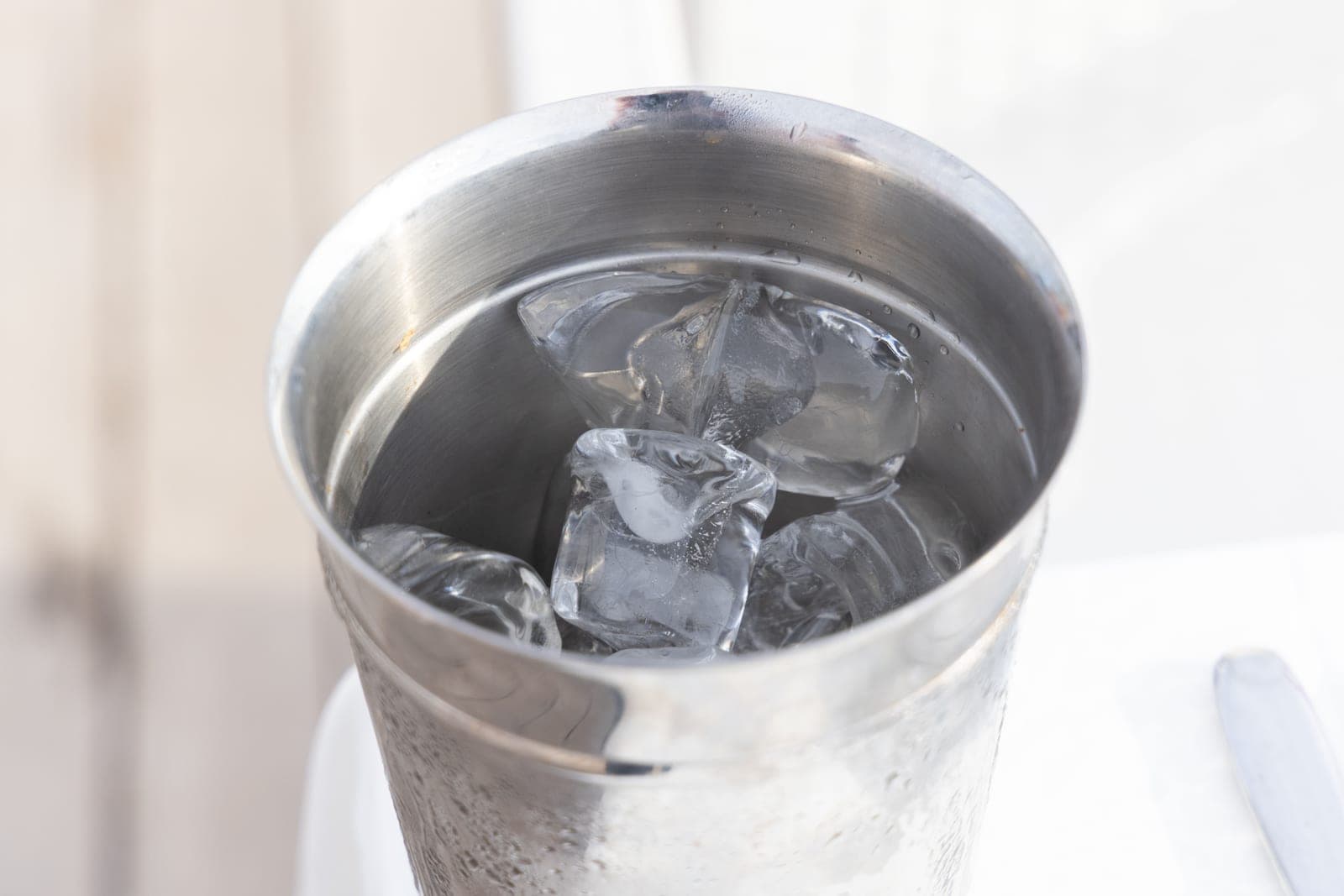
How much ice does a cold plunge need?
The answer is arithmetic, not a product claim. Here is the formula, a table for every tub size on this site, and why your tap temperature matters more than your tub does.
By Scooter M. · Published · Last updated
How we are paid: the buy links on this page are affiliate links. If you buy through one, we earn a commission from the retailer at no extra cost to you. It does not change what we rank or what we tell you to skip - the full FTC disclosure is here.
| # | Product | Capacity | Best for | Score | Price |
|---|---|---|---|---|---|
| 1 | 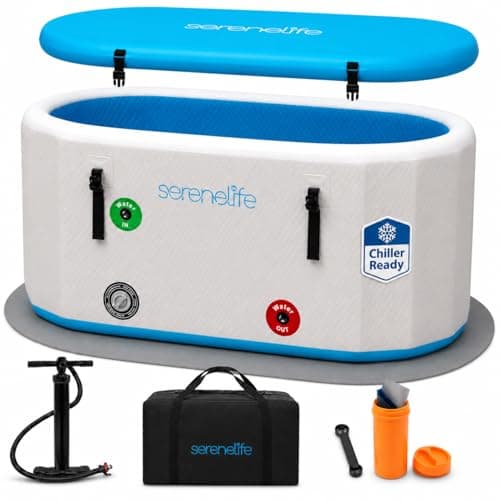 SereneLife XXL 216 Gallon Cold Plunge Tub The only tub here that publishes an interior dimension as well as an exterior one, with the port standard named three ways and a 3.15 in clamp-on insulated lid - and two external dimension sets on the same listing that do not agree. | 216 gal | Published interior size | 6.8 | $339.99 - Amazon |
| 2 | 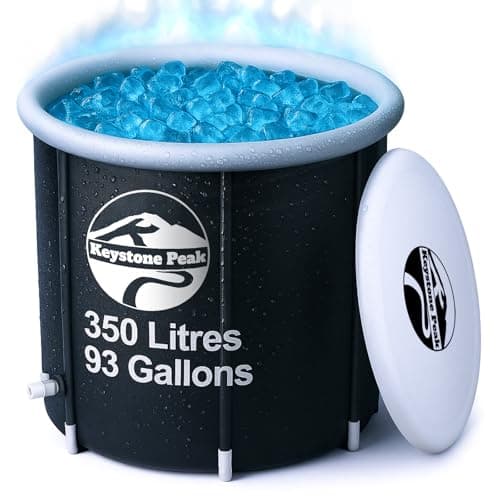 Keystone Peak Portable Cold Plunge Tub Three-layer insulation and a thermal inflatable lid with a five-year assurance behind it, though the capacity is published in liters and the assurance is not called a warranty. | 92 gal | Longest stated cover | 5.6 | $44.97 - Amazon |
| 3 | 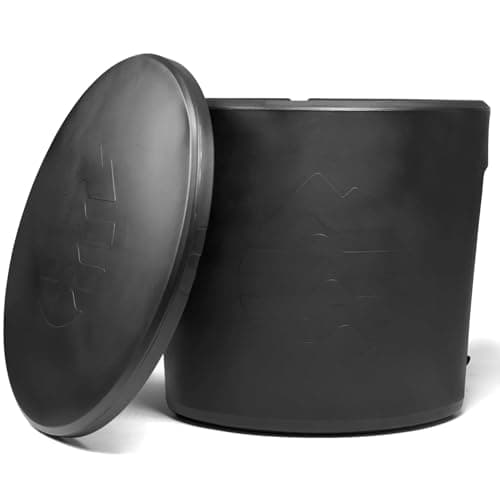 Ice Barrel 300 Insulated Cold Plunge Tub A rigid insulated barrel with built-in chiller ports and a published 77-gallon fill, from the only tub brand here that names its own material and country of manufacture - and publishes neither a weight nor a warranty term. | 77 gal | A tub that stays out | 6.3 | $1,149.99 - Amazon |
| 4 | 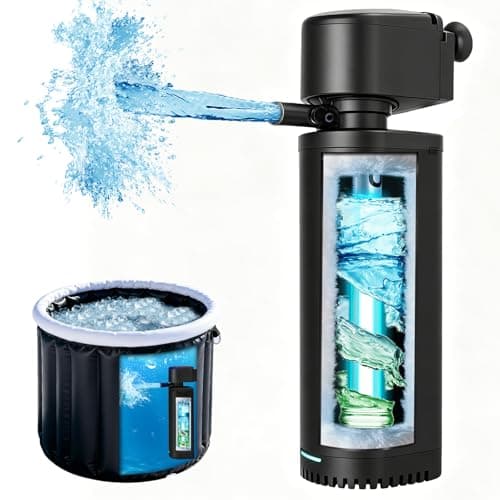 TARARIUM 500 GPH Cold Plunge Filter with UV Sanitation A 500 GPH submersible pump and filter with a UV stage, rated for tubs from 100 to 1,000 gallons, for anyone running ice rather than a chiller. | 1000 gal | Filtration without a chiller | 1.0 | $58.99 - Amazon |
| 5 | 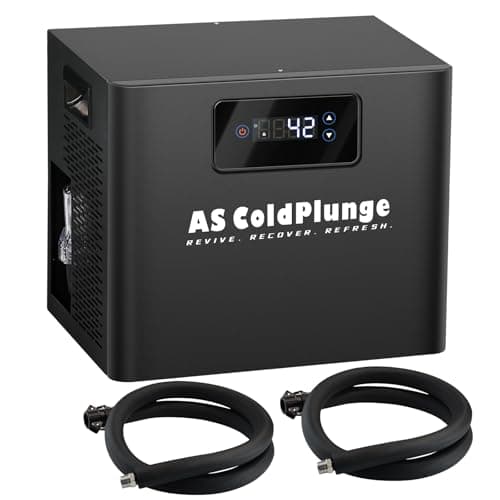 AS ColdPlunge 1/3 HP Cold Plunge Chiller 600 W, a 42 F floor, a reusable metal filter instead of cartridges, and a submersible pump in the box so it works with a bathtub that has no ports. | 79 gal | Best for a bathtub | 7.7 | $399.00 - Amazon |
The answer, first
Every other figure on this page comes from the same three inputs: your volume, your starting temperature and your target. There is no universal answer, which is exactly what we said when the question came up on chiller versus ice - so this page gives you the inputs and the arithmetic rather than a number to repeat.
The formula, so you can redo it
Cooling water with ice is an energy balance. The water gives up heat as it cools; the ice absorbs heat as it melts and then as the melt water warms to the final temperature. Setting those equal gives you the mass of ice you need:
pounds of ice = (gallons x 8.34 x (start F - target F)) / (144 + target F - 32)Three constants are doing the work, and all three are worth stating rather than hiding:
- 8.34 - pounds per US gallon of water. Derived from the USGS figure of 62.424 lb per cubic foot at 39.2 F, at 231 cubic inches per gallon.
- 144 - BTU absorbed per pound of ice as it melts, the latent heat of fusion of water. Published laboratory measurements cluster between about 143 and 144 BTU per pound (79.4 to 79.9 calories per gram); we use 144, and the difference is under one percent, which does not change a bag count.
- 1 - BTU per pound per degree F, the specific heat of water, which is why it does not appear in the formula as a separate term.
That is the whole method. It assumes bagged ice at about 32 F, a well-mixed tub and no heat coming in from the room while you are filling it - which is why it gives you a floor rather than a prediction. In a warm room with the lid off, you will use more.
Ice required, by tub size and temperature
The input that dominates, and it is not your tub
Look along the rows rather than down the columns. Going from a 70 F tap to a 55 F tap cuts the ice for the same 50 F target by roughly three quarters - from 103 lb to 26 lb on a 100-gallon tub. No equipment purchase comes close to that, and nobody selling tubs mentions it.
Mains water temperature follows the ground and the season. In much of the US a winter tap runs well under 60 F, which is already inside the beginner band described in cold plunge temperature, and a summer tap in a hot state can arrive at 80 F or above. The practical consequence: an ice setup that costs one bag a session in February can cost five in August for the same plunge. If you are deciding between ice and a chiller, do the sum for your worst month rather than your best.
Why the colder targets cost more than they look
The denominator in the formula shrinks as the target falls. Each pound of ice absorbs its 144 BTU melting, then the melt water has to be carried from 32 F to the final temperature - and the colder your target, the less that second term gives you. At a 50 F target each pound of ice is worth 162 BTU of cooling; at 39 F it is worth 151.
That is why the 39 F column is not simply proportional to the temperature drop, and why chasing the bottom of the band with ice gets expensive faster than you expect. Below about 45 F from warm tap water, a chiller stops being a convenience purchase and starts being the cheaper one - the break-even formula is here.
Freezer ice versus bagged ice, computed
Ice from a home freezer sits at around 0 F rather than 32 F, so each pound also absorbs sensible heat warming up to its melting point: about 0.5 BTU per pound per degree F over 32 degrees, or 16 BTU per pound on top of the 144. That makes freezer ice roughly 9 percent more effective per pound - 94 lb instead of 103 lb for the 100-gallon example.
Worth knowing, not worth planning around. A domestic freezer makes a few pounds of ice a day, so the hundred pounds that one fill needs is a week of production. Freezer ice is a top-up, bagged ice is a fill.
What actually cuts the bill
The first fill is physics and you cannot argue with it. Everything you can buy affects the next session, by deciding how much cold is still there tomorrow:
- A clamped insulated lid. The largest single path for heat coming back in is the open water surface, not the walls. A lid that clamps rather than rests is the cheapest real improvement available, and it is the reason the tubs we rate highest in the inflatable roundup are the ones that clamp.
- Insulated walls. A foam layer in the wall stack, or a rigid insulated tub, holds yesterday’s temperature so the next session is a top-up. That is the honest case for paying rigid-tub money - see the Ice Barrel review.
- Fewer gallons. The table is linear in volume. The 216-gallon tub costs nearly three times the 77-gallon one for the same temperature drop, every single fill - which is most of the size argument.
- A cooler room. A tub in a 60 F garage holds temperature far better than one in a 90 F one, which is a free improvement if you have the room - the garage case is here.
The thing ice setups are missing
Ice does not filter. A chiller comes with filtration, which means an ice-only plunge has the same fouling problem - body oils, skin cells, standing water at a temperature that slows bacteria without stopping them - and none of the equipment. That is why a standalone filter and a water treatment belong in an ice budget alongside the bags, and the routine is here. The filters themselves are compared in the cold plunge filter roundup, including the one type that works with no pump at all.
What we will not tell you
Every pick, in full
Each write-up below shows the score broken into its six components, the specs the listing actually publishes, and the running-cost arithmetic where a wattage exists to compute it from.
#1 - Published interior size
SereneLife XXL 216 Gallon Cold Plunge Tub
The only tub here that publishes an interior dimension as well as an exterior one, with the port standard named three ways and a 3.15 in clamp-on insulated lid - and two external dimension sets on the same listing that do not agree.
| Small-space fit | 14 / 20 |
|---|---|
| Electrical fit | 20 / 20 |
| Cost to run | 20 / 20 |
| Key-number disclosure | 5 / 15 |
| Spec completeness | 9 / 15 |
| Warranty | 0 / 10 |
| Total | 68 / 100 |
| Rated watts | Not published Not published |
|---|---|
| Water capacity | 216 Seller’s product title, read 2026-10-25 |
| Dimensions | 59 x 32.2 x 26.3 in outer and 51.1 x 26 x 24.4 in inner per the description; 53.15 x 31.5 x 24.02 in in the spec table Seller’s listing, read 2026-10-25 |
| Weight | Not published Not published |
| Cooling floor | Claim, no figure “Inlet and outlet ports work with common 20 mm G1/2 DN15 1/2 in chiller tubes, so you can connect a compatible water chiller system or use ice directly” |
| Material | Double-wall drop-stitch PVC, reinforced sidewalls, dual-layer inner sealing Seller’s listing, read 2026-10-25 |
| Warranty (months) | Not published Not published |
No electrical load. This draws no power of its own. The running cost of a plunge lives in the chiller, or in the bag of ice.
The disclosure that earns this its place is the interior dimension: 51.1 by 26 by 24.4 inches, published alongside the exterior. Almost nothing in this category gives you that, and it is the figure that actually decides whether you fit - the gap between a 59-inch outside and a 51-inch inside is eight inches of wall you cannot sit in. If you are tall, measure your seated length against the inner figure rather than the headline one.
Two more things it publishes that matter more than they look. The port standard is named three ways - 20 mm, G1/2, DN15, half-inch - which is what lets you buy a fitting that seals before the chiller arrives. And the lid is specified as a 3.15 inch clamp-on: both the thickness and the fact that it clamps rather than rests, which is the single cheapest thing that reduces your ice bill, because most heat comes back in through the open water surface.
The gaps are real. The external dimensions appear twice and disagree - 59 by 32.2 by 26.3 inches in the description against 53.15 by 31.5 by 24.02 in the specification table - which is the same pattern we keep finding, and we print both rather than choosing the flattering one. No empty weight, no warranty term and no material temperature tolerance are published; on that last point it is now in company, because no tub on this site publishes a cold rating at all.
Buy it if
Someone buying the largest tub on this site who wants an interior dimension and a named port standard before ordering.
Skip it if
You need the external dimensions to agree with themselves, or a published weight. Neither is available here.
#2 - Longest stated cover
Keystone Peak Portable Cold Plunge Tub
Three-layer insulation and a thermal inflatable lid with a five-year assurance behind it, though the capacity is published in liters and the assurance is not called a warranty.
| Small-space fit | 8 / 20 |
|---|---|
| Electrical fit | 20 / 20 |
| Cost to run | 20 / 20 |
| Key-number disclosure | 0 / 15 |
| Spec completeness | 8 / 15 |
| Warranty | 0 / 10 |
| Total | 56 / 100 |
| Rated watts | Not published Not published |
|---|---|
| Water capacity | 92 Seller’s listing, read 2026-09-07 |
| Dimensions | Packs to 9.84 x 4.72 x 25.2 in Seller’s listing, read 2026-09-07 |
| Weight | 3 kg Seller’s listing, read 2026-09-07 |
| Cooling floor | Not mentioned at all |
| Material | Three-layer insulation, leak-proof build Seller’s listing, read 2026-09-07 |
| Warranty (months) | Not published Not published |
No electrical load. This draws no power of its own. The running cost of a plunge lives in the chiller, or in the bag of ice.
Three hundred and fifty liters is about 92 US gallons, which puts this between the Pod Company Standard and the COSTWAY on volume. We convert it here because the listing does not, and a buyer comparing this against tubs quoted in gallons will otherwise be comparing two different units without noticing.
The five-year assurance is the longest coverage claim on any tub here. It is worth reading the word carefully: an 'assurance' backed by a support team is not the same undertaking as a warranty with terms, and we score warranty only where a term is published as one. Treat it as a signal of confidence rather than a contract.
There are no chiller ports mentioned anywhere in the listing, which for a tub at this price is the honest limitation. This is an ice tub. If you expect to add a chiller within the year, buy something with ports and save yourself the second purchase.
Buy it if
Someone who wants an ice-only tub with the longest stated support and no chiller ambitions.
Skip it if
You plan to add a chiller. There are no ports.
#3 - A tub that stays out
Ice Barrel 300 Insulated Cold Plunge Tub
A rigid insulated barrel with built-in chiller ports and a published 77-gallon fill, from the only tub brand here that names its own material and country of manufacture - and publishes neither a weight nor a warranty term.
| Small-space fit | 9 / 20 |
|---|---|
| Electrical fit | 20 / 20 |
| Cost to run | 20 / 20 |
| Key-number disclosure | 5 / 15 |
| Spec completeness | 9 / 15 |
| Warranty | 0 / 10 |
| Total | 63 / 100 |
| Rated watts | Not published Not published |
|---|---|
| Water capacity | 77 Seller’s listing, read 2026-10-17 |
| Dimensions | 35.5 x 35.5 x 30.5 in Seller’s listing, read 2026-10-17 |
| Weight | Not published Not published |
| Cooling floor | Claim, no figure “a rigid, fully insulated cold bath plunge tub built for years of ice baths; the insulation holds temperature longer between sessions” |
| Material | Recycled LLDPE, rotationally molded Seller’s listing, read 2026-10-17 |
| Warranty (months) | Not published Not published |
No electrical load. This draws no power of its own. The running cost of a plunge lives in the chiller, or in the bag of ice.
This is the tub the rest of this registry does not contain: a rigid, insulated vessel that is meant to stay where you put it. Thirty-five and a half inches square and thirty and a half tall is a barrel you sit upright in with your knees bent, not a bath you lie down in, and that is the trade for a footprint under nine square feet.
It publishes five of our eight checklist items, which is mid-table, and the two it names are the two that matter for a rigid tub: insulation in the wall and built-in chiller ports. Ports on a tub at this price are what stop the upgrade path from meaning a second tub. What it does not publish is a weight, which for a one-piece molded vessel that has to get through a doorway and up a path is the figure a buyer actually needs, and no warranty term at all.
One claim on the listing does not hold up. The maintenance bullet says that unlike other ice tubs there is "no need to spend money on ice" - but this tub has no cooling of its own, so ice or a chiller is exactly how the water gets cold. Insulation reduces how much ice you buy by holding yesterday's temperature; it does not remove the requirement. We read that as loose copywriting rather than a specification, and we are not going to repeat it.
Buy it if
Someone with a permanent spot - a garage, a deck, a yard - who wants an insulated tub that can take a chiller later.
Skip it if
The tub has to fold away, or you need to know what it weighs before it arrives. Neither is published.
#4 - Filtration without a chiller
TARARIUM 500 GPH Cold Plunge Filter with UV Sanitation
A 500 GPH submersible pump and filter with a UV stage, rated for tubs from 100 to 1,000 gallons, for anyone running ice rather than a chiller.
| Small-space fit | 8 / 20 |
|---|---|
| Electrical fit | 0 / 20 |
| Cost to run | 0 / 20 |
| Key-number disclosure | 0 / 15 |
| Spec completeness | 2 / 15 |
| Warranty | 0 / 10 |
| Total | 10 / 100 |
| Rated watts | Not published Not published |
|---|---|
| Maximum temperature | Not published Not published |
| Dimensions | Not published Not published |
| Weight | Not published Not published |
| Timer | Not published Not published |
| Cooling floor | Not the relevant number for this category |
| Material | Not published Not published |
| Warranty (months) | Not published Not published |
No running cost can be computed. The listing does not publish a rated wattage, so there is no honest way to tell you what a session costs. We will not estimate one. How we compute running costs
Chillers come with filtration built in. Ice does not, which leaves ice-only plungers with the same water quality problem and none of the equipment, and it is why a standalone filter belongs in this category rather than being an afterthought.
Five hundred gallons per hour turns over a 100-gallon tub five times an hour, which is well above what a plunge needs, and the listing describes a UV stage alongside the membrane filter - ultraviolet handles the biological load that a mechanical filter cannot touch. Running it for an hour after each session is enough to keep water clear for weeks.
The listing also recommends replacing the filter cotton every two weeks, which is the recurring cost to budget for, and notes an adjustable air valve for oxygenation. The wattage is not published, so we cannot give you a running cost - but a submersible pump in this class is a small load, tens of watts rather than hundreds, and it runs for an hour rather than continuously.
Buy it if
An ice-only plunger whose water is going cloudy between refills.
Skip it if
Your chiller already includes filtration. Most in this roundup do.
#5 - Best for a bathtub
AS ColdPlunge 1/3 HP Cold Plunge Chiller
600 W, a 42 F floor, a reusable metal filter instead of cartridges, and a submersible pump in the box so it works with a bathtub that has no ports.
| Small-space fit | 12 / 20 |
|---|---|
| Electrical fit | 20 / 20 |
| Cost to run | 16 / 20 |
| Key-number disclosure | 12 / 15 |
| Spec completeness | 11 / 15 |
| Warranty | 6 / 10 |
| Total | 77 / 100 |
| Rated watts | 600 Seller’s listing, read 2026-09-07 |
|---|---|
| Water capacity | 79 Seller’s listing, read 2026-09-07 |
| Dimensions | 11.8 x 14.9 x 12.6 in Seller’s listing, read 2026-09-07 |
| Weight | 35 lb Seller’s listing, read 2026-09-07 |
| Cooling floor | 42 Fno cooling rate published Seller’s listing, read 2026-09-07 |
| Material | Not published Not published |
| Warranty (months) | 12 Seller’s listing, read 2026-09-07 |
| Rated draw | 600 W |
|---|---|
| Cost per hour at full draw | 11.0 cents |
| Upper bound, running continuously | $80.29 per month |
A chiller cycles. It draws its rated power while the compressor runs and almost nothing while it does not, and how often it runs depends on ambient temperature, insulation, lid use and setpoint. We do not measure duty cycle, so we publish the two figures that need no assumption and no figure in between. Computed at 18.34 cents per kWh (June 2026). The method.
The submersible pump is what makes this the bathtub answer. A chiller normally needs a tub with inlet and outlet ports; a bathtub has neither. Dropping a pump into the water and running two hoses over the rim is inelegant and it works, and it is the cheapest route to a cold plunge for anyone who cannot give up floor space for a tub at all.
Six hundred watts is eleven cents an hour at full draw, comfortably mid-range here. The 79-gallon rating is a good match for a standard bathtub, which holds somewhere between 40 and 80 gallons at plunge depth.
The reusable metal mesh filter rather than disposable cartridges is a genuine running-cost detail that gets ignored because it is not electricity. Cartridge filters are a recurring purchase; a rinsable metal screen is not, and over a year that difference is larger than the difference in power draw between two chillers.
An availability note, because we said we would keep it current: this listing went to "Currently unavailable" on 2026-09-09 and we routed its buy link to a search rather than to a product nobody could add to a cart. Re-checked on 2026-09-12, it is back in stock with a buy-box offer, so the link points at the listing again.
Buy it if
Anyone plunging in an existing bathtub rather than buying a tub.
Skip it if
Your tub is over 79 gallons.
Questions people actually ask
How much ice do you need for a cold plunge?
About 103 lb - five 20 lb bags - to take 100 gallons of water from a 70 F tap down to 50 F. From a 55 F winter tap the same drop takes about 26 lb, which is one bag. The quantity is set by three inputs: how many gallons you are cooling, how warm the water starts, and how cold you want it. Change any one and the answer changes, which is why no single figure is worth quoting without them.
How many bags of ice for a cold plunge?
At the usual 20 lb bag: four bags for an 84-gallon tub from 70 F to 50 F, five for a 100-gallon tub, six for 129 gallons and eleven for 216 gallons. Halve the temperature drop and you halve the bags. Start from cold winter tap water and you need roughly a quarter as many.
How much ice to cool a cold plunge to 39 F?
Roughly 171 lb for 100 gallons from a 70 F start - about nine 20 lb bags - because the colder the target, the less work each pound of ice can still do once it has melted. Below about 45 F from warm tap water, ice becomes an expensive way to get there and a chiller starts to make sense.
Does ice from a home freezer work better than bagged ice?
Slightly, and the arithmetic says how much. Bagged ice is already at about 32 F, so each pound absorbs its latent heat of fusion only. Ice from a home freezer at around 0 F also has to warm up to 32 F first, which adds roughly 16 BTU per pound - about 9 percent more cooling per pound. Useful, not transformative, and your freezer cannot make 100 lb overnight.
What reduces how much ice a cold plunge needs?
In order of effect: a smaller volume of water, a clamped insulated lid, insulated walls, a cooler room, and starting from cold tap water rather than warm. The lid matters more than people expect because the open water surface is the largest path for heat coming back in. None of those change the first fill much - what they change is how much ice the second and third sessions need.
Is a chiller cheaper than ice?
If you plunge three or more times a week, usually yes, and the break-even arithmetic is on our chiller-versus-ice page. We do not publish a national ice price because there is not one worth publishing - bagged ice varies by several hundred percent between a supermarket and a convenience store. Work it with your own bag price and the pound figures below.
Sources
- U.S. Geological Survey, Water Science School - Water Density - 62.424 lb per cubic foot at 39.2 F, from which 8.34 lb per US gallon is derived at 231 cubic inches per gallon
- U.S. Energy Information Administration, Electric Power Monthly, Table 5.6.A - The residential electricity rate behind every chiller figure we compare ice against