Guides
Cold plunge temperature
The bands people actually use, mapped against the one published study that ranked temperature and duration combinations directly.
By Scooter M. · Published · Last updated
How we are paid: the buy links on this page are affiliate links. If you buy through one, we earn a commission from the retailer at no extra cost to you. It does not change what we rank or what we tell you to skip - the full FTC disclosure is here.
| # | Product | Rated draw | Best for | Score | Price |
|---|---|---|---|---|---|
| 1 | 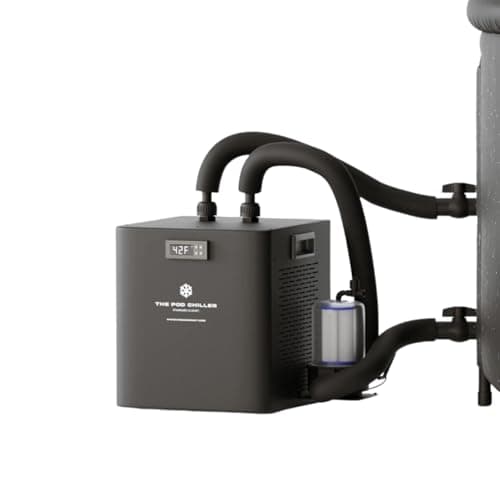 The Pod Company Standard Water Chiller, 1/3 HP 280 watts, a published 41 F floor and a 20-micron filter. It is less than half the draw of every other chiller here, and the listing volunteers the comparison. | 280 W | Cheapest to run | 7.2 | $569.00 - Amazon |
| 2 | 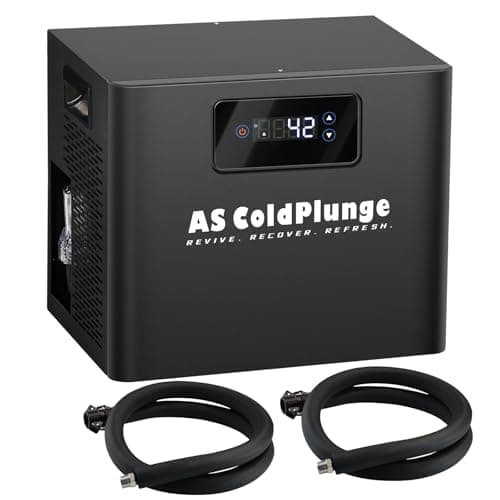 AS ColdPlunge 1/3 HP Cold Plunge Chiller 600 W, a 42 F floor, a reusable metal filter instead of cartridges, and a submersible pump in the box so it works with a bathtub that has no ports. | 600 W | Best for a bathtub | 7.7 | $399.00 - Amazon |
| 3 | 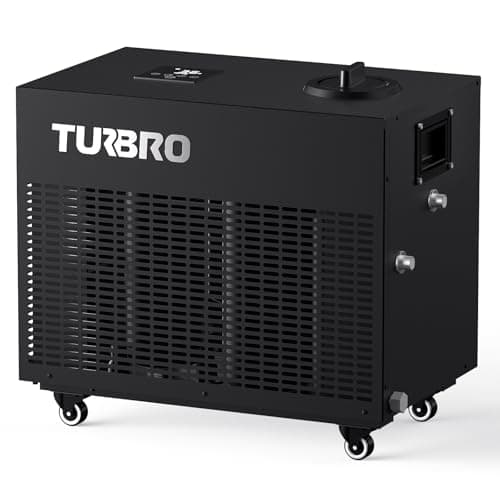 TURBRO FrostCore F85, 1 HP Cold Plunge Chiller The only chiller here that publishes a rated power, a BTU figure, a supply voltage, a temperature range and a cooling time - and it names its filtration in microns. | 1030 W | Most complete spec sheet | 5.9 | $1,399.00 - Amazon |
What temperature should a cold plunge be?
The bands
What the published research actually names
The most directly relevant work is a 2025 network meta-analysis in Frontiers in Physiology that compared combinations of immersion temperature and duration for recovery from exercise-induced muscle damage. Two findings, quoted as the authors framed them:
- Best for muscle soreness: medium duration, medium temperature - 10 to 15 minutes at 11 to 15 C (about 52 to 59 F).
- Best for biochemical markers and neuromuscular function: medium duration, low temperature - 10 to 15 minutes at 5 to 10 C (about 41 to 50 F).
Why colder is not automatically better
The intuition that colder equals more effective does not survive contact with the dosing data, for a reason that is fairly obvious once stated: colder water means shorter sessions. If the effective dose is a function of both temperature and time, driving temperature down while cutting time can leave you with less total exposure, not more.
There is also a practical cost. Holding a tub at 39 F rather than 50 F means substantially more chiller run time, which is real money - the difference between $9 and $40 a month depending on your unit. If the colder water is not buying you a better outcome, it is buying you a bigger bill. The figures are in what a chiller costs to run.
What your equipment can actually reach
Chiller floors are a real constraint and they are published, unlike most things in this category:
If you have decided you want water below 40 F, that rules out roughly half the category before you consider anything else. Most people never need it.
Measuring it
A chiller with a display tells you what it is holding. If you are running ice, you need a thermometer - and the temperature at the surface is not the temperature at the bottom unless something is circulating the water. Stir it before you read it, or you are measuring the layer the ice is floating in.
The timing question - when in the day, and how it interacts with training - is in when to cold plunge.
Every pick, in full
Each write-up below shows the score broken into its six components, the specs the listing actually publishes, and the running-cost arithmetic where a wattage exists to compute it from.
#1 - Cheapest to run
The Pod Company Standard Water Chiller, 1/3 HP
280 watts, a published 41 F floor and a 20-micron filter. It is less than half the draw of every other chiller here, and the listing volunteers the comparison.
| Small-space fit | 12 / 20 |
|---|---|
| Electrical fit | 20 / 20 |
| Cost to run | 20 / 20 |
| Key-number disclosure | 12 / 15 |
| Spec completeness | 8 / 15 |
| Warranty | 0 / 10 |
| Total | 72 / 100 |
| Rated watts | 280 Seller’s listing, read 2026-09-07 |
|---|---|
| Water capacity | Not published Not published |
| Dimensions | 13 x 13 x 21 in Seller’s listing, read 2026-09-07 |
| Weight | 40 lb Seller’s listing, read 2026-09-07 |
| Cooling floor | 41 Fno cooling rate published Seller’s listing, read 2026-09-07 |
| Material | Not published Not published |
| Warranty (months) | Not published Not published |
| Rated draw | 280 W |
|---|---|
| Cost per hour at full draw | 5.1 cents |
| Upper bound, running continuously | $37.47 per month |
A chiller cycles. It draws its rated power while the compressor runs and almost nothing while it does not, and how often it runs depends on ambient temperature, insulation, lid use and setpoint. We do not measure duty cycle, so we publish the two figures that need no assumption and no figure in between. Computed at 18.34 cents per kWh (June 2026). The method.
Two hundred and eighty watts is the number that decides this category. At the current US residential average it costs about five cents an hour at full draw, and even running continuously for a month - which no chiller does - the absolute ceiling is around thirty-eight dollars. The 1,200 W units in this roundup are four times that.
The listing's own comparison is a good one: about the same as a home freezer. That is a useful mental model, because a chiller works the same way and cycles the same way. It draws its rated power while the compressor is running and almost nothing while it is not, and how often it runs depends on your lid discipline, your room temperature and how well your tub is insulated.
The published floor is 41 F, which is warmer than the 37 to 39 F claimed by the bigger units. For most people that is irrelevant - the commonly recommended starting band is 50 to 59 F and experienced plungers usually settle around 45 to 50 F - but if you specifically want to get below 40, this will not do it.
Buy it if
Anyone whose plunge is a daily habit rather than an occasional event, where running cost compounds.
Skip it if
You want water below 41 F. This unit does not claim to go there.
#2 - Best for a bathtub
AS ColdPlunge 1/3 HP Cold Plunge Chiller
600 W, a 42 F floor, a reusable metal filter instead of cartridges, and a submersible pump in the box so it works with a bathtub that has no ports.
| Small-space fit | 12 / 20 |
|---|---|
| Electrical fit | 20 / 20 |
| Cost to run | 16 / 20 |
| Key-number disclosure | 12 / 15 |
| Spec completeness | 11 / 15 |
| Warranty | 6 / 10 |
| Total | 77 / 100 |
| Rated watts | 600 Seller’s listing, read 2026-09-07 |
|---|---|
| Water capacity | 79 Seller’s listing, read 2026-09-07 |
| Dimensions | 11.8 x 14.9 x 12.6 in Seller’s listing, read 2026-09-07 |
| Weight | 35 lb Seller’s listing, read 2026-09-07 |
| Cooling floor | 42 Fno cooling rate published Seller’s listing, read 2026-09-07 |
| Material | Not published Not published |
| Warranty (months) | 12 Seller’s listing, read 2026-09-07 |
| Rated draw | 600 W |
|---|---|
| Cost per hour at full draw | 11.0 cents |
| Upper bound, running continuously | $80.29 per month |
A chiller cycles. It draws its rated power while the compressor runs and almost nothing while it does not, and how often it runs depends on ambient temperature, insulation, lid use and setpoint. We do not measure duty cycle, so we publish the two figures that need no assumption and no figure in between. Computed at 18.34 cents per kWh (June 2026). The method.
The submersible pump is what makes this the bathtub answer. A chiller normally needs a tub with inlet and outlet ports; a bathtub has neither. Dropping a pump into the water and running two hoses over the rim is inelegant and it works, and it is the cheapest route to a cold plunge for anyone who cannot give up floor space for a tub at all.
Six hundred watts is eleven cents an hour at full draw, comfortably mid-range here. The 79-gallon rating is a good match for a standard bathtub, which holds somewhere between 40 and 80 gallons at plunge depth.
The reusable metal mesh filter rather than disposable cartridges is a genuine running-cost detail that gets ignored because it is not electricity. Cartridge filters are a recurring purchase; a rinsable metal screen is not, and over a year that difference is larger than the difference in power draw between two chillers.
An availability note, because we said we would keep it current: this listing went to "Currently unavailable" on 2026-09-09 and we routed its buy link to a search rather than to a product nobody could add to a cart. Re-checked on 2026-09-12, it is back in stock with a buy-box offer, so the link points at the listing again.
Buy it if
Anyone plunging in an existing bathtub rather than buying a tub.
Skip it if
Your tub is over 79 gallons.
#3 - Most complete spec sheet
TURBRO FrostCore F85, 1 HP Cold Plunge Chiller
The only chiller here that publishes a rated power, a BTU figure, a supply voltage, a temperature range and a cooling time - and it names its filtration in microns.
| Small-space fit | 12 / 20 |
|---|---|
| Electrical fit | 15 / 20 |
| Cost to run | 8 / 20 |
| Key-number disclosure | 15 / 15 |
| Spec completeness | 9 / 15 |
| Warranty | 0 / 10 |
| Total | 59 / 100 |
| Rated watts | 1030 Seller’s listing, read 2026-09-07 |
|---|---|
| Water capacity | 132 Seller’s listing, read 2026-09-07 |
| Dimensions | 21 x 24 in Seller’s listing, read 2026-09-07 |
| Weight | Not published Not published |
| Cooling floor | 36-86 F, 110 F to 36 F in about 5-6 hours Seller’s listing, read 2026-09-07 |
| Material | Not published Not published |
| Warranty (months) | Not published Not published |
| Rated draw | 1030 W |
|---|---|
| Cost per hour at full draw | 18.9 cents |
| Upper bound, running continuously | $137.82 per month |
A chiller cycles. It draws its rated power while the compressor runs and almost nothing while it does not, and how often it runs depends on ambient temperature, insulation, lid use and setpoint. We do not measure duty cycle, so we publish the two figures that need no assumption and no figure in between. Computed at 18.34 cents per kWh (June 2026). The method.
This is what a complete chiller spec sheet looks like: 1,030 W rated power, 9,553 BTU/h maximum cooling capacity, AC 110 to 120 V at 60 Hz, a 36 to 86 F range, and a stated cooling time with the starting temperature named. Every one of those is checkable, and together they let you predict what the unit will do in your room rather than hope.
The BTU figure is the one nobody else publishes and the one that actually lets you size a chiller properly. Horsepower is a compressor rating, not a cooling rating, and the relationship between the two varies by design. BTU per hour is the heat actually removed, which is the number that matters when you are deciding whether it can hold 132 gallons at 40 F in a warm garage.
At 1,030 W it is nineteen cents an hour at full draw - lower than both 1,200 W half-horse units here despite being a full horsepower, which is either better efficiency or a difference in how the figures were derived. The three-stage filtration is named by micron rating rather than described, and the ozone generator is a real sanitation method rather than a marketing word.
Buy it if
Someone who wants to size a chiller by arithmetic instead of by horsepower.
Skip it if
You want the smallest footprint. At 21 by 24 inches this is the largest unit here.
Questions people actually ask
What temperature should a cold plunge be?
Fifty to fifty-nine Fahrenheit for a beginner, forty-five to fifty for regular use, and forty to forty-five for experienced plungers. A 2025 network meta-analysis of immersion dosing ranked 10 to 15 minutes at 11 to 15 C - about 52 to 59 F - best for muscle soreness, which sits squarely in the beginner band.
Is colder better for a cold plunge?
Not automatically. The published dosing work found different optima for different outcomes: 11 to 15 C for soreness and 5 to 10 C for biochemical markers and neuromuscular function, both at 10 to 15 minutes. Colder water also means shorter sessions, so the total dose can end up lower.
What is the coldest a cold plunge should be?
There is no published lower limit for home use and we are not going to invent one. What we can tell you is that the chillers on this site publish floors between 36 and 42 F, so equipment sets a practical bound, and that the cold shock response gets more pronounced as temperature falls - which is a safety consideration rather than a performance one.
How cold is a bathtub with ice?
It depends on your tap temperature, how much ice you add and how insulated the tub is - which is why no honest figure exists. Cold tap water in most of the US in winter is already under 60 F, which is inside the beginner band before you add any ice at all.
Sources
- Wang H, Wang L, Pan Y. Impact of different doses of cold water immersion (duration and temperature variations) on recovery from acute exercise-induced muscle damage: a network meta-analysis. Frontiers in Physiology, 2025 - Ranked 10-15 min at 11-15 C best for soreness, and 10-15 min at 5-10 C best for biochemical markers and neuromuscular function.