Cold Plunges
DIY cold plunge: what a from-parts build actually needs
A plunge is four parts and one recurring cost. Here is what each part has to do, which of the three routes suits which vessel, and the arithmetic that decides it.
By Scooter M. · Published · Last updated
How we are paid: the buy links on this page are affiliate links. If you buy through one, we earn a commission from the retailer at no extra cost to you. It does not change what we rank or what we tell you to skip - the full FTC disclosure is here.

| # | Product | Rated draw | Best for | Score | Price |
|---|---|---|---|---|---|
| 1 | 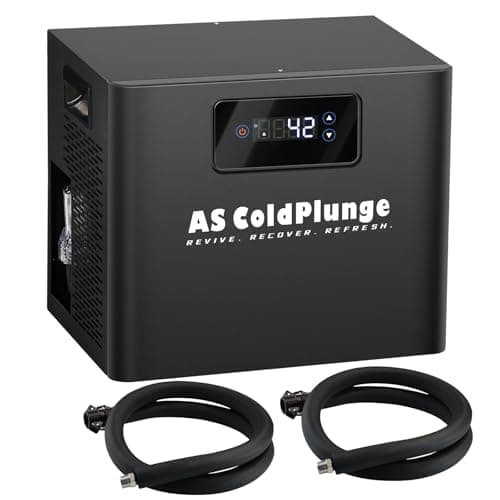 AS ColdPlunge 1/3 HP Cold Plunge Chiller 600 W, a 42 F floor, a reusable metal filter instead of cartridges, and a submersible pump in the box so it works with a bathtub that has no ports. | 600 W | Best for a bathtub | 7.7 | $399.00 - Amazon |
| 2 | 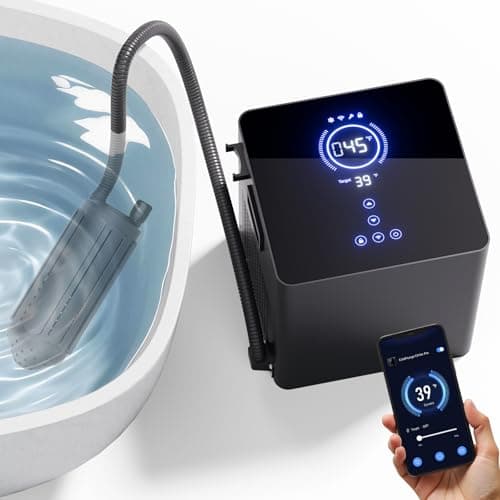 PlungeFit Cold Plunge Chiller Pro, 1/2 HP Drop-In A drop-in unit that cools directly in the water with no hoses or circulation loop, rated to 39 F for tubs up to 150 gallons at 1,200 W. | 1200 W | No plumbing at all | 6.4 | $549.00 - Amazon |
| 3 | 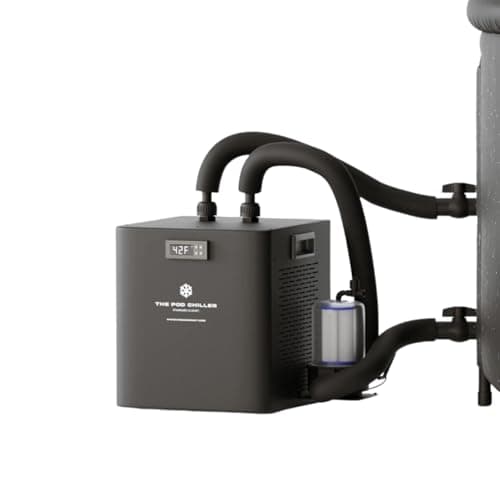 The Pod Company Standard Water Chiller, 1/3 HP 280 watts, a published 41 F floor and a 20-micron filter. It is less than half the draw of every other chiller here, and the listing volunteers the comparison. | 280 W | Cheapest to run | 7.2 | $569.00 - Amazon |
| 4 | 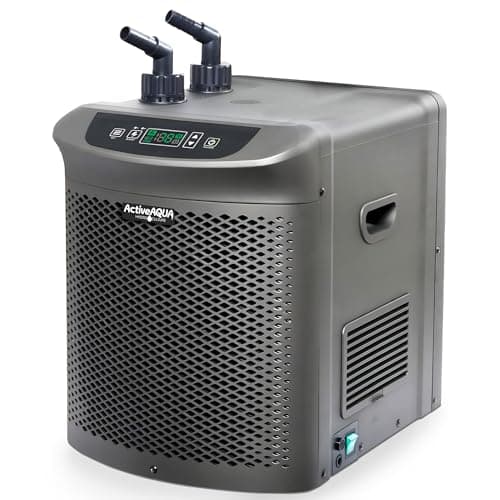 Active Aqua Water Chiller, 0.25 HP, Titanium A hydroponics chiller with a pure titanium evaporator and a published 190 W draw, repurposed for cold plunges long before cold plunges were a product category. | 190 W | Longest-serving design | 6.5 | $627.97 - Amazon |
The parts list, and what each part has to do
Most DIY plunge advice starts with the vessel because the vessel is the visible part. That is the wrong end. The vessel sets your water volume, the volume sets the chiller you need, and the chiller is where the money and the running cost live. Decide the volume first and the rest of the build is arithmetic.
The lid is the part people leave until last and it is the cheapest thing on the list that changes the running cost. Uncovered water gains heat from the room continuously, so the chiller cycles more often to hold setpoint, and uncovered water collects dust, leaves and light. A tub that is covered between sessions stays clear longer and costs less to hold cold, and neither of those is a marginal effect.
Work out your volume before you buy anything
Every decision downstream needs a real number, and the number printed on a tub is not reliably it - two of the listings in our inflatable roundup publish one capacity in the title and a different one in their own spec table. If you are building from a bathtub or a stock tank there is no published figure at all.
Fill it once through a hose with a flow meter, or in measured buckets, and write the number down. It takes one afternoon and it makes every decision after it correct rather than approximate. For reference, a standard US bathtub holds somewhere between 40 and 80 gallons at the depth you would actually plunge at, and a hundred gallons of water weighs about 830 pounds - which is worth knowing before you put a vessel on a balcony or a raised deck.
Route 1: a vessel and ice
The cheapest build to start and the most expensive to keep. You need no electricity, no plumbing and no ports - a vessel, water and enough ice to pull it down. It is a genuinely reasonable way to find out whether you will stick with cold exposure before committing to equipment.
The honest cons: ice is a recurring purchase and a recurring errand, the temperature is different every session because the ice quantity is never identical, and you still have a water quality problem. Cold slows bacterial growth, it does not stop it, and it does nothing at all about the body oils and skin cells that arrive with every session. An ice-only build needs a standalone filter pump to get the water clarity a chiller build gets included, and that is the most commonly skipped purchase in this route.
We are not going to publish a break-even against a national ice price, because there is not one worth publishing - bagged ice varies by several hundred percent between a supermarket, a convenience store and a bulk supplier. Chiller versus ice gives you the formula to work out your own from what ice actually costs where you live.
Route 2: a vessel and a chiller
The build most people end up at. A chiller holds a set temperature indefinitely, which removes both the errand and the session-to-session variability, and it brings filtration with it on most units. The decision inside this route is not really which chiller - it is whether your vessel has ports.
That middle row is the common DIY case and it is why the first pick above ships a submersible pump rather than assuming you have ports. The drop-in in the third row removes every hose, fitting and priming step, which in a bathroom you rent is worth more than it looks - but it does it at 1,200 W against 600 W for the hose-and-pump units, so you pay for the simplicity every hour it runs. Chillers for a bathtub works through that trade in full.
Route 3: the chest freezer conversion, and why it is not scored here
It is the build the DIY forums are full of, so it deserves a straight answer rather than silence: we do not recommend it and we will not score it.
The reason is the same standard we apply to everything else on this site. We score what a manufacturer publishes for the use we are recommending the product for. No chest freezer manufacturer rates its product for holding standing water that a person gets into. Converting one voids the warranty, it puts a mains-powered appliance in sustained contact with water, and it relies on a seal the maker never specified for that job. There are no published figures for a freezer used this way - no rated volume for water, no draw under this load, nothing - so there is nothing here for us to check.
That is not a claim that every such build fails. It is a statement that we have no way to verify one, and this site does not recommend equipment it cannot verify. If you are drawn to that route because of the price, the honest comparison is against the cheapest purpose-built setups, which are closer than the forum posts suggest once you have bought the pump, the fittings and the sealant.
Sizing the chiller to the vessel you chose
Match the chiller’s published gallon rating to your measured volume. Not its horsepower - horsepower rates the compressor motor, not the cooling, and two units both badged 1 HP can move materially different amounts of heat. Undersizing is the expensive mistake: the unit runs continuously, never reaches setpoint, and costs more to run than the right one would have.
Two adjustments to that table. If your vessel lives somewhere unconditioned - a garage that hits 95 F in summer - pick the next band up, because a published rating assumes an ambient temperature nobody states. And if your vessel is a stock tank or an uninsulated bathtub, you are fighting more heat gain than an insulated pod, so treat the rating as a ceiling rather than a target. How to size a chiller does the arithmetic properly.
What each route costs to keep running
Only the chiller route has an electricity cost, and it is computable from the published draw. At the current US residential average of 18.34 cents per kWh:
The spread across that table is more than six to one, and it is the single largest difference between two chillers that otherwise look alike on a listing page. A unit that publishes 280 W and one that publishes 600 W for the same 79-gallon rating are not the same purchase, and over a few years the gap is larger than the difference in their prices. The full running-cost workings are on their own page.
The parts people forget
The build is rarely short of a chiller. It is short of the small things that make it a routine rather than a project:
- A drain plan. A hundred gallons is not being tipped out. Either your vessel has a drain with a hose fitting or you need a submersible pump and a hose to a drain.
- Filtration, if you are on ice. Chiller builds usually get it included. Ice builds have the same water problem and none of the equipment.
- Weekly treatment. Typically dosed at about one ounce per hundred gallons, which is only a usable instruction once you have measured your volume.
- A thermometer you trust. A chiller’s own readout tells you what it thinks the water at its inlet is doing, which is not always what the water around you is doing.
- Circuit headroom. A 1,200 W chiller and anything else substantial on the same 15 A branch circuit is a trip waiting to happen. The electrical guide has the limits.
Cold plunge maintenance covers the water routine in full - filtration, dosing, lid discipline and the drain sequence that keeps your floor dry.
What we would build
If you already own a bathtub and want to find out whether cold exposure sticks: fill it, buy ice, and add a standalone filter pump when the water first goes cloudy. Nothing else. The total is small and you have learned the only thing that matters, which is whether you will actually do it three times a week.
If you know you will: measure your vessel, buy a chiller whose published rating covers that volume with a little headroom, and prefer one that publishes its wattage so you can budget the running cost. Where your vessel has no ports, buy one with a submersible pump in the box rather than assembling a loop from fittings - that is where the leaks come from and where an afternoon goes. Then buy the lid on the same day, not six weeks later.
For the temperature to actually aim at once it is built, our temperature guide covers the bands and what the evidence does and does not support.
Every pick, in full
Each write-up below shows the score broken into its six components, the specs the listing actually publishes, and the running-cost arithmetic where a wattage exists to compute it from.
#1 - Best for a bathtub
AS ColdPlunge 1/3 HP Cold Plunge Chiller
600 W, a 42 F floor, a reusable metal filter instead of cartridges, and a submersible pump in the box so it works with a bathtub that has no ports.
| Small-space fit | 12 / 20 |
|---|---|
| Electrical fit | 20 / 20 |
| Cost to run | 16 / 20 |
| Key-number disclosure | 12 / 15 |
| Spec completeness | 11 / 15 |
| Warranty | 6 / 10 |
| Total | 77 / 100 |
| Rated watts | 600 Seller’s listing, read 2026-09-07 |
|---|---|
| Water capacity | 79 Seller’s listing, read 2026-09-07 |
| Dimensions | 11.8 x 14.9 x 12.6 in Seller’s listing, read 2026-09-07 |
| Weight | 35 lb Seller’s listing, read 2026-09-07 |
| Cooling floor | 42 Fno cooling rate published Seller’s listing, read 2026-09-07 |
| Material | Not published Not published |
| Warranty (months) | 12 Seller’s listing, read 2026-09-07 |
| Rated draw | 600 W |
|---|---|
| Cost per hour at full draw | 11.0 cents |
| Upper bound, running continuously | $80.29 per month |
A chiller cycles. It draws its rated power while the compressor runs and almost nothing while it does not, and how often it runs depends on ambient temperature, insulation, lid use and setpoint. We do not measure duty cycle, so we publish the two figures that need no assumption and no figure in between. Computed at 18.34 cents per kWh (June 2026). The method.
The submersible pump is what makes this the bathtub answer. A chiller normally needs a tub with inlet and outlet ports; a bathtub has neither. Dropping a pump into the water and running two hoses over the rim is inelegant and it works, and it is the cheapest route to a cold plunge for anyone who cannot give up floor space for a tub at all.
Six hundred watts is eleven cents an hour at full draw, comfortably mid-range here. The 79-gallon rating is a good match for a standard bathtub, which holds somewhere between 40 and 80 gallons at plunge depth.
The reusable metal mesh filter rather than disposable cartridges is a genuine running-cost detail that gets ignored because it is not electricity. Cartridge filters are a recurring purchase; a rinsable metal screen is not, and over a year that difference is larger than the difference in power draw between two chillers.
An availability note, because we said we would keep it current: this listing went to "Currently unavailable" on 2026-09-09 and we routed its buy link to a search rather than to a product nobody could add to a cart. Re-checked on 2026-09-12, it is back in stock with a buy-box offer, so the link points at the listing again.
Buy it if
Anyone plunging in an existing bathtub rather than buying a tub.
Skip it if
Your tub is over 79 gallons.
#2 - No plumbing at all
PlungeFit Cold Plunge Chiller Pro, 1/2 HP Drop-In
A drop-in unit that cools directly in the water with no hoses or circulation loop, rated to 39 F for tubs up to 150 gallons at 1,200 W.
| Small-space fit | 12 / 20 |
|---|---|
| Electrical fit | 15 / 20 |
| Cost to run | 8 / 20 |
| Key-number disclosure | 12 / 15 |
| Spec completeness | 11 / 15 |
| Warranty | 6 / 10 |
| Total | 64 / 100 |
| Rated watts | 1200 Seller’s listing, read 2026-09-07 |
|---|---|
| Water capacity | 150 Seller’s listing, read 2026-09-07 |
| Dimensions | 11.8 x 15.4 x 12.6 in Seller’s listing, read 2026-09-07 |
| Weight | 45 lb Seller’s listing, read 2026-09-07 |
| Cooling floor | 39 Fno cooling rate published Seller’s listing, read 2026-09-07 |
| Material | Not published Not published |
| Warranty (months) | 12 Seller’s listing, read 2026-09-07 |
| Rated draw | 1200 W |
|---|---|
| Cost per hour at full draw | 22.0 cents |
| Upper bound, running continuously | $160.57 per month |
A chiller cycles. It draws its rated power while the compressor runs and almost nothing while it does not, and how often it runs depends on ambient temperature, insulation, lid use and setpoint. We do not measure duty cycle, so we publish the two figures that need no assumption and no figure in between. Computed at 18.34 cents per kWh (June 2026). The method.
Direct-in-water cooling removes the entire plumbing problem: no ports, no hoses, no pump priming, no leak points. For a renter, that also removes the part of a cold plunge setup most likely to put water on a floor you do not own.
It costs you in power. At 1,200 W this is twenty-two cents an hour at full draw and, in the theoretical case of running continuously for a month, about a hundred and sixty dollars. It will not run continuously - it cycles to hold a setpoint like any refrigeration - but among the chillers here it is at the expensive end and the 280 W Pod Company unit is at the other.
The 150-gallon rating and the 39 F floor are both genuine capability. If you have a large tub and you want it properly cold rather than merely cool, this is a reasonable pairing, and the WiFi scheduling means you can have it chill overnight on a cheaper tariff if your utility has one.
Buy it if
A renter who wants no plumbing and is prepared to pay for it in electricity.
Skip it if
Running cost is your first concern. This is the highest published draw here.
#3 - Cheapest to run
The Pod Company Standard Water Chiller, 1/3 HP
280 watts, a published 41 F floor and a 20-micron filter. It is less than half the draw of every other chiller here, and the listing volunteers the comparison.
| Small-space fit | 12 / 20 |
|---|---|
| Electrical fit | 20 / 20 |
| Cost to run | 20 / 20 |
| Key-number disclosure | 12 / 15 |
| Spec completeness | 8 / 15 |
| Warranty | 0 / 10 |
| Total | 72 / 100 |
| Rated watts | 280 Seller’s listing, read 2026-09-07 |
|---|---|
| Water capacity | Not published Not published |
| Dimensions | 13 x 13 x 21 in Seller’s listing, read 2026-09-07 |
| Weight | 40 lb Seller’s listing, read 2026-09-07 |
| Cooling floor | 41 Fno cooling rate published Seller’s listing, read 2026-09-07 |
| Material | Not published Not published |
| Warranty (months) | Not published Not published |
| Rated draw | 280 W |
|---|---|
| Cost per hour at full draw | 5.1 cents |
| Upper bound, running continuously | $37.47 per month |
A chiller cycles. It draws its rated power while the compressor runs and almost nothing while it does not, and how often it runs depends on ambient temperature, insulation, lid use and setpoint. We do not measure duty cycle, so we publish the two figures that need no assumption and no figure in between. Computed at 18.34 cents per kWh (June 2026). The method.
Two hundred and eighty watts is the number that decides this category. At the current US residential average it costs about five cents an hour at full draw, and even running continuously for a month - which no chiller does - the absolute ceiling is around thirty-eight dollars. The 1,200 W units in this roundup are four times that.
The listing's own comparison is a good one: about the same as a home freezer. That is a useful mental model, because a chiller works the same way and cycles the same way. It draws its rated power while the compressor is running and almost nothing while it is not, and how often it runs depends on your lid discipline, your room temperature and how well your tub is insulated.
The published floor is 41 F, which is warmer than the 37 to 39 F claimed by the bigger units. For most people that is irrelevant - the commonly recommended starting band is 50 to 59 F and experienced plungers usually settle around 45 to 50 F - but if you specifically want to get below 40, this will not do it.
Buy it if
Anyone whose plunge is a daily habit rather than an occasional event, where running cost compounds.
Skip it if
You want water below 41 F. This unit does not claim to go there.
#4 - Longest-serving design
Active Aqua Water Chiller, 0.25 HP, Titanium
A hydroponics chiller with a pure titanium evaporator and a published 190 W draw, repurposed for cold plunges long before cold plunges were a product category.
| Small-space fit | 12 / 20 |
|---|---|
| Electrical fit | 20 / 20 |
| Cost to run | 20 / 20 |
| Key-number disclosure | 5 / 15 |
| Spec completeness | 8 / 15 |
| Warranty | 0 / 10 |
| Total | 65 / 100 |
| Rated watts | 190 Seller’s listing, read 2026-09-07 |
|---|---|
| Water capacity | 92 Seller’s product title, read 2026-09-07 |
| Dimensions | 19 x 14 x 19 in Seller’s listing, read 2026-09-07 |
| Weight | 44.9 lb Seller’s listing, read 2026-09-07 |
| Cooling floor | Claim, no figure “ideal for hydroponic systems, aquaponic reservoirs, and even cold plunge baths with a large refrigeration capacity of 40-92 gallons” |
| Material | Not published Not published |
| Warranty (months) | Not published Not published |
| Rated draw | 190 W |
|---|---|
| Cost per hour at full draw | 3.5 cents |
| Upper bound, running continuously | $25.42 per month |
A chiller cycles. It draws its rated power while the compressor runs and almost nothing while it does not, and how often it runs depends on ambient temperature, insulation, lid use and setpoint. We do not measure duty cycle, so we publish the two figures that need no assumption and no figure in between. Computed at 18.34 cents per kWh (June 2026). The method.
This is an aquarium and hydroponics chiller, and that is the case for it rather than against. Aquarium chillers have been made to the same job for decades, they are expected to run unattended for years, and the titanium evaporator exists because someone else's fish were going to be swimming in the water. That is a longer track record than the cold-plunge-specific category has existed for.
At 190 W it is the second-cheapest to run here, about three and a half cents an hour at full draw. The rated volume range of 40 to 92 gallons is the constraint - this is not enough compressor for a 216-gallon tub, and it will run continuously trying.
The one thing it does not publish is a floor temperature. Aquarium chillers are specified by cooling capacity and volume rather than by a target temperature, which is a different but perfectly reasonable convention, and it means you are sizing by gallons instead of by degrees. Match it to a tub under 92 gallons and it is the right tool.
Buy it if
Someone with a tub under 92 gallons who wants a design with a long service history.
Skip it if
Your tub is over 92 gallons, or you want a published temperature floor. Neither fits.
Questions people actually ask
Can you build your own cold plunge?
Yes, and most home plunges are assembled rather than bought as one unit. A working plunge is four parts: a vessel that holds your volume, a cold source, circulation with filtration, and a lid. The vessel can be a bathtub you already own, a stock tank or a purpose-built tub. The part that decides the build is the cold source - ice is cheap to start and expensive to keep, a chiller is the reverse.
What size chiller do I need for a DIY cold plunge?
Match the chiller's published gallon rating to your vessel's measured volume, not to its horsepower and not to the number on its box. In the chillers we read, 1/3 HP units are typically rated for around 79 gallons, 1/2 HP for 105 to 150, and 1 HP for 132 to 230. Undersize it and the unit runs continuously without reaching setpoint, which costs more to run than the right one would.
Is a chest freezer cold plunge safe?
We will not tell you it is. A chest freezer is not rated by its manufacturer for immersion, converting one voids the warranty, and it puts a mains-powered appliance in sustained contact with water. There are no published figures for a freezer used this way, so there is nothing for us to score and nothing we could honestly verify. This site only recommends equipment whose maker publishes numbers for the use we are recommending it for.
How much does a DIY cold plunge cost to run?
Only the chiller has a running cost, and it is computable from the published draw. Across the chillers we read, published draws run from 190 W to 1,200 W, which at the current US residential average of 18.34 cents per kWh is between about 3.5 and 22 cents an hour at full draw. An ice build has no electricity cost and a recurring ice cost instead, which depends entirely on local ice prices.
Do you need a pump for a DIY cold plunge?
If you are running a chiller, yes - it needs water moving through it, and some chillers include a submersible pump while others expect you to supply one. If you are running ice, you still want a pump and filter, because ice does nothing about the body oils and skin cells that cloud the water. A standalone filter pump is the most commonly skipped purchase in an ice-only build.
Sources
- U.S. Energy Information Administration, Electric Power Monthly, Table 5.6.A - Average Price of Electricity to Ultimate Customers by End-Use Sector - U.S. Total, Residential: 18.34 cents per kWh, June 2026. Retrieved 2026-09-07.