Portable Saunas
The best sauna for a garage
A garage changes three things: what else is on the circuit, how cold the room starts, and where the moisture goes. Ranked on the figures the listings actually publish.
By Scooter M. · Published · Last updated
How we are paid: the buy links on this page are affiliate links. If you buy through one, we earn a commission from the retailer at no extra cost to you. It does not change what we rank or what we tell you to skip - the full FTC disclosure is here.
| # | Product | Rated watts | Best for | Score | Price |
|---|---|---|---|---|---|
| 1 | 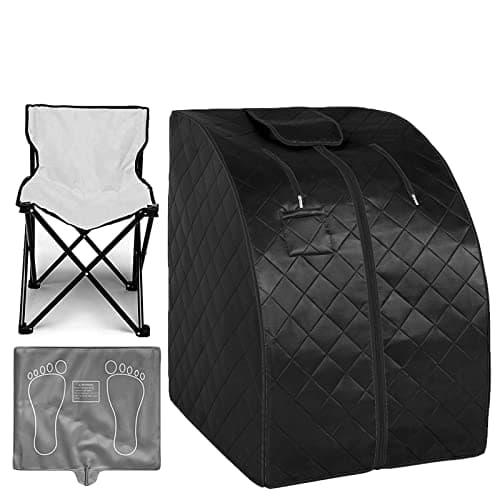 ZONEMEL Portable Infrared Sauna, 1 Person 1,050 W across three carbon panels plus a heated foot pad, with the wattage, the temperature ceiling and the timer all published - unusual for an infrared tent. | 1050 W | Best infrared for a standard outlet | 6.4 | $179.99 - Amazon |
| 2 | 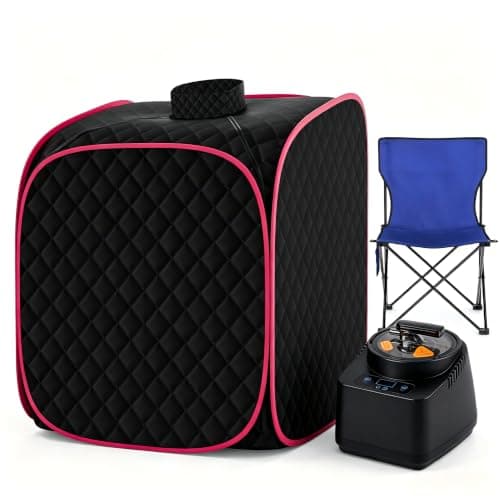 FniOk Portable Steam Sauna Tent, 1,000 W A 1,000 W steamer with a published 140 F ceiling and a 15-second warm-up claim, in the smallest assembled size of any steam tent here. | 1000 W | Fastest heat-up | 6.6 | $64.79 - Amazon |
| 3 | 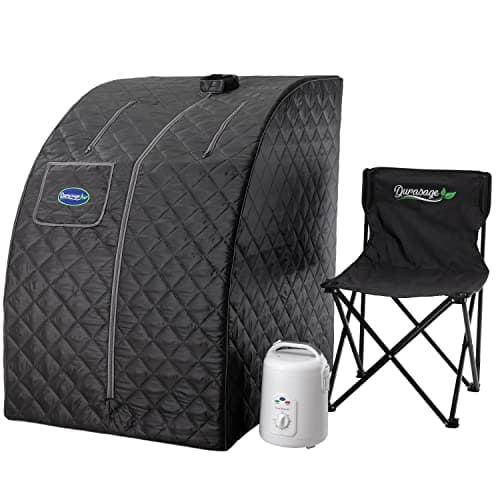 Durasage Lightweight Portable Personal Steam Sauna Spa An 800 W steam generator is the lowest published draw of any powered sauna here, which makes it the cheapest per session and the least likely to bother a shared circuit. | 800 W | Cheapest to run | 6.6 | $114.75 - Amazon |
| 4 | 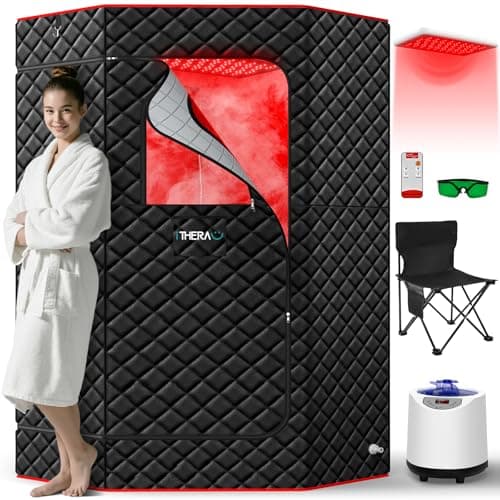 I-THERA-U XL Infrared Sauna Box with Red Light Lamp A pentagonal 45 x 35 in box with a 1,200 W steamer, a 324-LED red-light panel and a 90-minute timer, in 450D oxford rather than the usual thin polyester. | 1200 W | Most interior room | 6.1 | $159.99 - Amazon |
| 5 | 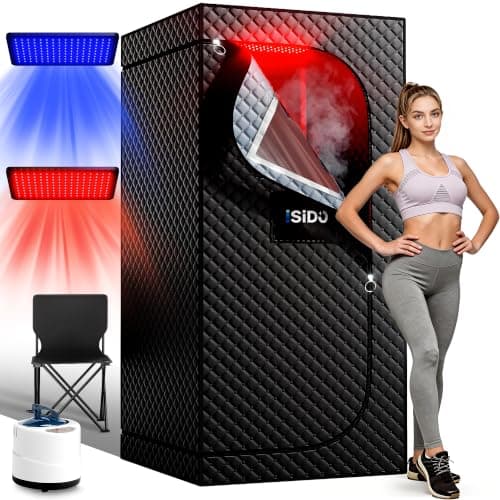 ISIDO Infrared Steam Sauna with Red and Blue Light Therapy A 1,300 W steam tent with a genuine 660 nm and 850 nm panel rather than a colored LED strip, and it publishes the wavelengths. | 1300 W | Best red-light combination | 6.1 | $179.99 - Amazon |
What a garage changes
So the ranking criteria change too. In the indoor roundup we rank on moisture, circuit load and floor space in a room you live in. For a garage, the order is:
- Published draw against a circuit you do not control. The lower the draw, the more room for the freezer that is already out there.
- Dry or wet. Condensation in a garage lands on tools and concrete.
- What the listing publishes at all - a maximum temperature and a timer range are the difference between a product you can plan around and one you cannot.
The circuit table
The last column is the one that matters in a garage, because a garage circuit is rarely dedicated. A chest freezer draws little while it idles and a lot when the compressor starts, and a door opener is a brief heavy load. A 1,300 W sauna leaves about 140 W of continuous headroom on a 15 A circuit - which is fine until something else kicks in. What a branch circuit can actually carry has the full arithmetic, including why an extension lead is the wrong answer here.
Moisture: the reason most garages want infrared
A steam unit boils water into the room for the length of the session. Indoors that is a humidity question; in a garage it is a rust question. Cold concrete and cold metal are the two best condensation surfaces you could design, and a garage usually has both, along with bikes, tools and boxes that do not benefit from a damp thirty minutes.
Infrared adds none. That is the single biggest reason to prefer a dry unit out there, and it is independent of which feels better - a question we treat separately in infrared versus steam, where the honest finding is that the two are not comparable on temperature alone.
The cold-start gap
Every maximum temperature on these listings - from 113 F to 150 F across the category - is published without the ambient temperature it was reached in. That is a real gap for a garage buyer, because the difference between starting at 70 F and starting at 40 F is most of the work the heater has to do.
We are not going to estimate a correction factor, because we have not measured one. What we can tell you is the shape of it: a unit with a higher published ceiling and a longer timer gives you more room to absorb a cold start than one that tops out low and shuts off at sixty minutes. On that basis the higher-wattage infrared units are the safer garage buy, which is the opposite of the advice we give for an apartment.
The floor is the other half of the problem
A garage floor is a concrete slab, and concrete is a heat sink that sits at ground temperature all year. Every unit here is designed to stand on a floor that is roughly room temperature, and none publishes what happens when it is not. Two practical consequences: the base of the sauna loses heat faster than the listing assumes, and anything damp that reaches the slab stays damp, because a cold slab does not dry.
Put something between the two. An interlocking foam mat or a rubber gym tile under the unit costs very little, insulates the base, and gives you a surface that is not freezing to stand on when you step out. It also protects the fabric floor of a tent from grit, which is the other thing a garage has in quantity.
Dust matters more than it sounds. A folding fabric sauna stored in a garage picks up brake dust, sawdust and whatever else is in the air, and the inside of the unit is where you then sit. If the sauna lives out there permanently, keep it zipped when not in use, or store the fabric indoors and bring it out for sessions - every unit on this page except none folds into a bag, which is exactly the property that makes that practical.
Winter, and what a published maximum is worth
The published ceilings across this group run from 113 F to 140 F, and every one of them is quoted without the ambient temperature it was measured at. In a 65 F room those numbers are plausible. In a 40 F garage in January, the heater is doing substantially more work before the session even starts, and nothing in any listing tells you how much longer that takes or whether the ceiling is still reachable.
We are not going to invent a correction, because we have not measured one. What we can say is what to prefer when the figure is unknown: a higher published ceiling gives you more room to lose some of it, and a longer timer means you are not fighting a sixty-minute cut-off while the room warms up. A unit that publishes 140 F and a 99-minute timer is a better cold -weather bet than one publishing 113 F and a fixed hour, even if both are pleasant in summer.
The same caveat runs through the sauna tent roundup, where the temperature column is the most quoted figure in the category and the least qualified.
If the garage also holds a cold plunge
A lot of garages end up with both, and the circuit is where they collide. A sauna is a short, heavy load; a chiller is a long, moderate one that may run for hours. Adding them together on a single 15 A circuit is the most common way to find out where the breaker is.
The arithmetic is simple enough to do before you buy: add the published draws of everything that could run at once, and keep the total under about 1,440 W continuous for a 15 A circuit. A 1,050 W sauna plus a 600 W chiller is already over that line, which is why contrast setups in a single-circuit garage usually mean running one at a time rather than both. The contrast therapy guide covers the sequencing, and the chiller value page covers which units add the least to the bill over three years.
What running one costs out there
Nothing that will change your mind. At the current US residential average, a thirty-minute session across this group costs between about 7 and 12 cents at full draw, and the spread between the cheapest and dearest to run is a few dollars a year at four sessions a week. The full per-session table is here. Electricity is not the deciding factor in this category - the circuit is.
One last garage-specific point that has nothing to do with heat: the door. An up-and-over or sectional garage door is the least insulated surface in the building and usually the draughtiest, and a sauna placed directly in front of one spends the session losing heat to it. If the garage has a spot away from the door and away from an uninsulated external wall, that is where the unit belongs, and it will reach temperature faster for no extra cost.
What we would buy for a garage
A dry infrared unit, sized so that its published draw leaves headroom on whatever circuit the garage has, and with the longest timer you can get. You give up the lowest running cost - the 800 W steam spa is the cheapest per session here - in exchange for not putting two to four liters of water into a room full of metal every time you use it.
If the garage is also where a cold plunge lives, the same circuit question applies twice over, and a chiller is a far larger and longer-running load than any sauna here. What a chiller costs over three years sets that out, and the contrast therapy guide covers running both in one space.
Every pick, in full
Each write-up below shows the score broken into its six components, the specs the listing actually publishes, and the running-cost arithmetic where a wattage exists to compute it from.
#1 - Best infrared for a standard outlet
ZONEMEL Portable Infrared Sauna, 1 Person
1,050 W across three carbon panels plus a heated foot pad, with the wattage, the temperature ceiling and the timer all published - unusual for an infrared tent.
| Small-space fit | 20 / 20 |
|---|---|
| Electrical fit | 15 / 20 |
| Cost to run | 20 / 20 |
| Key-number disclosure | 0 / 15 |
| Spec completeness | 9 / 15 |
| Warranty | 0 / 10 |
| Total | 64 / 100 |
| Rated watts | 1050 Seller’s listing, read 2026-09-07 |
|---|---|
| Maximum temperature | 140 F maximum Seller’s listing, read 2026-09-07 |
| Dimensions | 27.6 x 31.5 x 37.8 in Seller’s product title, read 2026-09-07 |
| Weight | 19.8 lb Seller’s listing, read 2026-09-07 |
| Timer | Up to 60 minutes Seller’s listing, read 2026-09-07 |
| EMF disclosure | Not mentioned at all |
| Material | Not published Not published |
| Warranty (months) | Not published Not published |
| Rated draw | 1050 W (8.8 A at 120 V) |
|---|---|
| Energy per 30-minute session | 0.525 kWh |
| Maximum cost per session | 9.6 cents |
| Maximum per month, 4 sessions a week | $1.67 |
| Circuit | Wants the outlet to itself |
These are maximums, assuming continuous draw. A resistive heater pulls its rated power only while the element is energized; once it reaches setpoint it cycles, so the real figure is lower and depends on your room. Computed at 18.34 cents per kWh (June 2026). The method, and how to substitute your own rate.
At 1,050 W this draws about 8.8 amps, which a standard 15 A outlet carries without complaint even with something else plugged in. It is the highest-powered infrared unit here that still sits comfortably under the 1,000 W line where we start recommending the outlet be left to itself, and a thirty-minute session works out to roughly ten cents at the national average rate.
The heated foot pad is the detail worth knowing about. Infrared tents heat what the panels face, and in a seated tent that means your back and sides get the heat while your feet sit on ambient floor. A separate foot element is the direct fix and not every unit in this price range includes one.
The footprint is the smallest of any sit-in sauna in this roundup: 27.6 by 31.5 inches deployed, about six square feet, which is roughly the area of a single armchair. That is what makes an infrared tent viable in a one-bedroom apartment at all.
Buy it if
Someone who wants dry infrared heat in the smallest deployed footprint that still fits an adult.
Skip it if
EMF disclosure matters to you. This listing does not mention it.
#2 - Fastest heat-up
FniOk Portable Steam Sauna Tent, 1,000 W
A 1,000 W steamer with a published 140 F ceiling and a 15-second warm-up claim, in the smallest assembled size of any steam tent here.
| Small-space fit | 17 / 20 |
|---|---|
| Electrical fit | 20 / 20 |
| Cost to run | 20 / 20 |
| Key-number disclosure | 0 / 15 |
| Spec completeness | 9 / 15 |
| Warranty | 0 / 10 |
| Total | 66 / 100 |
| Rated watts | 1000 Seller’s listing, read 2026-09-07 |
|---|---|
| Maximum temperature | 140 F maximum, 9 heat levels Seller’s listing, read 2026-09-07 |
| Dimensions | 31.5 x 31.5 x 40.5 in assembled Seller’s listing, read 2026-09-07 |
| Weight | 14.7 lb Seller’s listing, read 2026-09-07 |
| Timer | Not published Not published |
| EMF disclosure | Not the relevant number for this category |
| Material | High-density sealing material and waterproof canvas Seller’s listing, read 2026-09-07 |
| Warranty (months) | Not published Not published |
| Rated draw | 1000 W (8.3 A at 120 V) |
|---|---|
| Energy per 30-minute session | 0.500 kWh |
| Maximum cost per session | 9.2 cents |
| Maximum per month, 4 sessions a week | $1.59 |
| Circuit | Runs on any 15 A outlet |
These are maximums, assuming continuous draw. A resistive heater pulls its rated power only while the element is energized; once it reaches setpoint it cycles, so the real figure is lower and depends on your room. Computed at 18.34 cents per kWh (June 2026). The method, and how to substitute your own rate.
One thousand watts is 8.3 amps and sits right on our threshold: fine on a shared outlet, better on its own. A thirty-minute session costs about nine cents at the national average rate, which is second-cheapest here behind the 800 W Durasage.
The 140 F ceiling is high for a steam unit - most of this category tops out between 113 F and 130 F - and combined with 1,000 W and a 2.6 L reservoir it is a well-matched set of numbers rather than a headline figure with nothing behind it.
The '15s fast heating' claim in the title refers to the element, not the tent. Nothing fills a 31-inch cube with steam in fifteen seconds. Read it as how quickly the boiler starts producing rather than how quickly you can get in.
Buy it if
A first sauna where cost per session and a small footprint both matter.
Skip it if
You want a timer range or a warranty published. Neither is.
#3 - Cheapest to run
Durasage Lightweight Portable Personal Steam Sauna Spa
An 800 W steam generator is the lowest published draw of any powered sauna here, which makes it the cheapest per session and the least likely to bother a shared circuit.
| Small-space fit | 17 / 20 |
|---|---|
| Electrical fit | 20 / 20 |
| Cost to run | 20 / 20 |
| Key-number disclosure | 0 / 15 |
| Spec completeness | 9 / 15 |
| Warranty | 0 / 10 |
| Total | 66 / 100 |
| Rated watts | 800 Seller’s product title, read 2026-09-07 |
|---|---|
| Maximum temperature | Not published Not published |
| Dimensions | Packs to 28.6 x 12.3 x 8.4 in Seller’s listing, read 2026-09-07 |
| Weight | 15.8 lb Seller’s listing, read 2026-09-07 |
| Timer | 60-minute adjustable timer Seller’s listing, read 2026-09-07 |
| EMF disclosure | Not the relevant number for this category |
| Material | Heat-insulated fabric on PVC tubing Seller’s listing, read 2026-09-07 |
| Warranty (months) | Not published Not published |
| Rated draw | 800 W (6.7 A at 120 V) |
|---|---|
| Energy per 30-minute session | 0.400 kWh |
| Maximum cost per session | 7.3 cents |
| Maximum per month, 4 sessions a week | $1.27 |
| Circuit | Runs on any 15 A outlet |
These are maximums, assuming continuous draw. A resistive heater pulls its rated power only while the element is energized; once it reaches setpoint it cycles, so the real figure is lower and depends on your room. Computed at 18.34 cents per kWh (June 2026). The method, and how to substitute your own rate.
Eight hundred watts is the number that makes this interesting. It is a third less than the 1,200 W steamers that dominate the category, it draws about 6.7 amps on a 120 V circuit, and it is comfortably inside what a shared bedroom outlet will carry without an argument. For a renter running a sauna in a room that also has a television and a lamp on the same circuit, that is the whole decision.
The trade-off is honest and predictable: less steam power means a slower fill and a lower ceiling, and this listing does not publish a maximum temperature, which is the one checklist item you would most want alongside the wattage. A steam tent's temperature depends on room temperature and how well the fabric seals anyway, so a published maximum is less load-bearing here than it is on an infrared unit - but the absence still costs it a point.
This is a steam sauna, not an infrared one. Steam works on you from the outside in and gets you wet; infrared warms you more slowly and leaves you dry. Neither is better, and if you have not used both, that distinction will change your experience far more than any spec on this page.
Buy it if
A renter on a shared circuit who wants the lowest electrical load and the lowest running cost in the category.
Skip it if
You want infrared rather than steam, or you want a published temperature ceiling.
#4 - Most interior room
I-THERA-U XL Infrared Sauna Box with Red Light Lamp
A pentagonal 45 x 35 in box with a 1,200 W steamer, a 324-LED red-light panel and a 90-minute timer, in 450D oxford rather than the usual thin polyester.
| Small-space fit | 17 / 20 |
|---|---|
| Electrical fit | 15 / 20 |
| Cost to run | 20 / 20 |
| Key-number disclosure | 0 / 15 |
| Spec completeness | 9 / 15 |
| Warranty | 0 / 10 |
| Total | 61 / 100 |
| Rated watts | 1200 Seller’s product title, read 2026-09-07 |
|---|---|
| Maximum temperature | Not published Not published |
| Dimensions | 45 x 35 x 73 in Seller’s listing, read 2026-09-07 |
| Weight | 20.1 lb Seller’s listing, read 2026-09-07 |
| Timer | 90-minute timer, 15 heat levels Seller’s product title, read 2026-09-07 |
| EMF disclosure | Not mentioned at all |
| Material | 450D oxford fabric on thickened stainless steel piping Seller’s listing, read 2026-09-07 |
| Warranty (months) | Not published Not published |
| Rated draw | 1200 W (10 A at 120 V) |
|---|---|
| Energy per 30-minute session | 0.600 kWh |
| Maximum cost per session | 11.0 cents |
| Maximum per month, 4 sessions a week | $1.91 |
| Circuit | Wants the outlet to itself |
These are maximums, assuming continuous draw. A resistive heater pulls its rated power only while the element is energized; once it reaches setpoint it cycles, so the real figure is lower and depends on your room. Computed at 18.34 cents per kWh (June 2026). The method, and how to substitute your own rate.
The fabric weight is published, which is unusual and useful. 450D oxford is a real specification - denier is a measure of yarn thickness - and it is the difference between a tent that holds its shape through a year of humid sessions and one that softens and sags. Most listings in this category say 'durable material' and stop.
The red-light panel is specified as 108 LEDs at 660 nm and 216 at 850 nm. Again, actual wavelengths and actual counts, which is more than the seven-color strips get you.
At 45 by 35 inches this has the largest deployed footprint of any tent here - about eleven square feet, roughly a small armchair plus its clearance - and that is the cost of the extra interior room. In a studio apartment that is a real amount of floor to give up while it is standing, though it does fold away.
Buy it if
Anyone who has felt cramped in a standard sauna tent and has the floor space to fix it.
Skip it if
Floor space is your binding constraint. There are six-square-foot options here.
#5 - Best red-light combination
ISIDO Infrared Steam Sauna with Red and Blue Light Therapy
A 1,300 W steam tent with a genuine 660 nm and 850 nm panel rather than a colored LED strip, and it publishes the wavelengths.
| Small-space fit | 17 / 20 |
|---|---|
| Electrical fit | 15 / 20 |
| Cost to run | 20 / 20 |
| Key-number disclosure | 0 / 15 |
| Spec completeness | 9 / 15 |
| Warranty | 0 / 10 |
| Total | 61 / 100 |
| Rated watts | 1300 Seller’s listing, read 2026-09-07 |
|---|---|
| Maximum temperature | 130 F maximum Seller’s listing, read 2026-09-07 |
| Dimensions | 32 x 32 x 71 in Seller’s product title, read 2026-09-07 |
| Weight | 19.4 lb Seller’s listing, read 2026-09-07 |
| Timer | 9 temperature settings, 6-10 minute heat-up Seller’s listing, read 2026-09-07 |
| EMF disclosure | Not mentioned at all |
| Material | Triple-layer waterproofed cotton Seller’s listing, read 2026-09-07 |
| Warranty (months) | Not published Not published |
| Rated draw | 1300 W (10.8 A at 120 V) |
|---|---|
| Energy per 30-minute session | 0.650 kWh |
| Maximum cost per session | 11.9 cents |
| Maximum per month, 4 sessions a week | $2.06 |
| Circuit | Wants the outlet to itself |
These are maximums, assuming continuous draw. A resistive heater pulls its rated power only while the element is energized; once it reaches setpoint it cycles, so the real figure is lower and depends on your room. Computed at 18.34 cents per kWh (June 2026). The method, and how to substitute your own rate.
Most sauna tents advertising light therapy ship a seven-color LED strip, which is mood lighting. This one publishes actual wavelengths - 660 nm visible red and 850 nm near-infrared - which are the two figures the red-light literature is written around. Publishing the wavelength is the minimum bar for the claim to mean anything, and it is a bar most of this category does not clear.
The steamer is 1,300 W, which is 10.8 amps. That is over the 1,000 W line where we start telling people to give the sauna its own outlet, and comfortably under the 1,440 W continuous limit of a 15 A circuit. Thirty minutes costs about twelve cents at the national average rate.
The listing also notes the steamer has passed IEC 60335 and UL 499 testing, which are the relevant appliance safety standards for household heating equipment. That is a checkable claim about a named standard rather than a generic assurance, and it is rare enough in this category to be worth mentioning.
Buy it if
Someone who wants heat and red light in one purchase and wants the wavelengths published.
Skip it if
You want dry heat. This is a steam unit with a light panel, not an infrared cabin.
Questions people actually ask
Can you put a sauna in a garage?
Yes, and a garage solves the two problems an apartment creates: floor space and moisture. What it adds is a circuit that usually already has a door opener, a freezer or power tools on it, and an unheated room that starts far colder than a living room. Both are manageable once you know the published draw.
Will a garage sauna trip the breaker?
It can, because a garage circuit is rarely dedicated. A standard 15 A branch circuit carries about 1,440 W continuously, and the saunas here publish draws from 800 W to 1,300 W. Any of them fits on its own; a 1,300 W unit sharing a circuit with a chest freezer that cycles on is a different question. Check what else is on that circuit first.
Is infrared or steam better in a garage?
Infrared, in most garages. A steam session releases two to four liters of water into the room, and in an unheated garage that condenses on cold concrete, metal tools and whatever else is stored there. Infrared adds no moisture at all. If you want steam in a garage, ventilate it and do not store anything rust-prone nearby.
How long does a sauna take to heat up in a cold garage?
Nobody publishes that figure. Every maximum temperature on these listings - 113 F to 150 F - is quoted without the ambient temperature it was measured at, so a 40 F garage in January is outside every published claim. Expect longer heat-up and a lower ceiling than the listing implies, and treat the published maximum as a best case.