Portable Saunas
The best indoor sauna for a home
Indoors, three things decide it: what the unit does to the humidity of a room you live in, what it draws from a circuit you share, and whether it can be put away.
By Scooter M. · Published · Last updated
How we are paid: the buy links on this page are affiliate links. If you buy through one, we earn a commission from the retailer at no extra cost to you. It does not change what we rank or what we tell you to skip - the full FTC disclosure is here.
| # | Product | Rated watts | Best for | Score | Price |
|---|---|---|---|---|---|
| 1 | 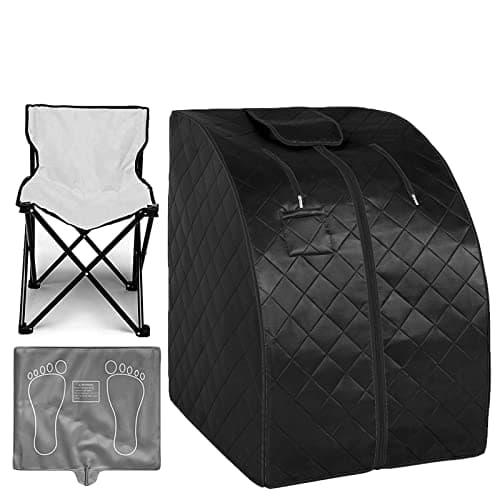 ZONEMEL Portable Infrared Sauna, 1 Person 1,050 W across three carbon panels plus a heated foot pad, with the wattage, the temperature ceiling and the timer all published - unusual for an infrared tent. | 1050 W | Best infrared for a standard outlet | 6.4 | $179.99 - Amazon |
| 2 | 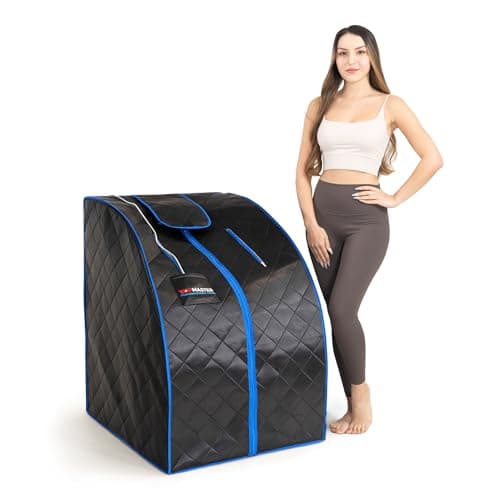 TopMaster Foldable Infrared Sauna Same 1,050 W and 140 F ceiling as the ZONEMEL infrared, with a heated foot pad, folding chair and cushion in the box. | 1050 W | Best kit for the money | 6.4 | $159.99 - Amazon |
| 3 | 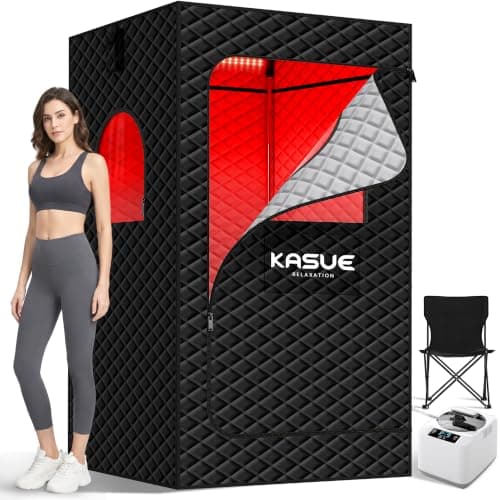 KASUE Infrared Sauna Tent with 3 L Steamer Five-layer insulated fabric, a 99-minute timer and a 30 x 30 in footprint - but no published wattage, which is the number you would want most. | Not published | Longest timer | 2.5 | $259.99 - Amazon |
| 4 | 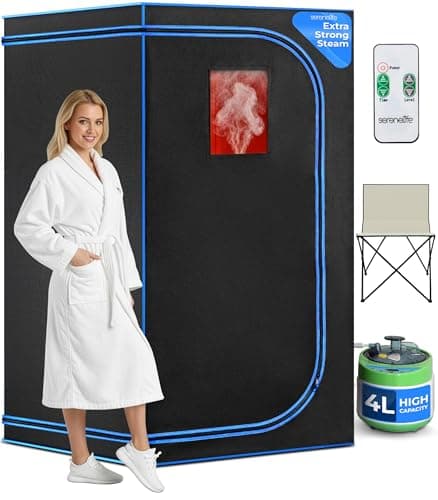 SereneLife Portable Sauna Box with 4L Steamer The most powerful steamer here at 1,600 W with a 4 L reservoir, which is also the highest electrical load of any tent in this roundup. | 1600 W | Fastest steam fill | 4.7 | $199.99 - Amazon |
| 5 | 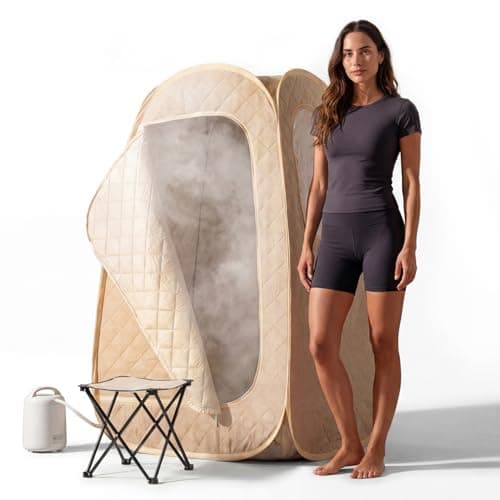 Homedics Portable Collapsible Steam Sauna The one recognizable household brand in the category, with a published one-year limited warranty and a modest 115 F ceiling - but no published wattage. | Not published | Best-known brand | 3.4 | $219.95 - Amazon |
| 6 | 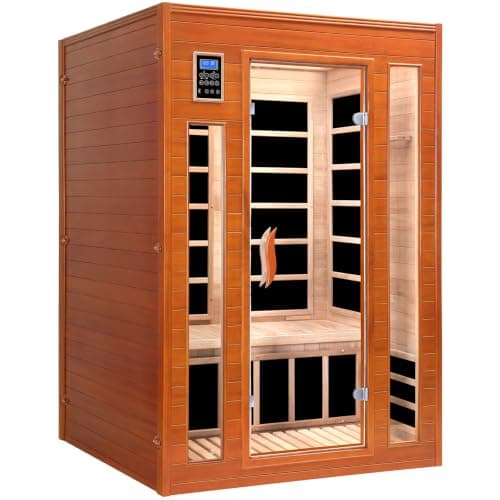 X-Vcak 2 Person Infrared Sauna Cabin A hemlock cabin with 1,800 W across eight panels, a 150 F ceiling and a 99-minute timer - the highest published draw in this category, and a permanent installation in everything but name. | 1800 W | Best if you own the room | 4.3 | $2,199.99 - Amazon |
Indoors changes which specification matters
A unit that is excellent in a garage can be the wrong purchase for a spare bedroom, and the difference is not quality. It is that a garage tolerates humidity, has its own circuit and has floor to spare, and a bedroom has none of those.
1. Moisture: the question that splits the category in two
A steam sauna boils two to four liters of water and pipes it into a fabric tent. All of that water ends up in your room. In a ventilated space it disperses and nothing happens. In a small room in February, against a cold exterior wall, it finds the coldest surface and stays there.
Infrared units radiate onto your skin and add no moisture whatsoever. If your home has any history of condensation or damp, that is not a preference - it is the decision, and it rules out more than half this category before you compare anything else. The full comparison of the two is here, including why steam at 113 F feels hotter than dry air at 140 F.
2. Load: what your circuit can actually carry
The figure is per circuit, not per outlet - one breaker usually feeds several sockets around a room, and everything on any of them shares the budget. In an older house where one circuit covers a bedroom and half a hallway, this is the whole decision, and it takes ten minutes with a lamp and the breaker panel to find out which side of it you are on. The procedure is here.
3. Floor: deployed and stored
Deployed footprints here run from about six square feet for the smallest infrared tent to nearly fourteen for a wooden cabin that does not fold at all. Six square feet is roughly one armchair. Fourteen square feet, permanently, is furniture.
The specification almost nobody publishes is the folded size. Package dimensions are the workaround where a listing gives them - not identical to the folded bundle, but the right order of magnitude, and better than nothing.
Do not compare the temperatures across types
This is the most common mistake in this category and it will lead you to the wrong unit. Published maxima here are 115 F, 122 F and 140 F for steam; 140 F and 150 F for infrared. Read plainly, infrared looks hotter.
It is not that simple. Your body cools itself by evaporating sweat, and in saturated steam there is nowhere for that sweat to go, so the heat load on you at 113 F in steam is greater than at 140 F in dry air. It is the same reason a commercial steam room runs at 110 to 120 F while a Finnish sauna runs at 175 to 195 F, and nobody calls the steam room the easy option. Pick the medium first, then compare temperatures within it.
What running one costs
At 18.34 cents per kWh, a 30-minute session across this whole category costs between seven and fifteen cents. Four sessions a week is between about $1.27 and $2.54 a month.
So cost is not a reason to choose between these. We publish the per-product figures anyway - in what a portable sauna costs to run - because across eleven competitor pages read during this site’s research there were eight passing mentions of running cost and not one published figure. The point is not that the number is large. It is that it is knowable and nobody bothers.
How these are ranked
On the same six-component disclosure score used across this site - small-space fit, electrical fit, cost to run, key-number disclosure, spec completeness and warranty - with the indoor considerations above deciding the order among products that score closely. It measures what a seller publishes, not how a product performs, because we have not used any of them. Every weight is published.
If your home is an apartment rather than a house, the lease, moisture and circuit questions are covered specifically in can you have a sauna in an apartment.
Two related pages split off from this one. If the sauna is going in an unheated garage rather than a room you live in, the circuit and the condensation questions change - the best sauna for a garage ranks on those instead. And the wooden cabin in the list above gets a full read in our X-Vcak cabin review. If two of you want to use it at once, the floor-space and circuit arithmetic changes again - the two-person page works it through.
Every pick, in full
Each write-up below shows the score broken into its six components, the specs the listing actually publishes, and the running-cost arithmetic where a wattage exists to compute it from.
#1 - Best infrared for a standard outlet
ZONEMEL Portable Infrared Sauna, 1 Person
1,050 W across three carbon panels plus a heated foot pad, with the wattage, the temperature ceiling and the timer all published - unusual for an infrared tent.
| Small-space fit | 20 / 20 |
|---|---|
| Electrical fit | 15 / 20 |
| Cost to run | 20 / 20 |
| Key-number disclosure | 0 / 15 |
| Spec completeness | 9 / 15 |
| Warranty | 0 / 10 |
| Total | 64 / 100 |
| Rated watts | 1050 Seller’s listing, read 2026-09-07 |
|---|---|
| Maximum temperature | 140 F maximum Seller’s listing, read 2026-09-07 |
| Dimensions | 27.6 x 31.5 x 37.8 in Seller’s product title, read 2026-09-07 |
| Weight | 19.8 lb Seller’s listing, read 2026-09-07 |
| Timer | Up to 60 minutes Seller’s listing, read 2026-09-07 |
| EMF disclosure | Not mentioned at all |
| Material | Not published Not published |
| Warranty (months) | Not published Not published |
| Rated draw | 1050 W (8.8 A at 120 V) |
|---|---|
| Energy per 30-minute session | 0.525 kWh |
| Maximum cost per session | 9.6 cents |
| Maximum per month, 4 sessions a week | $1.67 |
| Circuit | Wants the outlet to itself |
These are maximums, assuming continuous draw. A resistive heater pulls its rated power only while the element is energized; once it reaches setpoint it cycles, so the real figure is lower and depends on your room. Computed at 18.34 cents per kWh (June 2026). The method, and how to substitute your own rate.
At 1,050 W this draws about 8.8 amps, which a standard 15 A outlet carries without complaint even with something else plugged in. It is the highest-powered infrared unit here that still sits comfortably under the 1,000 W line where we start recommending the outlet be left to itself, and a thirty-minute session works out to roughly ten cents at the national average rate.
The heated foot pad is the detail worth knowing about. Infrared tents heat what the panels face, and in a seated tent that means your back and sides get the heat while your feet sit on ambient floor. A separate foot element is the direct fix and not every unit in this price range includes one.
The footprint is the smallest of any sit-in sauna in this roundup: 27.6 by 31.5 inches deployed, about six square feet, which is roughly the area of a single armchair. That is what makes an infrared tent viable in a one-bedroom apartment at all.
Buy it if
Someone who wants dry infrared heat in the smallest deployed footprint that still fits an adult.
Skip it if
EMF disclosure matters to you. This listing does not mention it.
#2 - Best kit for the money
TopMaster Foldable Infrared Sauna
Same 1,050 W and 140 F ceiling as the ZONEMEL infrared, with a heated foot pad, folding chair and cushion in the box.
| Small-space fit | 20 / 20 |
|---|---|
| Electrical fit | 15 / 20 |
| Cost to run | 20 / 20 |
| Key-number disclosure | 0 / 15 |
| Spec completeness | 9 / 15 |
| Warranty | 0 / 10 |
| Total | 64 / 100 |
| Rated watts | 1050 Seller’s listing, read 2026-09-07 |
|---|---|
| Maximum temperature | Up to 140 F Seller’s listing, read 2026-09-07 |
| Dimensions | 27.6 x 31.5 x 37.8 in Seller’s listing, read 2026-09-07 |
| Weight | 20 lb Seller’s listing, read 2026-09-07 |
| Timer | Up to 60 minutes Seller’s listing, read 2026-09-07 |
| EMF disclosure | Not mentioned at all |
| Material | Not published Not published |
| Warranty (months) | Not published Not published |
| Rated draw | 1050 W (8.8 A at 120 V) |
|---|---|
| Energy per 30-minute session | 0.525 kWh |
| Maximum cost per session | 9.6 cents |
| Maximum per month, 4 sessions a week | $1.67 |
| Circuit | Wants the outlet to itself |
These are maximums, assuming continuous draw. A resistive heater pulls its rated power only while the element is energized; once it reaches setpoint it cycles, so the real figure is lower and depends on your room. Computed at 18.34 cents per kWh (June 2026). The method, and how to substitute your own rate.
The published specification here is close to identical to the ZONEMEL infrared unit - same wattage, same ceiling, same dimensions, same timer - which happens often in this category because a lot of these tents come off the same production lines with different fabric and different names on the box.
We are not going to pretend we can tell you which one is better built, because that would require using both and we have used neither. What we can tell you is that the published specs are the same, so if the prices differ the cheaper one is the rational buy, and if the kit contents differ the more complete kit is.
This one includes the folding chair, heated foot pad and a sponge cushion. A cushion sounds like a throwaway inclusion until you have sat on a bare folding chair inside a hot tent for thirty minutes.
Buy it if
A buyer comparing near-identical infrared tents who wants the fuller accessory kit.
Skip it if
You would rather buy from a seller who says something about EMF.
#3 - Longest timer
KASUE Infrared Sauna Tent with 3 L Steamer
Five-layer insulated fabric, a 99-minute timer and a 30 x 30 in footprint - but no published wattage, which is the number you would want most.
| Small-space fit | 17 / 20 |
|---|---|
| Electrical fit | 0 / 20 |
| Cost to run | 0 / 20 |
| Key-number disclosure | 0 / 15 |
| Spec completeness | 8 / 15 |
| Warranty | 0 / 10 |
| Total | 25 / 100 |
| Rated watts | Not published Not published |
|---|---|
| Maximum temperature | Not published Not published |
| Dimensions | 30 x 30 x 70 in Seller’s listing, read 2026-09-07 |
| Weight | 15 lb Seller’s listing, read 2026-09-07 |
| Timer | 99-minute timer, 9 temperature levels Seller’s listing, read 2026-09-07 |
| EMF disclosure | Not mentioned at all |
| Material | Five-layer waterproof insulated fabric Seller’s listing, read 2026-09-07 |
| Warranty (months) | Not published Not published |
No running cost can be computed. The listing does not publish a rated wattage, so there is no honest way to tell you what a session costs. We will not estimate one. How we compute running costs
Five-layer insulated fabric is a genuine construction difference in a category where three layers is standard, and insulation is what decides whether a tent holds temperature in a cold room or bleeds it out through the walls. In a garage in winter that is the spec that determines whether the sauna works at all.
The 30 by 30 inch footprint is among the smallest here, at about six and a third square feet, and fifteen pounds is light enough to move one-handed.
The wattage is not published, and neither is a maximum temperature, so two of the eight checklist items and both of the computed cost components have nothing to work on. That is what holds the score down rather than anything visible about the product.
Buy it if
Someone in a cold room who needs the insulation more than they need the spec sheet.
Skip it if
You want a running cost. Without a wattage nobody can compute one.
#4 - Fastest steam fill
SereneLife Portable Sauna Box with 4L Steamer
The most powerful steamer here at 1,600 W with a 4 L reservoir, which is also the highest electrical load of any tent in this roundup.
| Small-space fit | 14 / 20 |
|---|---|
| Electrical fit | 8 / 20 |
| Cost to run | 16 / 20 |
| Key-number disclosure | 0 / 15 |
| Spec completeness | 9 / 15 |
| Warranty | 0 / 10 |
| Total | 47 / 100 |
| Rated watts | 1600 Seller’s listing, read 2026-09-07 |
|---|---|
| Maximum temperature | 122 F maximum Seller’s listing, read 2026-09-07 |
| Dimensions | 71 x 35 in Seller’s product title, read 2026-09-07 |
| Weight | 26 lb Seller’s listing, read 2026-09-07 |
| Timer | Up to 60 minutes Seller’s listing, read 2026-09-07 |
| EMF disclosure | Not the relevant number for this category |
| Material | Not published Not published |
| Warranty (months) | Not published Not published |
| Rated draw | 1600 W (13.3 A at 120 V) |
|---|---|
| Energy per 30-minute session | 0.800 kWh |
| Maximum cost per session | 14.7 cents |
| Maximum per month, 4 sessions a week | $2.54 |
| Circuit | Wants a dedicated 20 A circuit |
These are maximums, assuming continuous draw. A resistive heater pulls its rated power only while the element is energized; once it reaches setpoint it cycles, so the real figure is lower and depends on your room. Computed at 18.34 cents per kWh (June 2026). The method, and how to substitute your own rate.
Sixteen hundred watts is 13.3 amps on a 120 V circuit, which is above the 12 A continuous limit for a standard 15 A branch circuit. In practice that means this wants a circuit to itself: not an extension cord, not a shared bedroom outlet, and not the same circuit as a microwave or a hair dryer. If you are in an older apartment, this is the unit most likely to trip a breaker.
In return it fills fastest and holds the highest steam output here, and the 4 L reservoir is the largest, which means longer sessions without refilling. The 122 F ceiling is high for a steam tent.
It is also the heaviest tent at 26 pounds. Between the weight and the electrical load, this is a sauna that suits a garage or a spare room rather than one that gets moved and stowed daily.
Buy it if
Someone with a dedicated space and a circuit to spare who wants the strongest steam output.
Skip it if
You are on a shared or older circuit, or you plan to set it up and put it away every day.
#5 - Best-known brand
Homedics Portable Collapsible Steam Sauna
The one recognizable household brand in the category, with a published one-year limited warranty and a modest 115 F ceiling - but no published wattage.
| Small-space fit | 17 / 20 |
|---|---|
| Electrical fit | 0 / 20 |
| Cost to run | 0 / 20 |
| Key-number disclosure | 0 / 15 |
| Spec completeness | 11 / 15 |
| Warranty | 6 / 10 |
| Total | 34 / 100 |
| Rated watts | Not published Not published |
|---|---|
| Maximum temperature | Up to 115 F Seller’s listing, read 2026-09-07 |
| Dimensions | 35.43 x 35.43 x 57.87 in Seller’s listing, read 2026-09-07 |
| Weight | 13.7 lb Seller’s listing, read 2026-09-07 |
| Timer | Up to 60 minutes per session Seller’s listing, read 2026-09-07 |
| EMF disclosure | Not the relevant number for this category |
| Material | Polyester and polypropylene Seller’s listing, read 2026-09-07 |
| Warranty (months) | 12 Seller’s listing, read 2026-09-07 |
No running cost can be computed. The listing does not publish a rated wattage, so there is no honest way to tell you what a session costs. We will not estimate one. How we compute running costs
Homedics is a name most people already own something from, and the listing behaves accordingly: six of eight checklist items published, an actual warranty term rather than a promise of support, and a named material. That is a better disclosure record than most of this category manages.
The gap is the one that costs it most here - no rated wattage. The generator is described as 'high-efficiency' and nothing more, which means we cannot compute a running cost or tell you what it will do to your circuit. On a site built around exactly that arithmetic, an unpublished wattage from a large, established brand is more conspicuous than it would be from an anonymous seller.
The 115 F ceiling is the lowest published maximum here. For steam at full humidity that is still a real sauna session, but if you have used a commercial steam room and are expecting that intensity, this will feel gentle.
Buy it if
A cautious buyer who wants a brand with a service department and a written warranty behind the purchase.
Skip it if
You want to know what it costs to run. The wattage is not published, so nobody can tell you.
#6 - Best if you own the room
X-Vcak 2 Person Infrared Sauna Cabin
A hemlock cabin with 1,800 W across eight panels, a 150 F ceiling and a 99-minute timer - the highest published draw in this category, and a permanent installation in everything but name.
| Small-space fit | 6 / 20 |
|---|---|
| Electrical fit | 8 / 20 |
| Cost to run | 16 / 20 |
| Key-number disclosure | 5 / 15 |
| Spec completeness | 8 / 15 |
| Warranty | 0 / 10 |
| Total | 43 / 100 |
| Rated watts | 1800 Seller’s listing, read 2026-10-06 |
|---|---|
| Maximum temperature | 66-150 F Seller’s listing, read 2026-10-06 |
| Dimensions | 47 x 42 x 73 in Seller’s listing, read 2026-10-06 |
| Weight | Not published Not published |
| Timer | 1-99 minutes Seller’s listing, read 2026-10-06 |
| EMF disclosure | Claim, no figure “7-Color Therapy Light for Home, Indoor, Gym, Low EMF” |
| Material | Wood cabin with tempered glass door Seller’s listing, read 2026-10-06 |
| Warranty (months) | Not published Not published |
| Rated draw | 1800 W (15 A at 120 V) |
|---|---|
| Energy per 30-minute session | 0.900 kWh |
| Maximum cost per session | 16.5 cents |
| Maximum per month, 4 sessions a week | $2.86 |
| Circuit | Wants a dedicated 20 A circuit |
These are maximums, assuming continuous draw. A resistive heater pulls its rated power only while the element is energized; once it reaches setpoint it cycles, so the real figure is lower and depends on your room. Computed at 18.34 cents per kWh (June 2026). The method, and how to substitute your own rate.
At 1,800 W this draws a flat 15 amps at 120 V - the entire nameplate rating of a standard 15 A breaker, and well past the 1,440 W such a circuit is derated to for a load that runs continuously. The listing still describes an ordinary three-prong plug with leakage protection rather than a hardwired connection, so the plug will fit a wall outlet that the circuit behind it should not be asked to run. Budget a dedicated 20 A circuit as part of the purchase.
The reason a cabin appears in a portable sauna roundup at all is that it ships flat and assembles without tools. That is where the portability ends. At 47 by 42 inches deployed it claims close to fourteen square feet of floor permanently and it does not fold. This listing does not publish an assembled weight, which for a hemlock-and-glass box this size is the one figure worth having before you choose which floor it stands on. If you rent, this is the option that needs a landlord conversation and a plan for moving day.
What you get for the space is the highest temperature ceiling in this category at 150 F, eight heating panels rather than three, and an actual wooden cabin rather than fabric on a frame. Running it for thirty minutes costs about seventeen cents at the national average rate, so the cabin costs you floor area and circuit capacity rather than electricity. The title prints “Low EMF” and attaches no figure to it anywhere in the listing, which on our rubric is a phrase, not data.
Buy it if
Someone with a spare room, a spare 20 A circuit and no plan to move soon.
Skip it if
You rent, you share a circuit, or you need the room back after every session.
Questions people actually ask
What is the best indoor sauna for a home?
For most rooms, a dry infrared unit, because it adds no moisture to a space you live in. The best-documented options publish 1,050 W across three carbon panels with a 140 F ceiling and a footprint of about six square feet, which is roughly the area of an armchair and fits inside a standard 15 A circuit without argument.
Can you put a sauna inside your house?
Yes. A portable infrared or steam unit is a plug-in appliance, not an installation - no plumbing, no permits, no wiring. The two things to check first are what else is on the circuit you plan to use, and whether a steam model's moisture is a problem in your building.
Do indoor saunas cause moisture problems?
Steam models can, and infrared models cannot. A steam session releases two to four liters of water into the room. In a ventilated garage that is nothing; in a small bedroom in winter, in a building that already gets condensation on the windows, it is a real change to a room you sleep in. Infrared adds none at all.
How much space does an indoor sauna need?
Between about six and eleven square feet while standing for a fabric tent, and about ten square feet permanently for a wooden cabin that does not fold. The smallest unit on this site is 27.6 by 31.5 inches deployed, which is roughly the footprint of a single armchair.
Will an indoor sauna trip a breaker?
It can if it shares a circuit with other loads. A standard 15 A US branch circuit carries about 1,440 W continuously, and published draws here run from 800 W to 1,600 W. The largest steam generator is over that line on its own, before you plug in a lamp.