Portable Saunas
Portable sauna: infrared vs steam
The most common mistake in this category is comparing a steam tent's 113 F against an infrared cabin's 150 F as though they were the same measurement. They are not.
By Scooter M. · Published · Last updated
How we are paid: the buy links on this page are affiliate links. If you buy through one, we earn a commission from the retailer at no extra cost to you. It does not change what we rank or what we tell you to skip - the full FTC disclosure is here.

| # | Product | Rated watts | Best for | Score | Price |
|---|---|---|---|---|---|
| 1 | 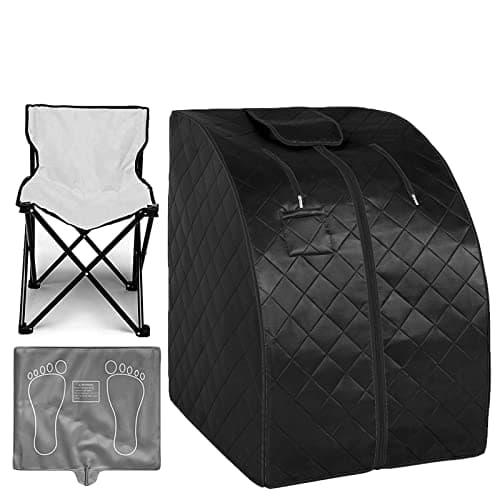 ZONEMEL Portable Infrared Sauna, 1 Person 1,050 W across three carbon panels plus a heated foot pad, with the wattage, the temperature ceiling and the timer all published - unusual for an infrared tent. | 1050 W | Best infrared for a standard outlet | 6.4 | $179.99 - Amazon |
| 2 | 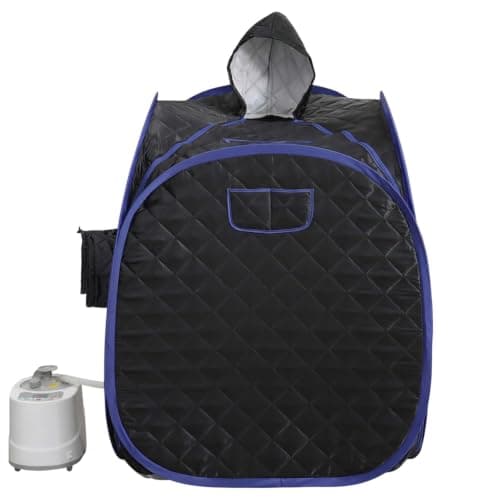 ZONEMEL Portable Steam Sauna, 900 W Publishes watts, maximum temperature, warm-up time, timer range and full dimensions - the most complete spec sheet in the category - and weighs nine pounds. | 900 W | Lightest to move | 6.8 | $72.99 - Amazon |
| 3 | 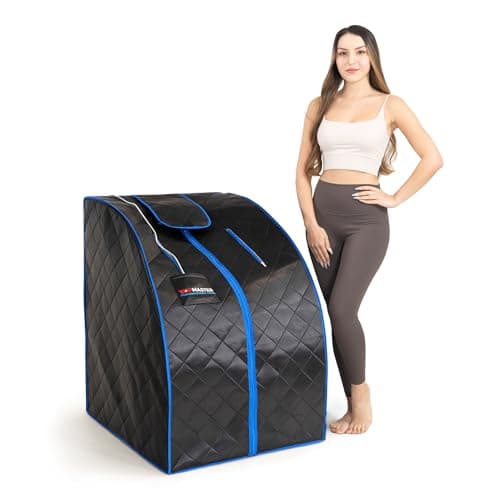 TopMaster Foldable Infrared Sauna Same 1,050 W and 140 F ceiling as the ZONEMEL infrared, with a heated foot pad, folding chair and cushion in the box. | 1050 W | Best kit for the money | 6.4 | $159.99 - Amazon |
| 4 | 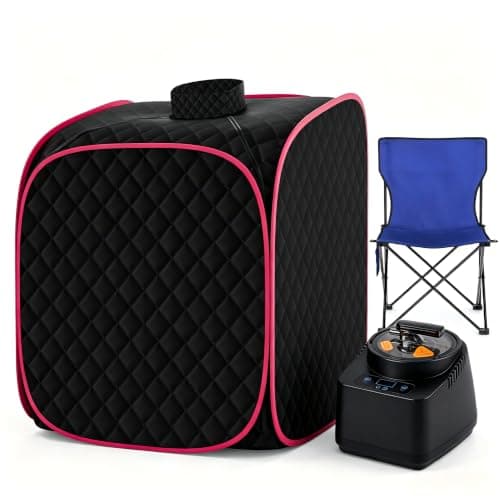 FniOk Portable Steam Sauna Tent, 1,000 W A 1,000 W steamer with a published 140 F ceiling and a 15-second warm-up claim, in the smallest assembled size of any steam tent here. | 1000 W | Fastest heat-up | 6.6 | $64.79 - Amazon |
The short answer
Why the temperatures do not compare
This is the part that leads people to buy the wrong one. Here are the published maxima from the products in our roundups:
Read naively, that table says infrared wins. It does not. Your body cools itself by evaporating sweat, and in saturated steam there is nowhere for that sweat to go. The heat load on you at 113 F in a steam tent is higher than at 140 F in dry air, and anyone who has used both will tell you the same thing.
Where that difference stops being academic is an unheated room: steam condenses on cold concrete and metal, which is why the garage roundup prefers dry units. This is also why traditional Finnish saunas run at 175 to 195 F while a steam room runs at 110 to 120 F, and why nobody thinks the steam room is the easy option.
What each one is actually like
Steam. A generator boils water and pipes it into the tent through a hose. You are wet within a couple of minutes. Heat-up is fast - listings quote 5 to 10 minutes - and the sensation is immediate and enveloping. Afterwards there is a reservoir to empty, a hose to drain, a tent to dry, and moisture in the room.
Infrared. Carbon panels radiate directly onto your skin rather than heating the air first, so the air temperature reads lower than the sensation. You stay dry. Warm-up is slower and the first ten minutes can feel underwhelming, which is why people conclude infrared is weak and then find themselves sweating hard at minute twenty. There is nothing to fill and nothing to empty.
Small-space considerations, which usually decide it
In a rented flat, the moisture line does more work than anything else on this page. A steam tent emptying three liters of water into a bedroom several times a week is a real change to that room’s humidity, and if your windows already run with condensation in winter it is not the right purchase. Infrared adds none.
Cost, which is close enough to ignore
At 18.34 cents per kWh, a 30-minute session costs about 8 cents on the 900 W steam tent, about 10 cents on the 1,050 W infrared units, and about 15 cents on the 1,600 W steam box. Those differences do not decide a purchase.
One caveat we will state rather than compute: a steam generator boils water continuously for the whole session, while an infrared panel reaches setpoint and cycles. So the real consumption gap probably favors infrared by more than the rated wattages suggest. We do not measure duty cycle, so that stays a caveat rather than a number. The method behind all of this is on the methodology page.
Where EMF comes into it
Only infrared units attract the EMF question, because only they have heating elements radiating directly at you. It is worth reading low EMF versus full spectrum before you pay a premium for either phrase - across twelve portable sauna listings, exactly zero published an EMF figure with a unit.
Those same heating elements are also why people ask whether an infrared sauna doubles as a red light device. It does not, and infrared sauna against red light therapy shows why: no sauna here publishes the wavelength its panels emit, which is the one figure the comparison would need.
That holds at the top of the market too, which is the uncomfortable part. What a premium infrared sauna actually buys you takes the same question to the two-thousand-dollar cabin and finds it publishes fewer specifications than the hundred-and-eighty-dollar tents, not more. With the type settled, the rest of the ladder - footprint, circuit, warranty - is in how to choose a portable infrared sauna.
Every pick, in full
Each write-up below shows the score broken into its six components, the specs the listing actually publishes, and the running-cost arithmetic where a wattage exists to compute it from.
#1 - Best infrared for a standard outlet
ZONEMEL Portable Infrared Sauna, 1 Person
1,050 W across three carbon panels plus a heated foot pad, with the wattage, the temperature ceiling and the timer all published - unusual for an infrared tent.
| Small-space fit | 20 / 20 |
|---|---|
| Electrical fit | 15 / 20 |
| Cost to run | 20 / 20 |
| Key-number disclosure | 0 / 15 |
| Spec completeness | 9 / 15 |
| Warranty | 0 / 10 |
| Total | 64 / 100 |
| Rated watts | 1050 Seller’s listing, read 2026-09-07 |
|---|---|
| Maximum temperature | 140 F maximum Seller’s listing, read 2026-09-07 |
| Dimensions | 27.6 x 31.5 x 37.8 in Seller’s product title, read 2026-09-07 |
| Weight | 19.8 lb Seller’s listing, read 2026-09-07 |
| Timer | Up to 60 minutes Seller’s listing, read 2026-09-07 |
| EMF disclosure | Not mentioned at all |
| Material | Not published Not published |
| Warranty (months) | Not published Not published |
| Rated draw | 1050 W (8.8 A at 120 V) |
|---|---|
| Energy per 30-minute session | 0.525 kWh |
| Maximum cost per session | 9.6 cents |
| Maximum per month, 4 sessions a week | $1.67 |
| Circuit | Wants the outlet to itself |
These are maximums, assuming continuous draw. A resistive heater pulls its rated power only while the element is energized; once it reaches setpoint it cycles, so the real figure is lower and depends on your room. Computed at 18.34 cents per kWh (June 2026). The method, and how to substitute your own rate.
At 1,050 W this draws about 8.8 amps, which a standard 15 A outlet carries without complaint even with something else plugged in. It is the highest-powered infrared unit here that still sits comfortably under the 1,000 W line where we start recommending the outlet be left to itself, and a thirty-minute session works out to roughly ten cents at the national average rate.
The heated foot pad is the detail worth knowing about. Infrared tents heat what the panels face, and in a seated tent that means your back and sides get the heat while your feet sit on ambient floor. A separate foot element is the direct fix and not every unit in this price range includes one.
The footprint is the smallest of any sit-in sauna in this roundup: 27.6 by 31.5 inches deployed, about six square feet, which is roughly the area of a single armchair. That is what makes an infrared tent viable in a one-bedroom apartment at all.
Buy it if
Someone who wants dry infrared heat in the smallest deployed footprint that still fits an adult.
Skip it if
EMF disclosure matters to you. This listing does not mention it.
#2 - Lightest to move
ZONEMEL Portable Steam Sauna, 900 W
Publishes watts, maximum temperature, warm-up time, timer range and full dimensions - the most complete spec sheet in the category - and weighs nine pounds.
| Small-space fit | 17 / 20 |
|---|---|
| Electrical fit | 20 / 20 |
| Cost to run | 20 / 20 |
| Key-number disclosure | 0 / 15 |
| Spec completeness | 11 / 15 |
| Warranty | 0 / 10 |
| Total | 68 / 100 |
| Rated watts | 900 Seller’s listing, read 2026-09-07 |
|---|---|
| Maximum temperature | 113 F maximum Seller’s listing, read 2026-09-07 |
| Dimensions | 33.5 x 32.3 x 41.7 in Seller’s listing, read 2026-09-07 |
| Weight | 9.2 lb Seller’s listing, read 2026-09-07 |
| Timer | 1-99 minutes, 9 heat levels Seller’s listing, read 2026-09-07 |
| EMF disclosure | Not the relevant number for this category |
| Material | Four layers of thickened pressed cotton on a stainless steel frame Seller’s listing, read 2026-09-07 |
| Warranty (months) | Not published Not published |
| Rated draw | 900 W (7.5 A at 120 V) |
|---|---|
| Energy per 30-minute session | 0.450 kWh |
| Maximum cost per session | 8.3 cents |
| Maximum per month, 4 sessions a week | $1.43 |
| Circuit | Runs on any 15 A outlet |
These are maximums, assuming continuous draw. A resistive heater pulls its rated power only while the element is energized; once it reaches setpoint it cycles, so the real figure is lower and depends on your room. Computed at 18.34 cents per kWh (June 2026). The method, and how to substitute your own rate.
Six of eight checklist items published, including the two that matter most for this site's purposes: 900 watts and a 113 F ceiling. That is 7.5 amps, well inside a standard outlet, and it costs about eight cents for a thirty-minute session at the national average rate.
The 113 F maximum is worth pausing on, because it is much lower than the 140 F figures quoted by infrared units in this roundup and that is not a defect. Steam at 113 F and 100 percent humidity is a harder environment to sit in than dry air at 140 F. Comparing the two numbers directly is the most common mistake buyers make in this category, and it is why our comparison of infrared and steam exists.
At 9.2 pounds it is the lightest full-size unit here by a clear margin, and the listing gives a real folding procedure rather than a claim of portability. If the sauna lives in a closet between sessions, weight is not a spec, it is the thing that decides whether you actually use it.
Buy it if
Someone in a small apartment who has to put the sauna away after every session.
Skip it if
You want dry infrared heat, or you want a higher temperature ceiling.
#3 - Best kit for the money
TopMaster Foldable Infrared Sauna
Same 1,050 W and 140 F ceiling as the ZONEMEL infrared, with a heated foot pad, folding chair and cushion in the box.
| Small-space fit | 20 / 20 |
|---|---|
| Electrical fit | 15 / 20 |
| Cost to run | 20 / 20 |
| Key-number disclosure | 0 / 15 |
| Spec completeness | 9 / 15 |
| Warranty | 0 / 10 |
| Total | 64 / 100 |
| Rated watts | 1050 Seller’s listing, read 2026-09-07 |
|---|---|
| Maximum temperature | Up to 140 F Seller’s listing, read 2026-09-07 |
| Dimensions | 27.6 x 31.5 x 37.8 in Seller’s listing, read 2026-09-07 |
| Weight | 20 lb Seller’s listing, read 2026-09-07 |
| Timer | Up to 60 minutes Seller’s listing, read 2026-09-07 |
| EMF disclosure | Not mentioned at all |
| Material | Not published Not published |
| Warranty (months) | Not published Not published |
| Rated draw | 1050 W (8.8 A at 120 V) |
|---|---|
| Energy per 30-minute session | 0.525 kWh |
| Maximum cost per session | 9.6 cents |
| Maximum per month, 4 sessions a week | $1.67 |
| Circuit | Wants the outlet to itself |
These are maximums, assuming continuous draw. A resistive heater pulls its rated power only while the element is energized; once it reaches setpoint it cycles, so the real figure is lower and depends on your room. Computed at 18.34 cents per kWh (June 2026). The method, and how to substitute your own rate.
The published specification here is close to identical to the ZONEMEL infrared unit - same wattage, same ceiling, same dimensions, same timer - which happens often in this category because a lot of these tents come off the same production lines with different fabric and different names on the box.
We are not going to pretend we can tell you which one is better built, because that would require using both and we have used neither. What we can tell you is that the published specs are the same, so if the prices differ the cheaper one is the rational buy, and if the kit contents differ the more complete kit is.
This one includes the folding chair, heated foot pad and a sponge cushion. A cushion sounds like a throwaway inclusion until you have sat on a bare folding chair inside a hot tent for thirty minutes.
Buy it if
A buyer comparing near-identical infrared tents who wants the fuller accessory kit.
Skip it if
You would rather buy from a seller who says something about EMF.
#4 - Fastest heat-up
FniOk Portable Steam Sauna Tent, 1,000 W
A 1,000 W steamer with a published 140 F ceiling and a 15-second warm-up claim, in the smallest assembled size of any steam tent here.
| Small-space fit | 17 / 20 |
|---|---|
| Electrical fit | 20 / 20 |
| Cost to run | 20 / 20 |
| Key-number disclosure | 0 / 15 |
| Spec completeness | 9 / 15 |
| Warranty | 0 / 10 |
| Total | 66 / 100 |
| Rated watts | 1000 Seller’s listing, read 2026-09-07 |
|---|---|
| Maximum temperature | 140 F maximum, 9 heat levels Seller’s listing, read 2026-09-07 |
| Dimensions | 31.5 x 31.5 x 40.5 in assembled Seller’s listing, read 2026-09-07 |
| Weight | 14.7 lb Seller’s listing, read 2026-09-07 |
| Timer | Not published Not published |
| EMF disclosure | Not the relevant number for this category |
| Material | High-density sealing material and waterproof canvas Seller’s listing, read 2026-09-07 |
| Warranty (months) | Not published Not published |
| Rated draw | 1000 W (8.3 A at 120 V) |
|---|---|
| Energy per 30-minute session | 0.500 kWh |
| Maximum cost per session | 9.2 cents |
| Maximum per month, 4 sessions a week | $1.59 |
| Circuit | Runs on any 15 A outlet |
These are maximums, assuming continuous draw. A resistive heater pulls its rated power only while the element is energized; once it reaches setpoint it cycles, so the real figure is lower and depends on your room. Computed at 18.34 cents per kWh (June 2026). The method, and how to substitute your own rate.
One thousand watts is 8.3 amps and sits right on our threshold: fine on a shared outlet, better on its own. A thirty-minute session costs about nine cents at the national average rate, which is second-cheapest here behind the 800 W Durasage.
The 140 F ceiling is high for a steam unit - most of this category tops out between 113 F and 130 F - and combined with 1,000 W and a 2.6 L reservoir it is a well-matched set of numbers rather than a headline figure with nothing behind it.
The '15s fast heating' claim in the title refers to the element, not the tent. Nothing fills a 31-inch cube with steam in fifteen seconds. Read it as how quickly the boiler starts producing rather than how quickly you can get in.
Buy it if
A first sauna where cost per session and a small footprint both matter.
Skip it if
You want a timer range or a warranty published. Neither is.
Questions people actually ask
Is infrared or steam better for a portable sauna?
Infrared if you want dry heat, no moisture in the room and no water to fill or empty. Steam if you want the enveloping, sweat-immediately feeling of a traditional sauna and do not mind humidity. At the same published temperature, steam feels considerably hotter, because water conducts heat into you far faster than air does.
Why do steam saunas have lower maximum temperatures?
Because they do not need a high one. At 100 percent humidity your sweat cannot evaporate, which is the mechanism your body uses to cool itself, so the heat load on you at 113 F in steam is greater than at 140 F in dry air. The published ceilings in this category reflect that: steam tents top out between 113 and 140 F, infrared units at 140 to 150 F.
Does an infrared portable sauna use less electricity?
Not meaningfully. Infrared units in our roundup publish between 1,050 W and 1,800 W and steam units between 800 W and 1,600 W. The ranges overlap across most of their span, and the single highest draw here is an infrared cabin. What differs is that infrared reaches setpoint and cycles, while a steam generator boils water continuously, so real consumption over a session is likely higher for steam - but we do not measure duty cycle and will not put a number on it.
Does a steam sauna cause damp in an apartment?
It adds real moisture to a room, so ventilate afterwards. A 2 to 4 liter reservoir emptied into a bedroom over 30 minutes is enough to raise humidity noticeably. In a well-ventilated room it is a non-issue; in a small flat that already has condensation on the windows in winter, it is worth thinking about. Infrared adds none.