Portable Saunas
Infrared sauna vs red light therapy
The two get sold as one idea because they share the word infrared. They are specified on completely different numbers, and the spec sheets are the easiest way to see it.
By Scooter M. · Published · Last updated
How we are paid: the buy links on this page are affiliate links. If you buy through one, we earn a commission from the retailer at no extra cost to you. It does not change what we rank or what we tell you to skip - the full FTC disclosure is here.
| # | Product | Rated watts | Best for | Score | Price |
|---|---|---|---|---|---|
| 1 | 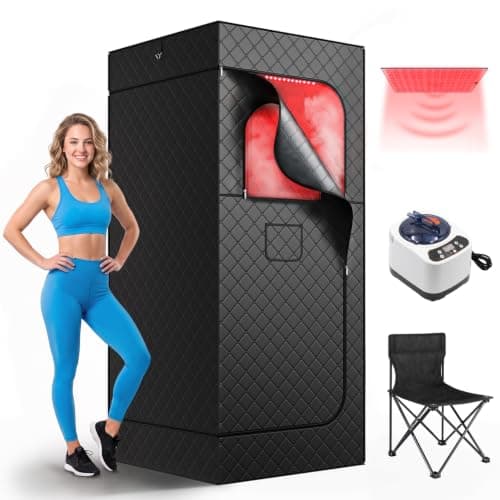 SOARFLY Infrared Steam Sauna with 660 nm and 850 nm Light Panel A 1,200 W steam tent with a genuine 660 nm and 850 nm panel rather than a colored LED strip, and the only sauna here that publishes a user height limit. | 1200 W | Best red-light combination | 6.1 | $119.99 - Amazon |
| 2 | 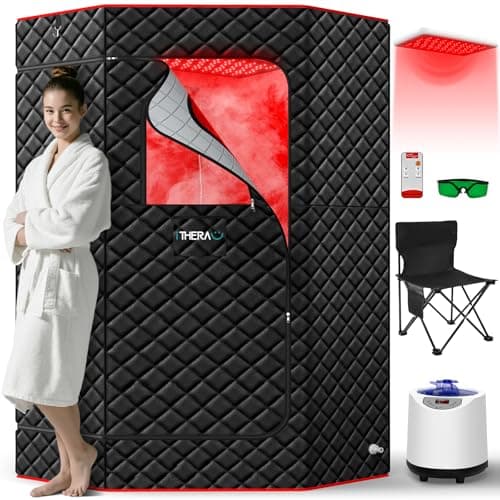 I-THERA-U XL Infrared Sauna Box with Red Light Lamp A pentagonal 45 x 35 in box with a 1,200 W steamer, a 324-LED red-light panel and a 90-minute timer, in 450D oxford rather than the usual thin polyester. | 1200 W | Most interior room | 6.1 | $159.99 - Amazon |
| 3 | 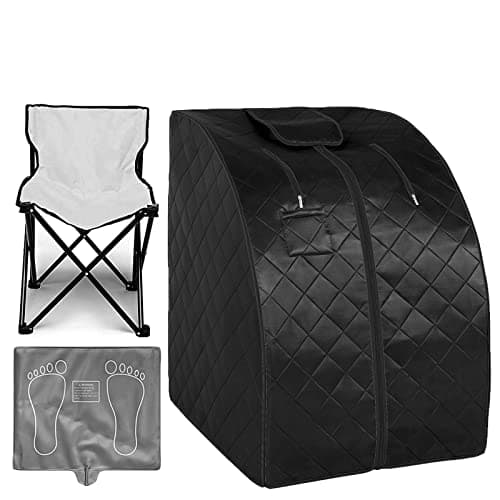 ZONEMEL Portable Infrared Sauna, 1 Person 1,050 W across three carbon panels plus a heated foot pad, with the wattage, the temperature ceiling and the timer all published - unusual for an infrared tent. | 1050 W | Best infrared for a standard outlet | 6.4 | $179.99 - Amazon |
| 4 | 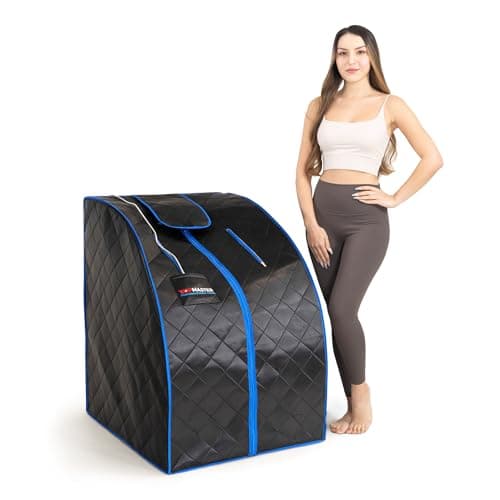 TopMaster Foldable Infrared Sauna Same 1,050 W and 140 F ceiling as the ZONEMEL infrared, with a heated foot pad, folding chair and cushion in the box. | 1050 W | Best kit for the money | 6.4 | $159.99 - Amazon |
| 5 | 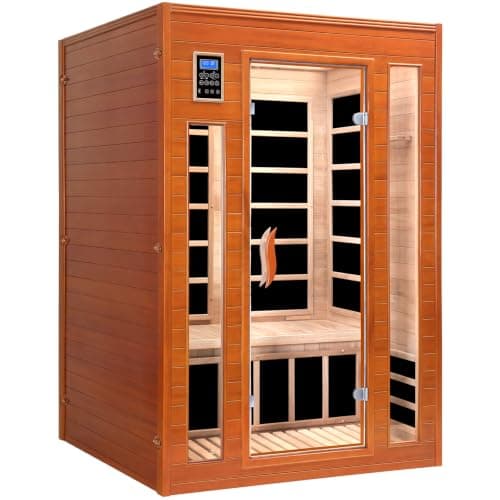 X-Vcak 2 Person Infrared Sauna Cabin A hemlock cabin with 1,800 W across eight panels, a 150 F ceiling and a 99-minute timer - the highest published draw in this category, and a permanent installation in everything but name. | 1800 W | Best if you own the room | 4.3 | $2,199.99 - Amazon |
The two spec sheets do not overlap at all
The confusion is entirely the word infrared doing two unrelated jobs. In infrared sauna it describes how the box makes you hot. In red light therapy the near-infrared figure, 850 nm, describes a specific wavelength of light. One is a heating method, the other is a lighting specification, and a buyer who treats them as synonyms usually ends up with a product that does the thing they were not shopping for.
1. What the heat units publish, and what they do not
Every sauna we cover publishes rated watts, and most publish a temperature ceiling. Those are real, checkable, decision-grade numbers: 1,050 W and a 140 F ceiling for the two infrared tents here, 1,800 W and 150 F for the hemlock cabin. You can size a circuit from those figures and compute a running cost from them, which is exactly what the rest of this hub does.
What none of them publishes is a single figure about light. Not a wavelength, not a band, not a spectral distribution. Carbon and ceramic heating panels are generally described as far infrared, which sits well above the 660 to 850 nm range the red-light research is written around, but no listing we read puts a number on it - so we are not going to supply one on the manufacturer’s behalf. The practical consequence is simple: if a seller will not tell you what its panels emit, you cannot treat the sauna as a light device.
2. What a red light claim has to publish to mean anything
Two numbers. The wavelength, which tells you the light is the right color - 660 nm visible red and 850 nm near-infrared are the figures that recur throughout the published photobiomodulation literature. And the irradiance, the power density at a stated distance in milliwatts per square centimeter, which tells you there is enough of it.
Of the combination units here, two publish the first number and none publishes the second. That is half a specification, and it is worth knowing before you pay a premium for the feature. Which sauna listings publish real wavelengths and which ship a seven-color strip works through the full table, including the two cabins that advertise chromotherapy with no figure attached at all.
3. Pick the outcome first, then the device
This is the whole decision, and it takes one question: what are you actually buying a session for?
We should be straightforward about that second row. This site covers red light as an attribute of sauna and blanket hardware; it does not cover standalone red light panels, and there is no affiliate reason dressed up as editorial judgment behind that. If a panel is what you need, the specification to demand is irradiance in milliwatts per square centimeter at a stated distance, because a figure quoted at the lens means nothing at the distance you would actually sit.
4. The electrical difference is larger than it looks
A sauna is a heating load and a lamp is not. At 18.34 cents per kWh, a thirty-minute session in a 1,050 W infrared tent costs about 10 cents, and the 1,800 W cabin about 17 cents. Those are small numbers, but the draw is not: 1,800 W is a flat 15 A at 120 V, past the 1,440 W a standard 15 A circuit is derated to for a continuous load.
A red light panel is a fraction of that. Which means the honest reading of a combination unit is that essentially all of its published wattage is heat, not light - and because no listing breaks the figure down, you cannot tell what the lamp contributes. If you bought the unit mainly for the lamp, you are paying a sauna’s electrical bill for it. Working out what your circuit already carries takes about ten minutes and is worth doing before either purchase.
5. Where steam complicates the comparison
Both combination units here are steam appliances with a light panel rather than dry infrared boxes, which matters for a room you live in: a steam session puts two to four liters of water into the air and dry infrared puts none. So “infrared sauna with red light therapy” can in practice mean a steam tent with a lamp, and the published figures are the only way to tell. The infrared against steam comparison covers why a steam tent at 113 F loads your body harder than dry air at 140 F, and why those two maxima are not comparable numbers.
What we will not tell you
We are not going to relay health claims for either technology. There is published research on photobiomodulation, most of it conducted at specified wavelengths and specified irradiances, and none of these products publishes enough to place itself relative to that work. Anyone telling you a sauna tent’s lamp replicates a clinical protocol is filling in a blank the manufacturer left empty - and so is anyone telling you the heating panels are doing it.
What is defensible is narrow and we will stick to it: if you were buying a sauna anyway and you are also curious about red light, a unit publishing 660 and 850 nm is a better use of one purchase than a unit publishing seven colors. If red light is the main event, buy the device built around it. That is the entire recommendation this page will make.
How these are ranked
On the same six-component disclosure score used everywhere on this site - small-space fit, electrical fit, cost to run, key-number disclosure, spec completeness and warranty. Light wavelengths are not a scoring component, because they apply to a fraction of the category; they are why the two combination units lead this page rather than what sets their order. It measures what a seller publishes, not how a product performs, because we have not used any of them. Every weight is published.
If the wavelength question is what brought you here, the full listing-by-listing read is in portable saunas with red light therapy. If the word spectrum is what brought you here, it is worth knowing that it gets used for two different things in this category - low EMF versus full spectrum separates them. The blanket version of the same question is in sauna blankets with red light therapy.
Every pick, in full
Each write-up below shows the score broken into its six components, the specs the listing actually publishes, and the running-cost arithmetic where a wattage exists to compute it from.
#1 - Best red-light combination
SOARFLY Infrared Steam Sauna with 660 nm and 850 nm Light Panel
A 1,200 W steam tent with a genuine 660 nm and 850 nm panel rather than a colored LED strip, and the only sauna here that publishes a user height limit.
| Small-space fit | 17 / 20 |
|---|---|
| Electrical fit | 15 / 20 |
| Cost to run | 20 / 20 |
| Key-number disclosure | 0 / 15 |
| Spec completeness | 9 / 15 |
| Warranty | 0 / 10 |
| Total | 61 / 100 |
| Rated watts | 1200 Seller’s listing, read 2026-10-03 |
|---|---|
| Maximum temperature | 130 F maximum Seller’s listing, read 2026-10-03 |
| Dimensions | 32 x 32 x 71 in Seller’s product title, read 2026-10-03 |
| Weight | Not published Not published |
| Timer | 99-minute timer, 9 temperature settings Seller’s product title, read 2026-10-03 |
| EMF disclosure | Not mentioned at all |
| Material | Three-layer waterproof cotton Seller’s listing, read 2026-10-03 |
| Warranty (months) | Not published Not published |
| Rated draw | 1200 W (10 A at 120 V) |
|---|---|
| Energy per 30-minute session | 0.600 kWh |
| Maximum cost per session | 11.0 cents |
| Maximum per month, 4 sessions a week | $1.91 |
| Circuit | Wants the outlet to itself |
These are maximums, assuming continuous draw. A resistive heater pulls its rated power only while the element is energized; once it reaches setpoint it cycles, so the real figure is lower and depends on your room. Computed at 18.34 cents per kWh (June 2026). The method, and how to substitute your own rate.
Most sauna tents advertising light therapy ship a seven-color LED strip, which is mood lighting. This one publishes actual wavelengths - 660 nm visible red and 850 nm near-infrared - which are the two figures the red-light literature is written around. Publishing the wavelength is the minimum bar for the claim to mean anything, and it is a bar most of this category does not clear. It does not publish a 470 nm blue figure, so do not buy it for blue light.
It is also the only portable sauna on this site that publishes a user height limit: it states that the interior accommodates users up to 6 ft 7 in. Thirteen sellers publish external dimensions and twelve of them stop there, leaving a tall buyer to guess. One sentence from one seller is not a trend, but it is the figure that decides the purchase and this is the one listing that gives it.
The steamer is published at 1,200 W with a stated maximum of 1,300 W. At the rated figure that is 10.0 amps - over the 1,000 W line where we start telling people to give the sauna its own outlet, and comfortably under the 1,440 W continuous limit of a 15 A circuit. Thirty minutes costs about eleven cents at the national average rate. No weight and no warranty term are published.
Buy it if
Someone who wants heat and red light in one purchase and wants the wavelengths published.
Skip it if
You want dry heat. This is a steam unit with a light panel, not an infrared cabin.
#2 - Most interior room
I-THERA-U XL Infrared Sauna Box with Red Light Lamp
A pentagonal 45 x 35 in box with a 1,200 W steamer, a 324-LED red-light panel and a 90-minute timer, in 450D oxford rather than the usual thin polyester.
| Small-space fit | 17 / 20 |
|---|---|
| Electrical fit | 15 / 20 |
| Cost to run | 20 / 20 |
| Key-number disclosure | 0 / 15 |
| Spec completeness | 9 / 15 |
| Warranty | 0 / 10 |
| Total | 61 / 100 |
| Rated watts | 1200 Seller’s product title, read 2026-09-07 |
|---|---|
| Maximum temperature | Not published Not published |
| Dimensions | 45 x 35 x 73 in Seller’s listing, read 2026-09-07 |
| Weight | 20.1 lb Seller’s listing, read 2026-09-07 |
| Timer | 90-minute timer, 15 heat levels Seller’s product title, read 2026-09-07 |
| EMF disclosure | Not mentioned at all |
| Material | 450D oxford fabric on thickened stainless steel piping Seller’s listing, read 2026-09-07 |
| Warranty (months) | Not published Not published |
| Rated draw | 1200 W (10 A at 120 V) |
|---|---|
| Energy per 30-minute session | 0.600 kWh |
| Maximum cost per session | 11.0 cents |
| Maximum per month, 4 sessions a week | $1.91 |
| Circuit | Wants the outlet to itself |
These are maximums, assuming continuous draw. A resistive heater pulls its rated power only while the element is energized; once it reaches setpoint it cycles, so the real figure is lower and depends on your room. Computed at 18.34 cents per kWh (June 2026). The method, and how to substitute your own rate.
The fabric weight is published, which is unusual and useful. 450D oxford is a real specification - denier is a measure of yarn thickness - and it is the difference between a tent that holds its shape through a year of humid sessions and one that softens and sags. Most listings in this category say 'durable material' and stop.
The red-light panel is specified as 108 LEDs at 660 nm and 216 at 850 nm. Again, actual wavelengths and actual counts, which is more than the seven-color strips get you.
At 45 by 35 inches this has the largest deployed footprint of any tent here - about eleven square feet, roughly a small armchair plus its clearance - and that is the cost of the extra interior room. In a studio apartment that is a real amount of floor to give up while it is standing, though it does fold away.
Buy it if
Anyone who has felt cramped in a standard sauna tent and has the floor space to fix it.
Skip it if
Floor space is your binding constraint. There are six-square-foot options here.
#3 - Best infrared for a standard outlet
ZONEMEL Portable Infrared Sauna, 1 Person
1,050 W across three carbon panels plus a heated foot pad, with the wattage, the temperature ceiling and the timer all published - unusual for an infrared tent.
| Small-space fit | 20 / 20 |
|---|---|
| Electrical fit | 15 / 20 |
| Cost to run | 20 / 20 |
| Key-number disclosure | 0 / 15 |
| Spec completeness | 9 / 15 |
| Warranty | 0 / 10 |
| Total | 64 / 100 |
| Rated watts | 1050 Seller’s listing, read 2026-09-07 |
|---|---|
| Maximum temperature | 140 F maximum Seller’s listing, read 2026-09-07 |
| Dimensions | 27.6 x 31.5 x 37.8 in Seller’s product title, read 2026-09-07 |
| Weight | 19.8 lb Seller’s listing, read 2026-09-07 |
| Timer | Up to 60 minutes Seller’s listing, read 2026-09-07 |
| EMF disclosure | Not mentioned at all |
| Material | Not published Not published |
| Warranty (months) | Not published Not published |
| Rated draw | 1050 W (8.8 A at 120 V) |
|---|---|
| Energy per 30-minute session | 0.525 kWh |
| Maximum cost per session | 9.6 cents |
| Maximum per month, 4 sessions a week | $1.67 |
| Circuit | Wants the outlet to itself |
These are maximums, assuming continuous draw. A resistive heater pulls its rated power only while the element is energized; once it reaches setpoint it cycles, so the real figure is lower and depends on your room. Computed at 18.34 cents per kWh (June 2026). The method, and how to substitute your own rate.
At 1,050 W this draws about 8.8 amps, which a standard 15 A outlet carries without complaint even with something else plugged in. It is the highest-powered infrared unit here that still sits comfortably under the 1,000 W line where we start recommending the outlet be left to itself, and a thirty-minute session works out to roughly ten cents at the national average rate.
The heated foot pad is the detail worth knowing about. Infrared tents heat what the panels face, and in a seated tent that means your back and sides get the heat while your feet sit on ambient floor. A separate foot element is the direct fix and not every unit in this price range includes one.
The footprint is the smallest of any sit-in sauna in this roundup: 27.6 by 31.5 inches deployed, about six square feet, which is roughly the area of a single armchair. That is what makes an infrared tent viable in a one-bedroom apartment at all.
Buy it if
Someone who wants dry infrared heat in the smallest deployed footprint that still fits an adult.
Skip it if
EMF disclosure matters to you. This listing does not mention it.
#4 - Best kit for the money
TopMaster Foldable Infrared Sauna
Same 1,050 W and 140 F ceiling as the ZONEMEL infrared, with a heated foot pad, folding chair and cushion in the box.
| Small-space fit | 20 / 20 |
|---|---|
| Electrical fit | 15 / 20 |
| Cost to run | 20 / 20 |
| Key-number disclosure | 0 / 15 |
| Spec completeness | 9 / 15 |
| Warranty | 0 / 10 |
| Total | 64 / 100 |
| Rated watts | 1050 Seller’s listing, read 2026-09-07 |
|---|---|
| Maximum temperature | Up to 140 F Seller’s listing, read 2026-09-07 |
| Dimensions | 27.6 x 31.5 x 37.8 in Seller’s listing, read 2026-09-07 |
| Weight | 20 lb Seller’s listing, read 2026-09-07 |
| Timer | Up to 60 minutes Seller’s listing, read 2026-09-07 |
| EMF disclosure | Not mentioned at all |
| Material | Not published Not published |
| Warranty (months) | Not published Not published |
| Rated draw | 1050 W (8.8 A at 120 V) |
|---|---|
| Energy per 30-minute session | 0.525 kWh |
| Maximum cost per session | 9.6 cents |
| Maximum per month, 4 sessions a week | $1.67 |
| Circuit | Wants the outlet to itself |
These are maximums, assuming continuous draw. A resistive heater pulls its rated power only while the element is energized; once it reaches setpoint it cycles, so the real figure is lower and depends on your room. Computed at 18.34 cents per kWh (June 2026). The method, and how to substitute your own rate.
The published specification here is close to identical to the ZONEMEL infrared unit - same wattage, same ceiling, same dimensions, same timer - which happens often in this category because a lot of these tents come off the same production lines with different fabric and different names on the box.
We are not going to pretend we can tell you which one is better built, because that would require using both and we have used neither. What we can tell you is that the published specs are the same, so if the prices differ the cheaper one is the rational buy, and if the kit contents differ the more complete kit is.
This one includes the folding chair, heated foot pad and a sponge cushion. A cushion sounds like a throwaway inclusion until you have sat on a bare folding chair inside a hot tent for thirty minutes.
Buy it if
A buyer comparing near-identical infrared tents who wants the fuller accessory kit.
Skip it if
You would rather buy from a seller who says something about EMF.
#5 - Best if you own the room
X-Vcak 2 Person Infrared Sauna Cabin
A hemlock cabin with 1,800 W across eight panels, a 150 F ceiling and a 99-minute timer - the highest published draw in this category, and a permanent installation in everything but name.
| Small-space fit | 6 / 20 |
|---|---|
| Electrical fit | 8 / 20 |
| Cost to run | 16 / 20 |
| Key-number disclosure | 5 / 15 |
| Spec completeness | 8 / 15 |
| Warranty | 0 / 10 |
| Total | 43 / 100 |
| Rated watts | 1800 Seller’s listing, read 2026-10-06 |
|---|---|
| Maximum temperature | 66-150 F Seller’s listing, read 2026-10-06 |
| Dimensions | 47 x 42 x 73 in Seller’s listing, read 2026-10-06 |
| Weight | Not published Not published |
| Timer | 1-99 minutes Seller’s listing, read 2026-10-06 |
| EMF disclosure | Claim, no figure “7-Color Therapy Light for Home, Indoor, Gym, Low EMF” |
| Material | Wood cabin with tempered glass door Seller’s listing, read 2026-10-06 |
| Warranty (months) | Not published Not published |
| Rated draw | 1800 W (15 A at 120 V) |
|---|---|
| Energy per 30-minute session | 0.900 kWh |
| Maximum cost per session | 16.5 cents |
| Maximum per month, 4 sessions a week | $2.86 |
| Circuit | Wants a dedicated 20 A circuit |
These are maximums, assuming continuous draw. A resistive heater pulls its rated power only while the element is energized; once it reaches setpoint it cycles, so the real figure is lower and depends on your room. Computed at 18.34 cents per kWh (June 2026). The method, and how to substitute your own rate.
At 1,800 W this draws a flat 15 amps at 120 V - the entire nameplate rating of a standard 15 A breaker, and well past the 1,440 W such a circuit is derated to for a load that runs continuously. The listing still describes an ordinary three-prong plug with leakage protection rather than a hardwired connection, so the plug will fit a wall outlet that the circuit behind it should not be asked to run. Budget a dedicated 20 A circuit as part of the purchase.
The reason a cabin appears in a portable sauna roundup at all is that it ships flat and assembles without tools. That is where the portability ends. At 47 by 42 inches deployed it claims close to fourteen square feet of floor permanently and it does not fold. This listing does not publish an assembled weight, which for a hemlock-and-glass box this size is the one figure worth having before you choose which floor it stands on. If you rent, this is the option that needs a landlord conversation and a plan for moving day.
What you get for the space is the highest temperature ceiling in this category at 150 F, eight heating panels rather than three, and an actual wooden cabin rather than fabric on a frame. Running it for thirty minutes costs about seventeen cents at the national average rate, so the cabin costs you floor area and circuit capacity rather than electricity. The title prints “Low EMF” and attaches no figure to it anywhere in the listing, which on our rubric is a phrase, not data.
Buy it if
Someone with a spare room, a spare 20 A circuit and no plan to move soon.
Skip it if
You rent, you share a circuit, or you need the room back after every session.
Questions people actually ask
Is an infrared sauna the same as red light therapy?
No. They share the word infrared and almost nothing else. An infrared sauna is a heating appliance: it is sold on rated watts and a maximum temperature, and the point of a session is that you get hot. A red light therapy device is a lighting appliance: it is sold on wavelength and, if the seller is thorough, on irradiance at a stated distance. Across every sauna on this site, not one publishes the wavelength its own heating panels emit - which tells you the seller does not consider it a light product either.
Is infrared sauna or red light therapy better?
They are not competing for the same job, so neither is better in the abstract. If you want heat, sweat and a sitting session, you want a sauna and you should rank on watts, temperature ceiling and footprint. If you specifically want red light exposure, you want a device specified in nanometers and milliwatts per square centimeter, and a sauna tent is not that device. Deciding which outcome you are buying first makes the rest of the comparison easy.
Do infrared saunas give you red light therapy?
Only if they contain a lamp that publishes red-light wavelengths, and most do not. Of the saunas we cover, two publish real 660 nm and 850 nm figures, two advertise a seven-color therapy light with no wavelength at all, and the rest make no light claim whatsoever. The heating panels themselves are not a red light source in any documented sense: they are sold as heat, rated in watts, with no published spectral output.
Can you get red light therapy and a sauna in one unit?
Yes, and if you wanted both anyway and floor space is limited, one box beats two. The honest limit is that these are saunas first. The two combination units here publish the wavelengths but neither publishes an irradiance figure at any distance, so you are buying light of the right color at an undocumented intensity.
What wavelength do infrared sauna heating panels emit?
None of the listings says. Every sauna we read publishes rated watts and most publish a maximum temperature, but zero publish the wavelength or the spectral band of the heating elements. Carbon and ceramic panels are generally sold as far infrared, which sits well above the 660 to 850 nm range the red-light literature is written around, but since no seller publishes a figure we are not going to put a number on it for them.
Do I need a red light panel if I already have an infrared sauna?
If red light specifically is what you are after, then owning a sauna does not cover it, because the sauna publishes nothing about light output. A dedicated panel is the product designed around that claim. This site does not sell standalone red light panels - our scope is red light as a feature of sauna and blanket hardware - so this is a case where the honest answer sends you outside what we cover.