Chillers
TURBRO FrostCore F85 review
The only chiller on this site you can size by arithmetic instead of by horsepower badge - and the only one that publishes enough to be argued with.
By Scooter M. · Published · Last updated
How we are paid: the buy links on this page are affiliate links. If you buy through one, we earn a commission from the retailer at no extra cost to you. It does not change what we rank or what we tell you to skip - the full FTC disclosure is here.
| # | Product | Rated draw | Best for | Score | Price |
|---|---|---|---|---|---|
| 1 | 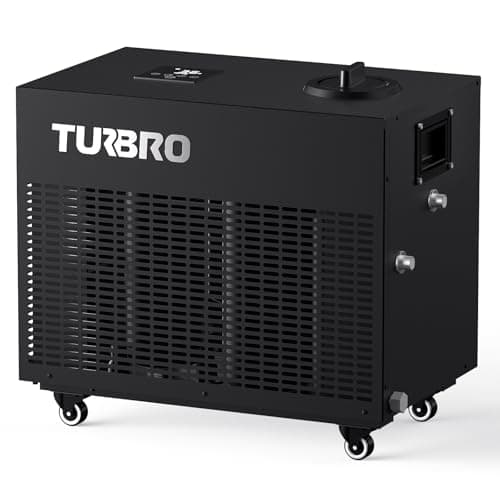 TURBRO FrostCore F85, 1 HP Cold Plunge Chiller The only chiller here that publishes a rated power, a BTU figure, a supply voltage, a temperature range and a cooling time - and it names its filtration in microns. | 1030 W | Most complete spec sheet | 5.9 | $1,399.00 - Amazon |
| 2 | 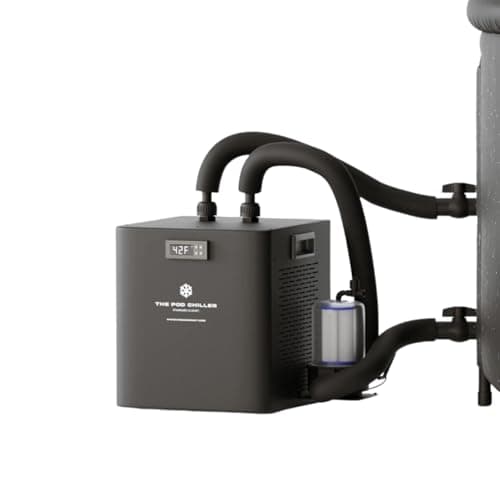 The Pod Company Standard Water Chiller, 1/3 HP 280 watts, a published 41 F floor and a 20-micron filter. It is less than half the draw of every other chiller here, and the listing volunteers the comparison. | 280 W | Cheapest to run | 7.2 | $569.00 - Amazon |
| 3 | 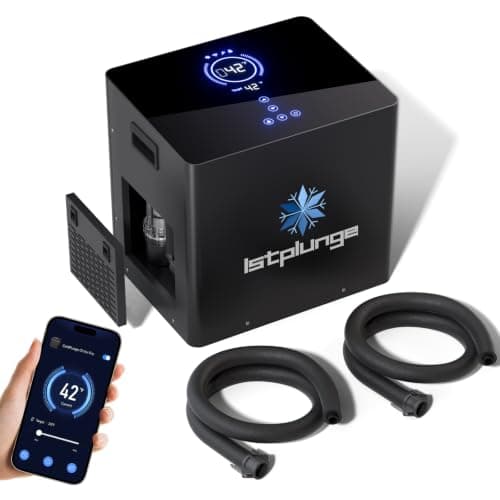 1stplunge 1/3 HP WiFi Cold Plunge Chiller A 42 F floor, a built-in pump and a rinsable metal filter, with app control and a top-mounted touchscreen - but no published wattage and no published gallon rating. | Not published | App and schedule control | 3.8 | $429.00 - Amazon |
Why this unit gets a page to itself
We have not used it. There is no lab behind this page, no power meter and no owned unit - the method page sets out exactly what we do instead. What follows is a reading of a specification that is unusually complete for this category, and an honest account of where even that specification runs out.
What the listing publishes
Six of our eight cold-gear checklist items are published here. For context, the least documented chiller on this site publishes two, and three chillers publish no wattage at all - which means no honest running cost can be computed for them.
Horsepower versus BTU, and why this matters
Nearly every chiller in this category is sold on horsepower. Horsepower rates the compressor motor. It does not rate the cooling, and the relationship between the two varies with the refrigerant, the heat exchanger and the design - two units both badged 1 HP can move materially different amounts of heat.
BTU per hour is the heat actually removed. It is the number that tells you whether a unit can out-pace the heat leaking into your tub from a warm room, and it is the number that makes sizing arithmetic rather than convention. That is the whole reason our sizing page has to tell you to match the published gallon rating instead: for eight of nine units, the better figure does not exist.
What it costs to run
This is where a published wattage earns its keep. At 1,030 W and the current US residential average of 18.34 cents per kWh:
Worth noting against its own category: at 1,030 W this full-horsepower unit draws less than both of the 1,200 W half-horsepower units on this site. That is either better efficiency or a difference in how the figures were derived, and we cannot tell you which - but it is a real, published comparison you can make, and it exists only because all three sellers printed a number. The full cost table is here.
The filtration, named properly
Three stages, published by micron rating rather than described: a 40-micron screen for hair and visible debris, a 20-micron cartridge for fine sediment, and an ozone generator for biological load. Ozone is a genuine sanitation method rather than a marketing word, and it is what stretches the interval between full water changes.
The catch is that the 20-micron stage is a cartridge, and cartridges are a recurring purchase. Two chillers on this site use a rinsable metal mesh instead, which costs nothing ongoing and takes thirty seconds under a tap. Over three years that difference is larger than the difference in power draw between two similar units, and it is invisible in every comparison because it is not electricity - covered properly here.
The honest downsides
- It is the biggest unit here. At 21 by 24 inches it claims about 3.1 square feet, against roughly 1.2 for the compact 1/3 HP units. Beside a tub in a garage that is nothing. In a small bathroom it is the thing you trip over.
- Cartridge filtration is a subscription. Better filtering, ongoing cost.
- 1,030 W is near the top of the category. If your tub is 79 gallons and you plunge at 50 F, a 280 W unit does the job at roughly a quarter of the running cost. Capacity you do not use is capacity you pay for hourly.
- No published noise figure. Not one chiller on this site publishes decibels any more - the one listing that did is gone - and this is no exception. For an indoor installation that absence matters - as the indoor page sets out.
- No published weight. On a unit this size, with casters mentioned but no mass, that is a gap for anyone planning where it lives.
Who should buy it, and who should not
Buy it if your tub is in the 100 to 132 gallon range, it lives somewhere warm or unconditioned, and you want to size by a real cooling figure rather than by a horsepower badge. The 36 to 86 F range also makes it the obvious pick if you want one vessel that is cold in July and warm in February.
Do not buy it if your tub is a bathtub or a small 79-gallon pod, or if you plunge at 50 F rather than chasing sub-40 water. You would be paying for headroom hourly and giving up three times the floor space to do it. The two alternatives below are the honest comparison: the 280 W unit is the cheapest to run on this site by a wide margin, and the 600 W unit is the compact middle.
If the tub lives outdoors in a hot climate, the sizing logic changes and the headroom starts earning its keep - that case is worked through here. And for the brand-direct comparison at roughly $960 more, the Orca 1 HP chiller publishes a decibel figure and a named compressor but no rated wattage and no gallon rating at all.
Every pick, in full
Each write-up below shows the score broken into its six components, the specs the listing actually publishes, and the running-cost arithmetic where a wattage exists to compute it from.
#1 - Most complete spec sheet
TURBRO FrostCore F85, 1 HP Cold Plunge Chiller
The only chiller here that publishes a rated power, a BTU figure, a supply voltage, a temperature range and a cooling time - and it names its filtration in microns.
| Small-space fit | 12 / 20 |
|---|---|
| Electrical fit | 15 / 20 |
| Cost to run | 8 / 20 |
| Key-number disclosure | 15 / 15 |
| Spec completeness | 9 / 15 |
| Warranty | 0 / 10 |
| Total | 59 / 100 |
| Rated watts | 1030 Seller’s listing, read 2026-09-07 |
|---|---|
| Water capacity | 132 Seller’s listing, read 2026-09-07 |
| Dimensions | 21 x 24 in Seller’s listing, read 2026-09-07 |
| Weight | Not published Not published |
| Cooling floor | 36-86 F, 110 F to 36 F in about 5-6 hours Seller’s listing, read 2026-09-07 |
| Material | Not published Not published |
| Warranty (months) | Not published Not published |
| Rated draw | 1030 W |
|---|---|
| Cost per hour at full draw | 18.9 cents |
| Upper bound, running continuously | $137.82 per month |
A chiller cycles. It draws its rated power while the compressor runs and almost nothing while it does not, and how often it runs depends on ambient temperature, insulation, lid use and setpoint. We do not measure duty cycle, so we publish the two figures that need no assumption and no figure in between. Computed at 18.34 cents per kWh (June 2026). The method.
This is what a complete chiller spec sheet looks like: 1,030 W rated power, 9,553 BTU/h maximum cooling capacity, AC 110 to 120 V at 60 Hz, a 36 to 86 F range, and a stated cooling time with the starting temperature named. Every one of those is checkable, and together they let you predict what the unit will do in your room rather than hope.
The BTU figure is the one nobody else publishes and the one that actually lets you size a chiller properly. Horsepower is a compressor rating, not a cooling rating, and the relationship between the two varies by design. BTU per hour is the heat actually removed, which is the number that matters when you are deciding whether it can hold 132 gallons at 40 F in a warm garage.
At 1,030 W it is nineteen cents an hour at full draw - lower than both 1,200 W half-horse units here despite being a full horsepower, which is either better efficiency or a difference in how the figures were derived. The three-stage filtration is named by micron rating rather than described, and the ozone generator is a real sanitation method rather than a marketing word.
Buy it if
Someone who wants to size a chiller by arithmetic instead of by horsepower.
Skip it if
You want the smallest footprint. At 21 by 24 inches this is the largest unit here.
#2 - Cheapest to run
The Pod Company Standard Water Chiller, 1/3 HP
280 watts, a published 41 F floor and a 20-micron filter. It is less than half the draw of every other chiller here, and the listing volunteers the comparison.
| Small-space fit | 12 / 20 |
|---|---|
| Electrical fit | 20 / 20 |
| Cost to run | 20 / 20 |
| Key-number disclosure | 12 / 15 |
| Spec completeness | 8 / 15 |
| Warranty | 0 / 10 |
| Total | 72 / 100 |
| Rated watts | 280 Seller’s listing, read 2026-09-07 |
|---|---|
| Water capacity | Not published Not published |
| Dimensions | 13 x 13 x 21 in Seller’s listing, read 2026-09-07 |
| Weight | 40 lb Seller’s listing, read 2026-09-07 |
| Cooling floor | 41 Fno cooling rate published Seller’s listing, read 2026-09-07 |
| Material | Not published Not published |
| Warranty (months) | Not published Not published |
| Rated draw | 280 W |
|---|---|
| Cost per hour at full draw | 5.1 cents |
| Upper bound, running continuously | $37.47 per month |
A chiller cycles. It draws its rated power while the compressor runs and almost nothing while it does not, and how often it runs depends on ambient temperature, insulation, lid use and setpoint. We do not measure duty cycle, so we publish the two figures that need no assumption and no figure in between. Computed at 18.34 cents per kWh (June 2026). The method.
Two hundred and eighty watts is the number that decides this category. At the current US residential average it costs about five cents an hour at full draw, and even running continuously for a month - which no chiller does - the absolute ceiling is around thirty-eight dollars. The 1,200 W units in this roundup are four times that.
The listing's own comparison is a good one: about the same as a home freezer. That is a useful mental model, because a chiller works the same way and cycles the same way. It draws its rated power while the compressor is running and almost nothing while it is not, and how often it runs depends on your lid discipline, your room temperature and how well your tub is insulated.
The published floor is 41 F, which is warmer than the 37 to 39 F claimed by the bigger units. For most people that is irrelevant - the commonly recommended starting band is 50 to 59 F and experienced plungers usually settle around 45 to 50 F - but if you specifically want to get below 40, this will not do it.
Buy it if
Anyone whose plunge is a daily habit rather than an occasional event, where running cost compounds.
Skip it if
You want water below 41 F. This unit does not claim to go there.
#3 - App and schedule control
1stplunge 1/3 HP WiFi Cold Plunge Chiller
A 42 F floor, a built-in pump and a rinsable metal filter, with app control and a top-mounted touchscreen - but no published wattage and no published gallon rating.
| Small-space fit | 12 / 20 |
|---|---|
| Electrical fit | 0 / 20 |
| Cost to run | 0 / 20 |
| Key-number disclosure | 12 / 15 |
| Spec completeness | 8 / 15 |
| Warranty | 6 / 10 |
| Total | 38 / 100 |
| Rated watts | Not published Not published |
|---|---|
| Water capacity | Not published Not published |
| Dimensions | 11.4 x 14.9 x 14.2 in Seller’s listing, read 2026-09-13 |
| Weight | 50 lb Seller’s listing, read 2026-09-13 |
| Cooling floor | 42 Fno cooling rate published Seller’s listing, read 2026-09-13 |
| Material | Not published Not published |
| Warranty (months) | 12 Seller’s listing, read 2026-09-13 |
No running cost can be computed. The listing does not publish a rated wattage, so there is no honest way to tell you what a session costs. We will not estimate one. How we compute running costs
Four of eight checklist items, and the two missing ones are the two that cost the most: there is no rated wattage and no gallon rating on this listing. Both computed cost components therefore score zero, and the total reflects that rather than working around it.
The unit this replaced published 600 W and a 79-gallon rating. We have not carried either figure across. A 1/3 HP compressor is not an unknown quantity - the two other 1/3 HP chillers here that do publish a draw sit at 280 W and 600 W - but attributing one manufacturer's number to another manufacturer's product is how a spec sheet becomes fiction, so the cells stay empty.
What it adds over the unit it replaced is control rather than cooling: 2.4 GHz WiFi with app scheduling and a top-mounted HD touchscreen, so the setpoint and the run schedule are reachable without crouching behind the unit. The filtration argument is unchanged and still a good one - a built-in pump and a reusable metal mesh element you rinse and refit, with no cartridges to buy.
Buy it if
Someone who wants the chiller on a schedule from a phone and accepts buying without a published draw.
Skip it if
You need to size by gallons or budget by watts. This listing publishes neither.
Questions people actually ask
Is the TURBRO FrostCore F85 worth it?
If you have a tub near its 132-gallon rating and you want to size by arithmetic rather than by guesswork, it is the only unit on this site that gives you the numbers to do that. If your tub is 79 gallons and you plunge at 50 F, you are buying capacity and disclosure you will not use, and a 280 W unit will cost a fraction as much to run.
How much does the TURBRO FrostCore F85 cost to run?
At its published 1,030 W rated power and the current US residential average of 18.34 cents per kWh, it costs about 18.9 cents an hour at full draw. Running six hours a day that is roughly $34.47 a month; the absolute continuous-running upper bound is $137.89. Real consumption depends on duty cycle, which we do not measure.
What does 9,300 BTU mean on a cold plunge chiller?
BTU per hour is the amount of heat the unit actually removes, which is the figure that decides whether it can out-pace heat leaking into your tub. Horsepower describes the compressor motor instead, and the relationship between the two varies by design. This listing publishes 9,553 BTU/h maximum cooling capacity - the only BTU figure on this site.
Does the TURBRO FrostCore F85 heat as well as cool?
Its published range is 36 to 86 F, which spans well above room temperature, so it is specified to hold water warm as well as cold. That makes it a year-round vessel controller rather than a summer-only one, which matters if you can only justify a single setup.
What are the downsides of the TURBRO FrostCore F85?
It is the largest unit in our roundup at 21 by 24 inches, roughly 3.1 square feet of floor, which is two to three times the footprint of the compact 1/3 HP units. It uses replaceable 20-micron cartridges rather than a rinsable metal screen, so filtration is a recurring cost. And at 1,030 W it is near the top of the category for draw - only the two 1,200 W units are higher.