Portable Saunas
The best portable sauna for tall people
Every seller publishes an external height and not one publishes who fits inside it. At the top of this category 73 inches is the ceiling, which is six foot one before you subtract the frame.
By Scooter M. · Published · Last updated
How we are paid: the buy links on this page are affiliate links. If you buy through one, we earn a commission from the retailer at no extra cost to you. It does not change what we rank or what we tell you to skip - the full FTC disclosure is here.
| # | Product | Rated watts | Best for | Score | Price |
|---|---|---|---|---|---|
| 1 | 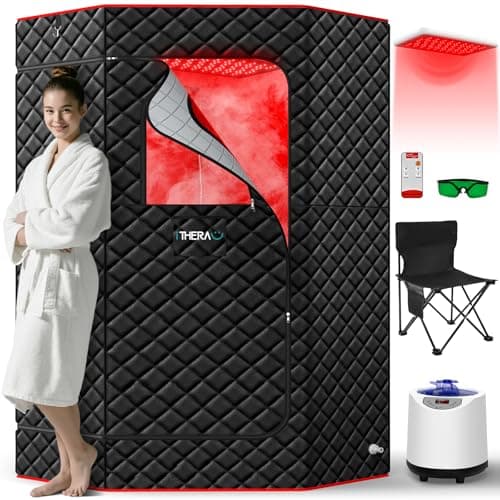 I-THERA-U XL Infrared Sauna Box with Red Light Lamp A pentagonal 45 x 35 in box with a 1,200 W steamer, a 324-LED red-light panel and a 90-minute timer, in 450D oxford rather than the usual thin polyester. | 1200 W | Most interior room | 6.1 | $159.99 - Amazon |
| 2 | 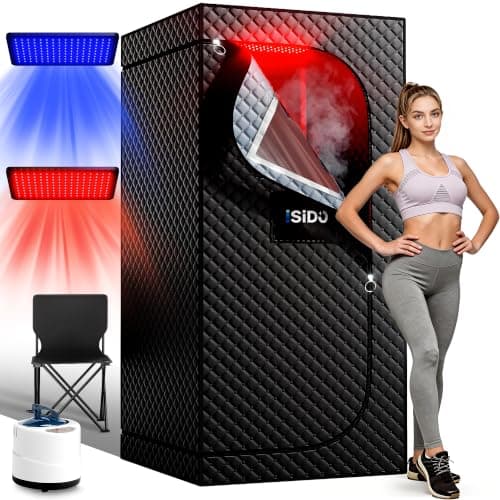 ISIDO Infrared Steam Sauna with Red and Blue Light Therapy A 1,300 W steam tent with a genuine 660 nm and 850 nm panel rather than a colored LED strip, and it publishes the wavelengths. | 1300 W | Best red-light combination | 6.1 | $179.99 - Amazon |
| 3 | 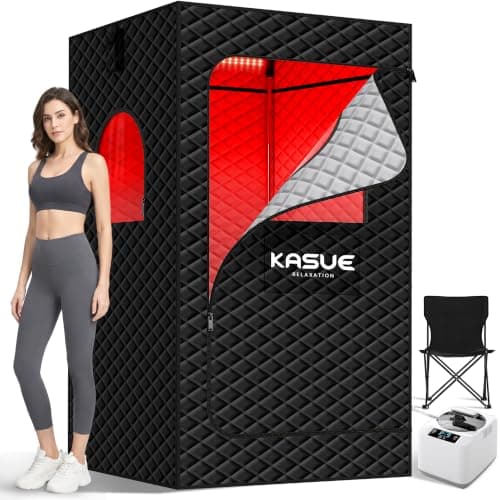 KASUE Infrared Sauna Tent with 3 L Steamer Five-layer insulated fabric, a 99-minute timer and a 30 x 30 in footprint - but no published wattage, which is the number you would want most. | Not published | Longest timer | 2.5 | $159.99 - Amazon |
| 4 | 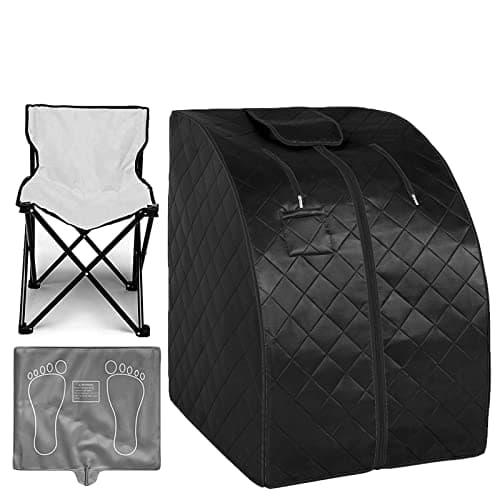 ZONEMEL Portable Infrared Sauna, 1 Person 1,050 W across three carbon panels plus a heated foot pad, with the wattage, the temperature ceiling and the timer all published - unusual for an infrared tent. | 1050 W | Best infrared for a standard outlet | 6.4 | $179.99 - Amazon |
The figure nobody publishes
That gap is worth holding onto, because it is not inevitable. Over in the blanket category one seller states that its blanket fits users up to about 6 ft 4 in - a single sentence that answers the question directly. Portable sauna sellers publish wattages, temperatures, timers, layer counts and heat-up times, and then leave the one dimension a tall buyer came for blank.
We have not used any of these and we have not sat in them, so we cannot close that gap for you - the method page sets out what we do instead. What follows is every published height, ranked, and an honest account of what each one leaves you.
Every published height, tallest first
The category splits cleanly in two, with one unit stranded in the middle. There is a standing-height group between 70 and 73 in, a seated-box group between 37.8 and 48.8 in, and the 57.9 in unit that is too short for the first job and taller than the second needs.
The arithmetic that changes the recommendation
73 in is 6 ft 1 in. That is the tallest figure published by anything in this category, and it is an external dimension - measured across the outside of a frame, on a unit that sits on the floor.
Subtract what has to come out of it. A fabric tent has a frame with a top rail. Most have a tapered or domed roof, so the full height exists only at the center line. Several ship a heated foot pad or a floor mat that lifts you an inch or so off the ground. None of those figures is published either, but together they mean a 73 in external unit does not give a six-foot person six feet of clear interior - it gives them noticeably less.
Which leads somewhere counter-intuitive. You sit down in a portable sauna. That is how all of them are designed to be used, tall or short. So for a larger frame the figures that actually bind are shoulder width and interior length, not height - and those track the footprint, not the height column.
Why footprint matters more than height
Compare the top and bottom of that table on floor area rather than height. The 73 in iTHERA is 45 by 35 in, about 10.9 sq ft. The 37.8 in ZONEMEL is 27.6 by 31.5 in, about 6.0 sq ft. The taller unit is not just taller - it is 81 percent larger in floor area, which is where shoulders and knees actually live.
Now compare two units that are close in height. The 71 in ISIDO is 7.1 sq ft and the 71 in Manastin is 12.5 sq ft - a difference of 76 percent at identical published height. Height alone would tell you those two are equivalent for a tall user. Footprint says one has half again as much room as the other.
This is why the pick below is the unit with both the joint-tallest height and the largest single-person footprint, rather than simply the tallest thing in the category. The rigid cabin matches it on height and is 0.9 sq ft smaller, at 231 lb and needing a dedicated 20 A circuit - reviewed in full here - so height parity is not the whole comparison.
The pick, and what is wrong with it
The iTHERA U-XL publishes 45 by 35 by 73 in, 20.1 lb, a 450D oxford shell over thick insulation, a 90-minute timer with 15 heat levels, and 1,200 W. Five of eight checklist items. On our rubric it scores 6.1, and at 1,200 W it stays under the 1,440 W continuous limit for a standard 15 A branch circuit, so it wants a sole-use outlet rather than new wiring.
Its real gap is that it publishes no maximum temperature. For a sauna that is a genuine omission - the ceiling is the specification that says what the thing is for - and a tall buyer who also wants a published ceiling has to trade down on room to get one. Our value ranking works through what that trade costs over three years.
The other honest caveat is the one this whole page is about: 45 by 35 by 73 in is the outside of a tent. iTHERA does not publish an interior width, an interior height, a seat height or a user limit, and neither does anyone else here. We are recommending the largest published box in the category, not a verified fit.
If you want a published temperature as well
Two of the standing-height units publish a ceiling. The ISIDO states 130 F at 71 in and 7.1 sq ft, though it is a steam unit with a light panel rather than an infrared cabin - worth knowing before you buy it as infrared, and the two are not comparable on temperature anyway. The KASUE tent is 70 in at 6.3 sq ft with the longest timer in the category at 99 minutes, but publishes no wattage, which means no running cost and no circuit check - it scores 2.5 for that reason.
So the tall buyer's menu is genuinely constrained: the most room but no published ceiling, a published ceiling in a smaller steam unit, or a mid-size tent whose electrical load is unknown. There is no unit here that publishes height, footprint, wattage and a temperature ceiling all at once.
The case for buying a short one on purpose
If you are over six foot and the standing-height units feel like a compromise, consider that the seated boxes are not actually competing on the same axis. In a 37.8 in box your head and shoulders sit above the opening with a collar around your neck - the height of the shell is irrelevant to your height, because you are not inside it above the shoulders.
What you give up is floor area, and at 6.0 sq ft that is the real constraint rather than the 37.8 in figure. What you gain is the smallest deployed footprint in the category, a published 1,050 W draw, the joint-highest rubric score at 6.4, and a unit light enough to put away every day. For a tall person in a small apartment that can be a better answer than eleven square feet of tent that never gets folded up.
The unit to avoid on this logic is the 57.9 in one. It is too short to sit upright inside with your head clear, and too tall to work as a collar-style seated box, and it publishes no wattage either.
Two sellers will not even publish a deployed height
Two units are missing from the table above, and the reason is worth recording rather than hiding in a caption.
One publishes only a packed size - 28.6 by 12.3 by 8.4 in, the dimensions of the box in a cupboard - and no deployed dimensions whatsoever. You cannot know how tall it stands, how much floor it takes, or whether you fit, because the only measurements offered describe it folded up. The other publishes 71 by 35 in, which is a length and a width for a unit you are partly lying in, with no third figure at all.
For most buyers those omissions are an annoyance. For a tall buyer they are disqualifying, because the single dimension that decides the purchase does not exist on the page. We score both units on what they do publish and neither does badly overall - but no rubric score can tell you whether you fit inside something whose height is unpublished.
Our own scores cannot answer this question
A methodological admission, since this page exists because of it. Our 100-point rubric scores small-space fit, electrical fit, cost to run, key-number disclosure, specification completeness and warranty. It does not score whether you fit, and it cannot, because not one seller publishes the figure it would need.
That has a practical consequence for how you read the rest of this site. The 6.4-scoring seated box and the 6.1-scoring standing tent are close on our rubric, and for a six-foot-three buyer they are not close at all as products. Where a rubric is built on published data and the data does not exist, the rubric goes quiet - and a page like this one, doing arithmetic on external dimensions and saying so, is the honest substitute rather than a better score.
The figure behind the figure: where the heat actually is
One more gap that bears on height specifically. An infrared unit heats what its panels face. A taller user sitting in the same shell has their torso higher relative to those panels than a shorter user does, so panel placement matters as much as shell height.
Not one listing in this category publishes panel positions, panel heights or how many panels there are at what level. One unit publishes that it includes a heated foot pad, which is the closest anyone comes to describing where the heat is aimed, and it is a seated box. So a tall buyer cannot tell from any published figure whether a given unit heats their shoulders or their shins.
We are not going to turn that into a recommendation, because we would be inventing the engineering to do it. It belongs here as the second unpublished figure that decides this purchase, after user height - and as a reason to treat the whole category's silence on fit as a pattern rather than an oversight.
Buy from a seller who publishes a return window
Since fit cannot be confirmed from any published figure, the return policy is doing the work a specification normally would. That argues for buying the standing-height units through a marketplace with a standard return window rather than direct from a brand whose terms you have to go and find - and for unpacking and sitting in the thing the day it arrives, while returning it is still straightforward. It is a poor substitute for a published interior height. It is the only substitute available.
What we cannot tell you
We have not sat in any of these, and no seller publishes the figures that would let us tell you whether you fit: interior height, interior width, seat height, user height limit or user weight limit. Thirteen listings, none of those five figures anywhere. Everything on this page is inferred from external dimensions, and inference is not a fit guarantee.
If you are near the limits, the practical move is the one no buying guide can do for you: mark 45 by 35 in on your floor, sit a kitchen chair in the middle of it, and see whether your shoulders and knees are inside the square. That tells you more than any figure in the table above, because the figure you need has not been published.
The same question in the other two categories is answered better. Sauna blankets for taller users covers the one seller publishing an interior circumference, which is the figure that decides fit across the shoulders, and cold plunge tubs for tall people covers the single seller publishing both a height and a weight limit.
Every pick, in full
Each write-up below shows the score broken into its six components, the specs the listing actually publishes, and the running-cost arithmetic where a wattage exists to compute it from.
#1 - Most interior room
I-THERA-U XL Infrared Sauna Box with Red Light Lamp
A pentagonal 45 x 35 in box with a 1,200 W steamer, a 324-LED red-light panel and a 90-minute timer, in 450D oxford rather than the usual thin polyester.
| Small-space fit | 17 / 20 |
|---|---|
| Electrical fit | 15 / 20 |
| Cost to run | 20 / 20 |
| Key-number disclosure | 0 / 15 |
| Spec completeness | 9 / 15 |
| Warranty | 0 / 10 |
| Total | 61 / 100 |
| Rated watts | 1200 Seller’s product title, read 2026-09-07 |
|---|---|
| Maximum temperature | Not published Not published |
| Dimensions | 45 x 35 x 73 in Seller’s listing, read 2026-09-07 |
| Weight | 20.1 lb Seller’s listing, read 2026-09-07 |
| Timer | 90-minute timer, 15 heat levels Seller’s product title, read 2026-09-07 |
| EMF disclosure | Not mentioned at all |
| Material | 450D oxford fabric on thickened stainless steel piping Seller’s listing, read 2026-09-07 |
| Warranty (months) | Not published Not published |
| Rated draw | 1200 W (10 A at 120 V) |
|---|---|
| Energy per 30-minute session | 0.600 kWh |
| Maximum cost per session | 11.0 cents |
| Maximum per month, 4 sessions a week | $1.91 |
| Circuit | Wants the outlet to itself |
These are maximums, assuming continuous draw. A resistive heater pulls its rated power only while the element is energized; once it reaches setpoint it cycles, so the real figure is lower and depends on your room. Computed at 18.34 cents per kWh (June 2026). The method, and how to substitute your own rate.
The fabric weight is published, which is unusual and useful. 450D oxford is a real specification - denier is a measure of yarn thickness - and it is the difference between a tent that holds its shape through a year of humid sessions and one that softens and sags. Most listings in this category say 'durable material' and stop.
The red-light panel is specified as 108 LEDs at 660 nm and 216 at 850 nm. Again, actual wavelengths and actual counts, which is more than the seven-color strips get you.
At 45 by 35 inches this has the largest deployed footprint of any tent here - about eleven square feet, roughly a small armchair plus its clearance - and that is the cost of the extra interior room. In a studio apartment that is a real amount of floor to give up while it is standing, though it does fold away.
Buy it if
Anyone who has felt cramped in a standard sauna tent and has the floor space to fix it.
Skip it if
Floor space is your binding constraint. There are six-square-foot options here.
#2 - Best red-light combination
ISIDO Infrared Steam Sauna with Red and Blue Light Therapy
A 1,300 W steam tent with a genuine 660 nm and 850 nm panel rather than a colored LED strip, and it publishes the wavelengths.
| Small-space fit | 17 / 20 |
|---|---|
| Electrical fit | 15 / 20 |
| Cost to run | 20 / 20 |
| Key-number disclosure | 0 / 15 |
| Spec completeness | 9 / 15 |
| Warranty | 0 / 10 |
| Total | 61 / 100 |
| Rated watts | 1300 Seller’s listing, read 2026-09-07 |
|---|---|
| Maximum temperature | 130 F maximum Seller’s listing, read 2026-09-07 |
| Dimensions | 32 x 32 x 71 in Seller’s product title, read 2026-09-07 |
| Weight | 19.4 lb Seller’s listing, read 2026-09-07 |
| Timer | 9 temperature settings, 6-10 minute heat-up Seller’s listing, read 2026-09-07 |
| EMF disclosure | Not mentioned at all |
| Material | Triple-layer waterproofed cotton Seller’s listing, read 2026-09-07 |
| Warranty (months) | Not published Not published |
| Rated draw | 1300 W (10.8 A at 120 V) |
|---|---|
| Energy per 30-minute session | 0.650 kWh |
| Maximum cost per session | 11.9 cents |
| Maximum per month, 4 sessions a week | $2.06 |
| Circuit | Wants the outlet to itself |
These are maximums, assuming continuous draw. A resistive heater pulls its rated power only while the element is energized; once it reaches setpoint it cycles, so the real figure is lower and depends on your room. Computed at 18.34 cents per kWh (June 2026). The method, and how to substitute your own rate.
Most sauna tents advertising light therapy ship a seven-color LED strip, which is mood lighting. This one publishes actual wavelengths - 660 nm visible red and 850 nm near-infrared - which are the two figures the red-light literature is written around. Publishing the wavelength is the minimum bar for the claim to mean anything, and it is a bar most of this category does not clear.
The steamer is 1,300 W, which is 10.8 amps. That is over the 1,000 W line where we start telling people to give the sauna its own outlet, and comfortably under the 1,440 W continuous limit of a 15 A circuit. Thirty minutes costs about twelve cents at the national average rate.
The listing also notes the steamer has passed IEC 60335 and UL 499 testing, which are the relevant appliance safety standards for household heating equipment. That is a checkable claim about a named standard rather than a generic assurance, and it is rare enough in this category to be worth mentioning.
Buy it if
Someone who wants heat and red light in one purchase and wants the wavelengths published.
Skip it if
You want dry heat. This is a steam unit with a light panel, not an infrared cabin.
#3 - Longest timer
KASUE Infrared Sauna Tent with 3 L Steamer
Five-layer insulated fabric, a 99-minute timer and a 30 x 30 in footprint - but no published wattage, which is the number you would want most.
| Small-space fit | 17 / 20 |
|---|---|
| Electrical fit | 0 / 20 |
| Cost to run | 0 / 20 |
| Key-number disclosure | 0 / 15 |
| Spec completeness | 8 / 15 |
| Warranty | 0 / 10 |
| Total | 25 / 100 |
| Rated watts | Not published Not published |
|---|---|
| Maximum temperature | Not published Not published |
| Dimensions | 30 x 30 x 70 in Seller’s listing, read 2026-09-07 |
| Weight | 15 lb Seller’s listing, read 2026-09-07 |
| Timer | 99-minute timer, 9 temperature levels Seller’s listing, read 2026-09-07 |
| EMF disclosure | Not mentioned at all |
| Material | Five-layer waterproof insulated fabric Seller’s listing, read 2026-09-07 |
| Warranty (months) | Not published Not published |
No running cost can be computed. The listing does not publish a rated wattage, so there is no honest way to tell you what a session costs. We will not estimate one. How we compute running costs
Five-layer insulated fabric is a genuine construction difference in a category where three layers is standard, and insulation is what decides whether a tent holds temperature in a cold room or bleeds it out through the walls. In a garage in winter that is the spec that determines whether the sauna works at all.
The 30 by 30 inch footprint is among the smallest here, at about six and a third square feet, and fifteen pounds is light enough to move one-handed.
The wattage is not published, and neither is a maximum temperature, so two of the eight checklist items and both of the computed cost components have nothing to work on. That is what holds the score down rather than anything visible about the product.
Buy it if
Someone in a cold room who needs the insulation more than they need the spec sheet.
Skip it if
You want a running cost. Without a wattage nobody can compute one.
#4 - Best infrared for a standard outlet
ZONEMEL Portable Infrared Sauna, 1 Person
1,050 W across three carbon panels plus a heated foot pad, with the wattage, the temperature ceiling and the timer all published - unusual for an infrared tent.
| Small-space fit | 20 / 20 |
|---|---|
| Electrical fit | 15 / 20 |
| Cost to run | 20 / 20 |
| Key-number disclosure | 0 / 15 |
| Spec completeness | 9 / 15 |
| Warranty | 0 / 10 |
| Total | 64 / 100 |
| Rated watts | 1050 Seller’s listing, read 2026-09-07 |
|---|---|
| Maximum temperature | 140 F maximum Seller’s listing, read 2026-09-07 |
| Dimensions | 27.6 x 31.5 x 37.8 in Seller’s product title, read 2026-09-07 |
| Weight | 19.8 lb Seller’s listing, read 2026-09-07 |
| Timer | Up to 60 minutes Seller’s listing, read 2026-09-07 |
| EMF disclosure | Not mentioned at all |
| Material | Not published Not published |
| Warranty (months) | Not published Not published |
| Rated draw | 1050 W (8.8 A at 120 V) |
|---|---|
| Energy per 30-minute session | 0.525 kWh |
| Maximum cost per session | 9.6 cents |
| Maximum per month, 4 sessions a week | $1.67 |
| Circuit | Wants the outlet to itself |
These are maximums, assuming continuous draw. A resistive heater pulls its rated power only while the element is energized; once it reaches setpoint it cycles, so the real figure is lower and depends on your room. Computed at 18.34 cents per kWh (June 2026). The method, and how to substitute your own rate.
At 1,050 W this draws about 8.8 amps, which a standard 15 A outlet carries without complaint even with something else plugged in. It is the highest-powered infrared unit here that still sits comfortably under the 1,000 W line where we start recommending the outlet be left to itself, and a thirty-minute session works out to roughly ten cents at the national average rate.
The heated foot pad is the detail worth knowing about. Infrared tents heat what the panels face, and in a seated tent that means your back and sides get the heat while your feet sit on ambient floor. A separate foot element is the direct fix and not every unit in this price range includes one.
The footprint is the smallest of any sit-in sauna in this roundup: 27.6 by 31.5 inches deployed, about six square feet, which is roughly the area of a single armchair. That is what makes an infrared tent viable in a one-bedroom apartment at all.
Buy it if
Someone who wants dry infrared heat in the smallest deployed footprint that still fits an adult.
Skip it if
EMF disclosure matters to you. This listing does not mention it.
Questions people actually ask
What is the best portable sauna for a tall person?
The iTHERA U-XL. At 45 by 35 by 73 in it publishes both the joint-tallest external height in the category and the largest interior footprint, which is the combination that actually matters for a larger frame. It also publishes its 1,200 W draw, so you can work out the circuit and the running cost - which four units in this category do not let you do.
Do portable saunas publish a maximum user height?
No. Not one of the thirteen portable saunas on this site publishes a user height limit, a user weight limit or an interior seat height. Every one publishes external dimensions and nothing about who fits inside them. For comparison, one sauna blanket seller does state a user height of about 6 ft 4 in, so the figure is not impossible to publish - this category simply does not.
Can a six-foot person stand up in a portable sauna?
Not really, and it is worth being precise. The tallest units publish 73 in external, which is 6 ft 1 in. Subtract the frame, the roof taper and a floor pad and a six-foot user has essentially no headroom. Treat 70 to 73 in as enough to sit upright with your head clear, not enough to stand.
Is a seated sauna box better for a tall person?
Often yes, which is the opposite of what most buyers assume. You sit down in a portable sauna regardless, so the binding figures for a larger frame are shoulder width and interior length rather than height. A 37.8 in seated box with a 6.0 sq ft footprint can be a worse fit than a 73 in tent with a 10.9 sq ft footprint even though it sounds taller - what changes is how much room your shoulders and knees have.
Which portable saunas are too short for a tall person?
The seated boxes in the 37.8 to 48.8 in range are designed so your head sits above the opening, which works at any height but puts your shoulders inside a narrow shell. The genuinely awkward figure is the 57.9 in unit: too short to sit upright with your head inside and taller than a seated box needs to be. If you are over six foot, the 70 to 73 in group is where to look first.