Portable Saunas
The best infrared sauna for the money
Unlike blankets, this category publishes its wattages, so a three-year cost of ownership can actually be computed. It turns out electricity is a rounding error and the purchase decides everything.
By Scooter M. · Published · Last updated
How we are paid: the buy links on this page are affiliate links. If you buy through one, we earn a commission from the retailer at no extra cost to you. It does not change what we rank or what we tell you to skip - the full FTC disclosure is here.
| # | Product | Rated watts | Best for | Score | Price |
|---|---|---|---|---|---|
| 1 | 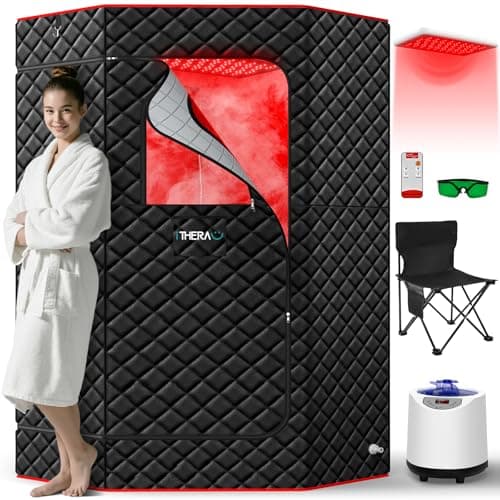 I-THERA-U XL Infrared Sauna Box with Red Light Lamp A pentagonal 45 x 35 in box with a 1,200 W steamer, a 324-LED red-light panel and a 90-minute timer, in 450D oxford rather than the usual thin polyester. | 1200 W | Most interior room | 6.1 | $159.99 - Amazon |
| 2 | 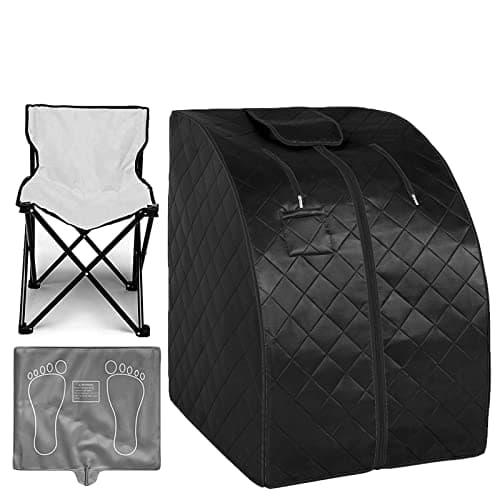 ZONEMEL Portable Infrared Sauna, 1 Person 1,050 W across three carbon panels plus a heated foot pad, with the wattage, the temperature ceiling and the timer all published - unusual for an infrared tent. | 1050 W | Best infrared for a standard outlet | 6.4 | $179.99 - Amazon |
| 3 | 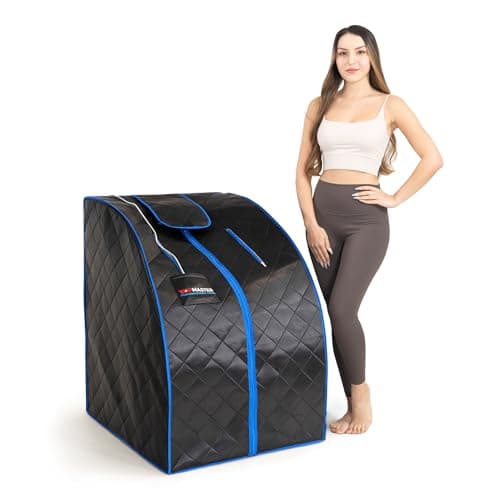 TopMaster Foldable Infrared Sauna Same 1,050 W and 140 F ceiling as the ZONEMEL infrared, with a heated foot pad, folding chair and cushion in the box. | 1050 W | Best kit for the money | 6.4 | $179.99 - Amazon |
| 4 | 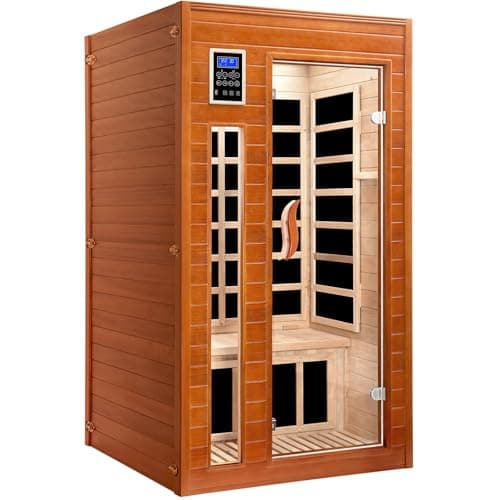 X-Vcak 1-2 Person Infrared Sauna Cabin A 231 lb hemlock cabin with 1,450 W across six panels, a 150 F ceiling and a 99-minute timer. It is a permanent installation in everything but name. | 1450 W | Best if you own the room | 4.2 | $1,599.99 - Amazon |
Why this category can be ranked on value and blankets cannot
That is worth stating up front because it is the opposite of the advice this kind of page usually gives. There is no efficiency play to be made in portable saunas. A 1,450 W cabin costs about eight dollars a year more to run than a 1,050 W tent - less than one restaurant coffee a month - so choosing on wattage to save money is optimizing the smallest term in the equation.
What wattage does decide is whether you can plug the thing in, which is a different question and a more expensive one. We come back to it below. The running-cost page has the cents-per-session arithmetic for all twelve units including the steam ones; this page uses those figures to rank the infrared subset on what it costs to own.
First, which of these are actually infrared
The word gets applied loosely in this category, and it changes what you are buying. A steam tent with a red light panel inside it is not an infrared sauna, and a unit that heats water to make vapor behaves nothing like one that radiates heat at your skin - the infrared versus steam comparison works through why their published temperatures are not comparable measurements.
So this page covers the genuine infrared units only. That excludes the steam tents, which are cheaper to buy and cheaper to run and which win a value comparison against infrared on price alone - if steam is acceptable to you, buy a steam tent and stop reading. It also excludes one unit sold as an infrared-and-red-light combination that is in fact a steam unit with a light panel.
Three-year cost of ownership, ranked
The cheapest unit to own scores higher on our rubric than the most expensive one, and it is not close. The X-Vcak cabin costs about ten times as much to buy, roughly seven times as much to own across three years, and scores 4.2 against 6.1.
The finding: the purchase gap is 63 times the running gap
Put the two spreads side by side, because this is the whole argument of the page:
About $1,440 against $22.89 is a ratio of roughly 60 to 1. Three years of electricity for the hungriest unit here comes to $82.97, which is under 6 percent of the purchase premium that unit carries. Put the comparison the other way round: the cabin uses about $7.63 a year more electricity than the cheapest unit to run, so it would take something like 190 years of that difference to equal what you paid extra at the till.
This is why we do not rank this category on efficiency, and why a seller advertising low power draw is not offering you a saving worth having. What the money buys or fails to buy is disclosure, build, size and whether you can plug it in.
Why the same method gives the opposite answer for chillers
We rank cold plunge chillers on exactly this basis - purchase price plus three years of computed electricity - and there the conclusion reverses completely. A 600 W chiller adds something like $723 of electricity over three years against about $229 for a 190 W one, and that gap outruns most of the price differences in the category. That page is here.
The reason is duty cycle, not wattage. A chiller holds a volume of water against a warm room around the clock, so it runs for a large fraction of every day. A sauna runs for thirty minutes while you are sitting in it and is switched off the rest of the time. Similar rated draws, entirely different annual hours - which is why the same arithmetic ranks one category on electricity and this one on purchase price.
It is worth saying plainly that this is the method working rather than a formula being applied. If we ran the numbers and reported that the cheapest sauna to buy also happened to be the best value because electricity mattered, we would be telling you something we had not checked. Sauna blankets make a third case again: no seller publishes a wattage at all, so the blanket value page cannot compute a running cost for anything and has to rank on disclosure instead.
The eleven-dollar question
The top two rows are separated by about $11 across three years - roughly $20 more to buy, $8.58 less to run. That is the entire decision between them, so it is worth knowing what the $11 gets you.
The iTHERA U-XL is about $160, draws 1,200 W, publishes five of eight checklist items, has a 90-minute timer with 15 heat levels, and at 45 by 35 by 73 in has the most interior room of anything in this category. What it does not publish is a maximum temperature. For a sauna that is a real gap: the ceiling is the specification that says what the unit is for, and without it you are trusting the category average.
The ZONEMEL 1-person unit is about $180, draws 1,050 W, publishes five of eight, and states 140 F maximum. It is smaller inside - 27.6 by 31.5 by 37.8 in, a seated box rather than a standing tent - and it scores 6.4 against 6.1, the highest infrared score here.
So: about $11 over three years buys a published temperature ceiling and 150 fewer watts on your circuit, and costs you a lot of interior room. If you are tall or you dislike sitting hunched, take the iTHERA and accept the missing figure. If you want the seller on record about how hot it gets, take the ZONEMEL. The TOPMASTER unit in the third row is the same 1,050 W and the same price from a different seller with a nearly identical spec sheet, which makes it a useful fallback when one of the two is out of stock rather than a distinct choice.
The premium tier, and the cost that is not in the price
The X-Vcak cabin, at about $1,600, is a hemlock box with tempered glass, 1,450 W, a published 66 to 150 F range and a 1 to 99 minute timer. It publishes five of eight items, the same count as the cheapest tent. It scores 4.2, and it is worth being precise about why a more substantial product scores lower.
Two reasons, both of them things you will live with. It weighs 231 lb, so it is portable only in the sense that it arrives flat - it does not get put away, and the floor it occupies is gone for good. And at 1,450 W it is above the 1,440 W that a standard 15 A US branch circuit is derated to for a continuous load, which means it wants a dedicated 20 A circuit.
By contrast the 1,200 W and 1,050 W units sit under that threshold, so they want a sole-use outlet rather than new wiring - nothing else heavy on the same circuit, which is a rule you follow rather than a bill you pay. Our electrical page works through the derating and what it means on a shared apartment circuit, and the full review of this cabin covers it in detail.
None of which makes the cabin a bad product. It is the only unit here you can stand up in with a glass door and a wooden interior, and if you own the room and want a fixture rather than something stored in a closet, that is a legitimate thing to buy. It is simply not the value pick, and the gap is about $1,450 over three years.
The one we cannot rank
A fifth infrared tent belongs in this comparison on price and does not appear in the table. It is the same price as our pick, publishes four of eight checklist items and has the longest timer in the category at 99 minutes. It does not publish a rated wattage.
Without that figure there is no cost of ownership to compute, so it cannot be placed on a value ranking at all - not penalized, just absent, because the arithmetic has nothing to work with. It scores 2.5 on our rubric, and a large part of that is the missing wattage, which our scoring treats as a zero rather than a guess. If a seller will not say what a heater draws, a value page is the wrong page to read about it.
The one thing no amount of money buys here
Infrared heat is the thing people ask us about EMF most often, and it is worth knowing before you decide how much to spend that not one of the thirteen portable saunas on this site publishes an EMF figure. Not the cabin at about $1,600, not the tent at about $160, not anything in between.
The infrared units are not even making an unsubstantiated claim - they are silent on the subject entirely, which is a different posture from the blanket category where several sellers assert “low EMF” without a number behind it. Silence is more honest than an empty claim, but it leaves a buyer with nothing.
So if a published EMF figure is a requirement for you, the honest answer is that this category cannot meet it at any price, and spending more does not move you closer. The EMF hub covers what these figures establish and which categories publish them at all - and the low-EMF portable sauna page deals specifically with what to do when the number you want does not exist.
Does the conclusion survive heavier use?
Four sessions a week is our standard assumption across the site, and a fair objection is that a daily user would see a different answer. So here is the same table at two sessions a week and at seven, for the widest and narrowest draws on the page.
A daily user for three years still sees a $40.06 spread against a $1,440 purchase spread - a ratio of 36 to 1 rather than 63 to 1. The conclusion does not just survive heavier use, it never comes close to being threatened by it. There is no realistic session frequency at which electricity decides this category.
Floor space, and the cost that never comes back
The scarce resource in a small home is not money in the abstract, it is floor. So the footprint figures belong in a value comparison, and they cut against our own pick.
The cabin occupies slightly less floor than our value pick while standing there - 10.00 sq ft against 10.94. The difference is that the tent's ten square feet are borrowed and the cabin's are spent. At 231 lb the cabin is a permanent change to a room; at 20.1 lb the tent is a thing you put in a closet between sessions.
If floor space is your binding constraint rather than money, the ZONEMEL at 6.04 sq ft is the real answer here and the $11.42 three-year premium over the iTHERA becomes easy - you are buying back nearly five square feet as well as a published temperature ceiling. Our small-space setup page works through fitting this alongside everything else in one room.
What we cannot tell you
We have not used any of these. We have not put a power meter on one, verified that any unit reaches its published ceiling, or run one for three years to see whether the heating panels or the zips outlast the warranty - which, for every unit on this page, is not published at all. Seven of the twelve saunas on this site publish no warranty term, and none of the four here do.
The three-year window is our assumption, not a durability claim. We chose it because it is long enough for electricity to matter if it were ever going to, and the point of the table is that it does not. If the cheapest tent lasts eighteen months and the cabin lasts fifteen years, the ranking inverts - and no seller here publishes anything that would let you judge that.
Decide in sixty seconds
Want the most sauna for the least total money? iTHERA U-XL, about $160, roughly $229 across three years, most interior room, no published temperature ceiling. Want the seller on record about temperature and a slightly lighter load on your circuit? ZONEMEL, about $180, roughly $240, smaller inside. Want a permanent fixture and own the room? The cabin at about $1,600, plus an electrician. And if infrared is not actually a requirement, the steam tents in our tent roundup start under $75 and run cheaper still.
Every pick, in full
Each write-up below shows the score broken into its six components, the specs the listing actually publishes, and the running-cost arithmetic where a wattage exists to compute it from.
#1 - Most interior room
I-THERA-U XL Infrared Sauna Box with Red Light Lamp
A pentagonal 45 x 35 in box with a 1,200 W steamer, a 324-LED red-light panel and a 90-minute timer, in 450D oxford rather than the usual thin polyester.
| Small-space fit | 17 / 20 |
|---|---|
| Electrical fit | 15 / 20 |
| Cost to run | 20 / 20 |
| Key-number disclosure | 0 / 15 |
| Spec completeness | 9 / 15 |
| Warranty | 0 / 10 |
| Total | 61 / 100 |
| Rated watts | 1200 Seller’s product title, read 2026-09-07 |
|---|---|
| Maximum temperature | Not published Not published |
| Dimensions | 45 x 35 x 73 in Seller’s listing, read 2026-09-07 |
| Weight | 20.1 lb Seller’s listing, read 2026-09-07 |
| Timer | 90-minute timer, 15 heat levels Seller’s product title, read 2026-09-07 |
| EMF disclosure | Not mentioned at all |
| Material | 450D oxford fabric on thickened stainless steel piping Seller’s listing, read 2026-09-07 |
| Warranty (months) | Not published Not published |
| Rated draw | 1200 W (10 A at 120 V) |
|---|---|
| Energy per 30-minute session | 0.600 kWh |
| Maximum cost per session | 11.0 cents |
| Maximum per month, 4 sessions a week | $1.91 |
| Circuit | Wants the outlet to itself |
These are maximums, assuming continuous draw. A resistive heater pulls its rated power only while the element is energized; once it reaches setpoint it cycles, so the real figure is lower and depends on your room. Computed at 18.34 cents per kWh (June 2026). The method, and how to substitute your own rate.
The fabric weight is published, which is unusual and useful. 450D oxford is a real specification - denier is a measure of yarn thickness - and it is the difference between a tent that holds its shape through a year of humid sessions and one that softens and sags. Most listings in this category say 'durable material' and stop.
The red-light panel is specified as 108 LEDs at 660 nm and 216 at 850 nm. Again, actual wavelengths and actual counts, which is more than the seven-color strips get you.
At 45 by 35 inches this has the largest deployed footprint of any tent here - about eleven square feet, roughly a small armchair plus its clearance - and that is the cost of the extra interior room. In a studio apartment that is a real amount of floor to give up while it is standing, though it does fold away.
Buy it if
Anyone who has felt cramped in a standard sauna tent and has the floor space to fix it.
Skip it if
Floor space is your binding constraint. There are six-square-foot options here.
#2 - Best infrared for a standard outlet
ZONEMEL Portable Infrared Sauna, 1 Person
1,050 W across three carbon panels plus a heated foot pad, with the wattage, the temperature ceiling and the timer all published - unusual for an infrared tent.
| Small-space fit | 20 / 20 |
|---|---|
| Electrical fit | 15 / 20 |
| Cost to run | 20 / 20 |
| Key-number disclosure | 0 / 15 |
| Spec completeness | 9 / 15 |
| Warranty | 0 / 10 |
| Total | 64 / 100 |
| Rated watts | 1050 Seller’s listing, read 2026-09-07 |
|---|---|
| Maximum temperature | 140 F maximum Seller’s listing, read 2026-09-07 |
| Dimensions | 27.6 x 31.5 x 37.8 in Seller’s product title, read 2026-09-07 |
| Weight | 19.8 lb Seller’s listing, read 2026-09-07 |
| Timer | Up to 60 minutes Seller’s listing, read 2026-09-07 |
| EMF disclosure | Not mentioned at all |
| Material | Not published Not published |
| Warranty (months) | Not published Not published |
| Rated draw | 1050 W (8.8 A at 120 V) |
|---|---|
| Energy per 30-minute session | 0.525 kWh |
| Maximum cost per session | 9.6 cents |
| Maximum per month, 4 sessions a week | $1.67 |
| Circuit | Wants the outlet to itself |
These are maximums, assuming continuous draw. A resistive heater pulls its rated power only while the element is energized; once it reaches setpoint it cycles, so the real figure is lower and depends on your room. Computed at 18.34 cents per kWh (June 2026). The method, and how to substitute your own rate.
At 1,050 W this draws about 8.8 amps, which a standard 15 A outlet carries without complaint even with something else plugged in. It is the highest-powered infrared unit here that still sits comfortably under the 1,000 W line where we start recommending the outlet be left to itself, and a thirty-minute session works out to roughly ten cents at the national average rate.
The heated foot pad is the detail worth knowing about. Infrared tents heat what the panels face, and in a seated tent that means your back and sides get the heat while your feet sit on ambient floor. A separate foot element is the direct fix and not every unit in this price range includes one.
The footprint is the smallest of any sit-in sauna in this roundup: 27.6 by 31.5 inches deployed, about six square feet, which is roughly the area of a single armchair. That is what makes an infrared tent viable in a one-bedroom apartment at all.
Buy it if
Someone who wants dry infrared heat in the smallest deployed footprint that still fits an adult.
Skip it if
EMF disclosure matters to you. This listing does not mention it.
#3 - Best kit for the money
TopMaster Foldable Infrared Sauna
Same 1,050 W and 140 F ceiling as the ZONEMEL infrared, with a heated foot pad, folding chair and cushion in the box.
| Small-space fit | 20 / 20 |
|---|---|
| Electrical fit | 15 / 20 |
| Cost to run | 20 / 20 |
| Key-number disclosure | 0 / 15 |
| Spec completeness | 9 / 15 |
| Warranty | 0 / 10 |
| Total | 64 / 100 |
| Rated watts | 1050 Seller’s listing, read 2026-09-07 |
|---|---|
| Maximum temperature | Up to 140 F Seller’s listing, read 2026-09-07 |
| Dimensions | 27.6 x 31.5 x 37.8 in Seller’s listing, read 2026-09-07 |
| Weight | 20 lb Seller’s listing, read 2026-09-07 |
| Timer | Up to 60 minutes Seller’s listing, read 2026-09-07 |
| EMF disclosure | Not mentioned at all |
| Material | Not published Not published |
| Warranty (months) | Not published Not published |
| Rated draw | 1050 W (8.8 A at 120 V) |
|---|---|
| Energy per 30-minute session | 0.525 kWh |
| Maximum cost per session | 9.6 cents |
| Maximum per month, 4 sessions a week | $1.67 |
| Circuit | Wants the outlet to itself |
These are maximums, assuming continuous draw. A resistive heater pulls its rated power only while the element is energized; once it reaches setpoint it cycles, so the real figure is lower and depends on your room. Computed at 18.34 cents per kWh (June 2026). The method, and how to substitute your own rate.
The published specification here is close to identical to the ZONEMEL infrared unit - same wattage, same ceiling, same dimensions, same timer - which happens often in this category because a lot of these tents come off the same production lines with different fabric and different names on the box.
We are not going to pretend we can tell you which one is better built, because that would require using both and we have used neither. What we can tell you is that the published specs are the same, so if the prices differ the cheaper one is the rational buy, and if the kit contents differ the more complete kit is.
This one includes the folding chair, heated foot pad and a sponge cushion. A cushion sounds like a throwaway inclusion until you have sat on a bare folding chair inside a hot tent for thirty minutes.
Buy it if
A buyer comparing near-identical infrared tents who wants the fuller accessory kit.
Skip it if
You would rather buy from a seller who says something about EMF.
#4 - Best if you own the room
X-Vcak 1-2 Person Infrared Sauna Cabin
A 231 lb hemlock cabin with 1,450 W across six panels, a 150 F ceiling and a 99-minute timer. It is a permanent installation in everything but name.
| Small-space fit | 9 / 20 |
|---|---|
| Electrical fit | 8 / 20 |
| Cost to run | 16 / 20 |
| Key-number disclosure | 0 / 15 |
| Spec completeness | 9 / 15 |
| Warranty | 0 / 10 |
| Total | 42 / 100 |
| Rated watts | 1450 Seller’s listing, read 2026-09-07 |
|---|---|
| Maximum temperature | 66-150 F Seller’s listing, read 2026-09-07 |
| Dimensions | 40 x 36 x 73 in Seller’s listing, read 2026-09-07 |
| Weight | 231 lb Seller’s listing, read 2026-09-07 |
| Timer | 1-99 minutes Seller’s listing, read 2026-09-07 |
| EMF disclosure | Not mentioned at all |
| Material | Wood cabin with tempered glass door Seller’s listing, read 2026-09-07 |
| Warranty (months) | Not published Not published |
| Rated draw | 1450 W (12.1 A at 120 V) |
|---|---|
| Energy per 30-minute session | 0.725 kWh |
| Maximum cost per session | 13.3 cents |
| Maximum per month, 4 sessions a week | $2.30 |
| Circuit | Wants a dedicated 20 A circuit |
These are maximums, assuming continuous draw. A resistive heater pulls its rated power only while the element is energized; once it reaches setpoint it cycles, so the real figure is lower and depends on your room. Computed at 18.34 cents per kWh (June 2026). The method, and how to substitute your own rate.
At 1,450 W this draws about 12.1 amps, which is right at the continuous-load limit of a standard 15 A circuit. The listing mentions a three-prong plug with leakage protection, so it is a 120 V appliance rather than a hardwired one, but it should have the circuit to itself and you should know what else is on that circuit before the first session.
The reason this is in a portable sauna roundup at all is that it ships flat and assembles without tools. That is where the portability ends. At 231 pounds assembled it is furniture, it does not fold, and it claims ten square feet of floor permanently. If you rent, this is the option that requires a conversation with a landlord and a plan for moving day.
What you get for that is the highest temperature ceiling here at 150 F, six heating panels rather than three, and an actual wooden cabin rather than fabric on a frame. Running it for thirty minutes costs about thirteen cents at the national average rate, which is the same order as the fabric tents - the cabin costs you space, not electricity.
Buy it if
Someone with a spare room, a spare circuit and no plan to move soon.
Skip it if
You rent, you share a circuit, or you need the room back after every session.
Questions people actually ask
What is the best infrared sauna for the money?
The iTHERA U-XL, at about $160. Over three years at four thirty-minute sessions a week it comes to roughly $229 all in, the lowest total here, and it has the most interior room in the category at 45 by 35 by 73 in. Its one real gap is that it does not publish a maximum temperature, and for about $11 more across the same three years the ZONEMEL 1-person unit does.
How much does an infrared sauna cost to run per year?
At four thirty-minute sessions a week and 18.34 cents per kWh, the units here cost between $20.03 and $27.66 a year in electricity. The 1,050 W models are about $20 a year, the 1,200 W model about $23, and the 1,450 W cabin about $28. Those figures are computed from each seller's published rated wattage, not estimated.
Is an expensive infrared sauna cabin worth it over a tent?
On every figure we can check, no. The hemlock cabin at about $1,600 scores 4.2 on our rubric against 6.1 for a tent at about $160, comes to roughly $1,683 against roughly $229 over three years, weighs 231 lb so it does not get put away, and at 1,450 W wants a dedicated 20 A circuit - an electrician's bill that is not in the price. It is the right buy only if you own the room and want a permanent fixture rather than a sauna you can store.
Does a higher wattage infrared sauna cost much more to run?
Barely. Across every unit here that publishes a wattage, three years of electricity spans $60.08 to $82.97 - a difference of $22.89. Purchase prices over the same set span roughly $160 to roughly $1,600, a difference of about $1,440. The purchase gap is around 60 times the running-cost gap, so choosing on wattage to save money is the wrong optimization.
Why can't you rank every infrared sauna on value?
Because some sellers do not publish a rated wattage, and without that figure no honest cost of ownership can be computed. One infrared tent here, at the same price as our pick, publishes four of eight checklist items but no wattage, so it cannot be placed in the table below at all. It is not excluded for being cheap; it is excluded for being uncostable.