Chillers
Cold plunge temperature controllers, and the two figures that decide them
Thirty-six dollars turns a chiller with no thermostat, or a chest freezer, into a plunge that holds a number. Buy on the published switching rating and the probe - everything else on these listings is for brewing beer.
By Scooter M. · Published · Last updated
How we are paid: the buy links on this page are affiliate links. If you buy through one, we earn a commission from the retailer at no extra cost to you. It does not change what we rank or what we tell you to skip - the full FTC disclosure is here.
| # | Product | Max output load | Best for | Score | Price |
|---|---|---|---|---|---|
| 1 | 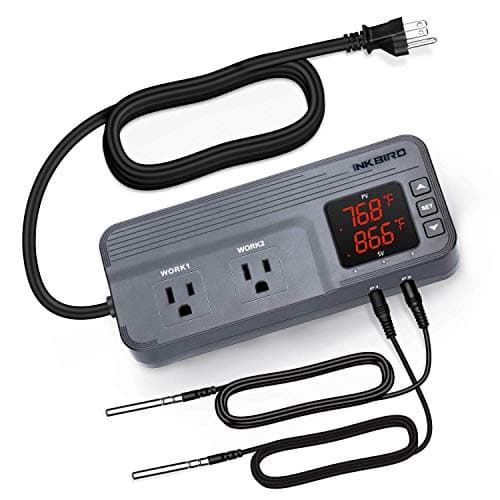 Inkbird ITC-608T Dual-Sensor Temperature Controller The only controller here that publishes all four things a plunge needs: an 1,800 W switching rating, waterproof sensors, a compressor delay to stop short-cycling, and an ETL listing. | 1,800 W (120 V, 15 A) | Best for a real chiller | 1.0 | $52.99 - Amazon |
| 2 | 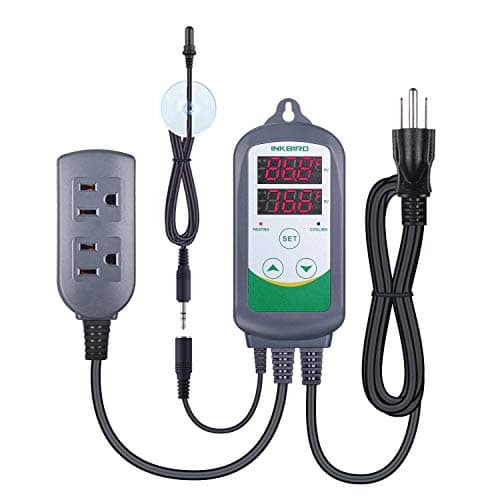 Inkbird ITC-308S Submersible-Probe Temperature Controller The same price as the standard ITC-308 with a fully submersible probe and a higher switching rating - 1,200 W against 1,100 - which makes the standard version the wrong one to buy for water. | 1,200 W (110 V) | Cheapest with a water probe | 1.2 | $35.99 - Amazon |
| 3 | 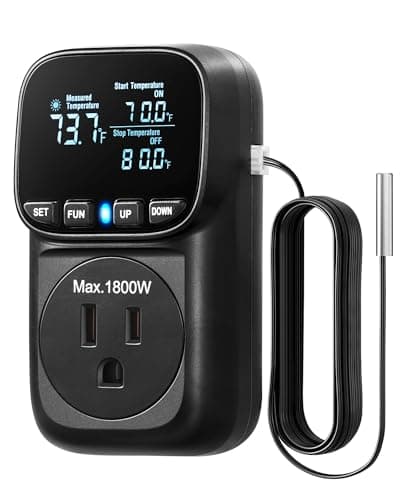 DEWENWILS 15 A Thermostat Outlet with Timer The cheapest controller here and, at a published 1,800 W and 15 A, one of only two with enough switching headroom for a full-size chiller - but it publishes nothing about its probe. | 1,800 W (15 A) | Cheapest with headroom | 1.0 | $19.99 - Amazon |
| 4 | 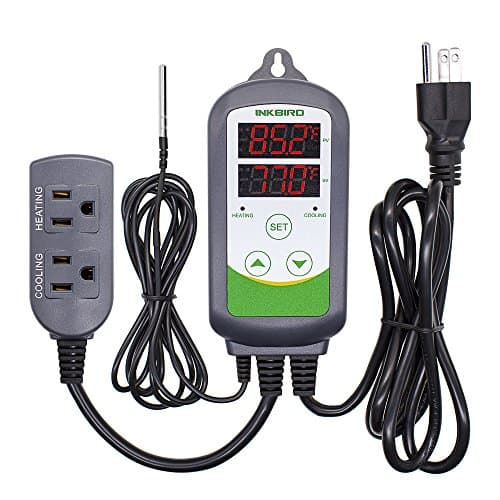 Inkbird ITC-308 Temperature Controller The controller most people end up buying, with dual relay outputs and a 1,100 W maximum load - the lowest rating here, and a standard rather than submersible probe. | 1,100 W (110 V) | The default, and not for water | 1.2 | $35.99 - Amazon |
| 5 | 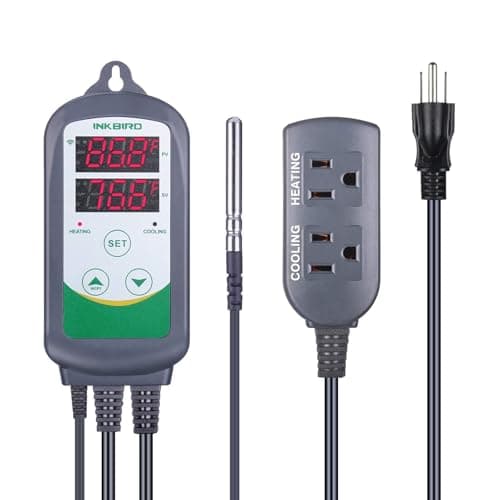 Inkbird WiFi ITC-308 Temperature Controller The ITC-308 with an app and a high and low temperature alarm, at about fifteen dollars more - and the same 1,100 W switching limit and standard probe as the model it is based on. | 1,100 W (110 V) | Remote monitoring | 1.2 | $49.99 - Amazon |
The short version
One thing to be clear about first: most purpose-built plunge chillers already hold a setpoint, so most people reading this do not need a controller. These matter for a chest freezer conversion, which is a box that only knows fully on, and for any cooling device sold without a thermostat.
How we judged these, before any ranking
- The published maximum output load, against the published draw of the chiller you intend to switch. This is the figure that makes a controller usable or not.
- Whether the probe belongs in water. Submersible or waterproof, in the seller’s own words, or not mentioned.
- A published compressor delay, if there is a compressor on the other end.
- A published safety listing, on a device switching 15 A next to a tub of water.
We have not opened any of these or measured a relay. Every figure below is read from the seller’s own listing on 2026-11-03.
The matching problem, in one table
This is the whole page. On the left is what each controller publishes it can switch; the chiller draws on the right are the published figures from our own chiller roundup.
The probe is the other half, and it is cheap to get right
A controller reads one thing and acts on it. If the probe is not in the water, it is reading an insulated tub wall or the air of a garage, and the setpoint it holds is not the temperature you get into.
Inkbird makes this easy to decide by selling two versions at the same price. The ITC-308S publishes a fully submersible probe - the listing’s own wording is that an aquarium probe works better in water than a standard probe - and a 1,200 W rating. The plain ITC-308 publishes a standard probe and 1,100 W. Same money. There is no reading of that comparison where the standard model is the right buy for a tub.
The DEWENWILS is the awkward case: it has the switching rating a big chiller needs and says nothing whatsoever about its sensor. If you buy it, assume the probe is not submersible until you can see otherwise, and plan to read the water some other way.
Compressor delay: one listing publishes it
Switching a compressor off and immediately back on is how refrigeration dies. A plain thermostat around a tight setpoint will do exactly that, repeatedly, overnight, while you are asleep. A controller that enforces a minimum interval between switches is protecting the most expensive component in the setup.
The ITC-608T is the only unit here whose listing says it has one. That single line is why it leads this page despite being the dearest, and it is why we would not put a bare thermostat in front of a $400 chiller to save sixteen dollars.
None of these is a cold plunge product
Worth saying plainly, because the listings make it obvious: these are sold for home brewing, fermentation, incubators, greenhouses, mushroom growing and reptile enclosures. Not one mentions cold plunges or ice baths.
That is not a mark against them. The hardware is indifferent to what the water is for, and the same thing is true of the hydroponics and aquarium chillers we cover in whether an aquarium chiller works for a cold plunge. What it does mean is that no part of these listings has been written with your application in mind, so the figures that matter to you are the generic ones - load, probe, delay - rather than anything in the marketing.
Where a controller actually changes the outcome
- A chest freezer conversion. The freezer has one speed. A controller is what turns it into a tub that holds 40 F instead of a block of ice, and it is the reason that build is a parts list rather than a product.
- A chiller with no setpoint. Rare but real, and a controller is cheaper than replacing the unit.
- Protocol consistency. If you are working to the bands in our temperature guide, the temperature has to be the controlled variable rather than the random one.
- Running a filter on a schedule. The cyclic timer on the DEWENWILS will run a pump for a set period rather than continuously, which suits the standalone units in the filter roundup.
What none of them publishes
- A relay cycle life. The relay is the part that wears out, and no listing states how many switches it is rated for.
- An IP rating. These are indoor plug-in devices, and a plunge frequently lives in a garage or on a patio. Keep the controller dry and out of the weather - nothing on these listings suggests it can take a splash.
- Any plunge-specific guidance. No setpoint advice, no mention of water, no compressor sizing help beyond the load figure.
What we would buy
- Inkbird ITC-608T - the pick, and the only one that publishes all four things that matter: 1,800 W at 15 A, waterproof sensors, a compressor delay and an ETL listing. Honest downside: the dearest here, and half its feature list - humidity control, twelve timing periods - is for greenhouses rather than tubs.
- Inkbird ITC-308S - the value pick for anything up to about 600 W. Fully submersible probe, 1,200 W, same price as the dry-probe version. Honest downside: no compressor delay, and 1,200 W is no real margin against a 1,200 W chiller.
- DEWENWILS 15 A outlet - the cheapest route to switching a big load, with a -40 to 210 F range, 0.1 F precision and a cyclic timer. Honest downside: the listing says nothing about the probe, which on a device for reading water temperature is the one thing you needed to know.
- Inkbird ITC-308 - only if you already own it. Fine for a small unit with the probe kept dry. Honest downside: 1,100 W rules out the biggest chiller we track, and the submersible version costs the same.
- Inkbird WiFi ITC-308 - buy it for the alarm, not the app: a high, low and sensor-fault alarm on your phone is worth more than remote setpoint changes. Honest downside: same 1,100 W limit and same dry probe as the non-WiFi model, and several chillers now publish an app of their own.
Every pick, in full
Each write-up below shows the score broken into its six components, the specs the listing actually publishes, and the running-cost arithmetic where a wattage exists to compute it from.
#1 - Best for a real chiller
Inkbird ITC-608T Dual-Sensor Temperature Controller
The only controller here that publishes all four things a plunge needs: an 1,800 W switching rating, waterproof sensors, a compressor delay to stop short-cycling, and an ETL listing.
| Small-space fit | 8 / 20 |
|---|---|
| Electrical fit | 0 / 20 |
| Cost to run | 0 / 20 |
| Key-number disclosure | 0 / 15 |
| Spec completeness | 2 / 15 |
| Warranty | 0 / 10 |
| Total | 10 / 100 |
| Rated watts | Not published Not published |
|---|---|
| Maximum temperature | Not published Not published |
| Dimensions | 8.1 x 1.37 x 3.34 in Seller’s listing, read 2026-11-03 |
| Weight | Not published Not published |
| Timer | Not published Not published |
| Cooling floor | Not the relevant number for this category |
| Material | Not published Not published |
| Warranty (months) | Not published Not published |
No running cost can be computed. The listing does not publish a rated wattage, so there is no honest way to tell you what a session costs. We will not estimate one. How we compute running costs
Four published figures, and every one of them matters for switching a chiller rather than a fermentation fridge. The 1,800 W maximum load at 15 A clears every chiller draw on this site with real headroom, which matters because a compressor pulls far more on startup than it does running and no chiller listing publishes that inrush figure. The temperature sensors are stated as waterproof across a -40 to 212 F range, so one can sit in the water rather than taped to the outside of a tub.
The feature that separates it from everything else here is the published compressor delay. Short-cycling - switching a compressor off and straight back on - is the standard way to kill refrigeration, and a bare thermostat will do exactly that around a setpoint. A controller that enforces a delay between switches is protecting the most expensive part of your setup, and this is the only listing on this page that says it has one.
It is also the only one publishing a safety certification: ETL listed, on a device switching 15 A a few feet from a tub of water. What it does not publish is a relay cycle life, an IP rating of its own, or any mention of cold plunge use - it is sold for brewing, greenhouses and reptile enclosures, and the dual sensors are pitched at temperature-plus-humidity setups you will not use.
Buy it if
Anyone switching an actual chiller, or converting a chest freezer, who wants headroom and a compressor delay rather than the cheapest relay.
Skip it if
You only need a readout. This is a controller, not a thermometer, and it is the dearest one here.
#2 - Cheapest with a water probe
Inkbird ITC-308S Submersible-Probe Temperature Controller
The same price as the standard ITC-308 with a fully submersible probe and a higher switching rating - 1,200 W against 1,100 - which makes the standard version the wrong one to buy for water.
| Small-space fit | 8 / 20 |
|---|---|
| Electrical fit | 0 / 20 |
| Cost to run | 0 / 20 |
| Key-number disclosure | 0 / 15 |
| Spec completeness | 4 / 15 |
| Warranty | 0 / 10 |
| Total | 12 / 100 |
| Rated watts | Not published Not published |
|---|---|
| Maximum temperature | Not published Not published |
| Dimensions | 7.48 x 3.34 x 4.13 in Seller’s listing, read 2026-11-03 |
| Weight | 0.99 lb Seller’s listing, read 2026-11-03 |
| Timer | Not published Not published |
| Cooling floor | Not the relevant number for this category |
| Material | Not published Not published |
| Warranty (months) | Not published Not published |
No running cost can be computed. The listing does not publish a rated wattage, so there is no honest way to tell you what a session costs. We will not estimate one. How we compute running costs
This is the quiet value pick, and the reason is a comparison the listings make easy. Inkbird sells the ITC-308 and this ITC-308S at the same price. The S publishes a fully submersible probe - its own words are that an aquarium probe works better in water than a standard probe - and a 1,200 W maximum load against the standard model's 1,100 W. Same money, better probe, more headroom.
For a plunge the probe is the whole argument. A standard controller probe is a bead on a wire meant to sit in air or strap to a vessel wall, and reading the tub through an inch of insulated PVC is how you end up chasing a setpoint you never reach. A probe you can drop in the water reads the water.
What it does not have is the 608T's compressor delay or its ETL listing, and 1,200 W is only just above the draw of the two 1,200 W chillers on this site - which is to say no margin at all once startup current is accounted for. Pair it with something smaller: the 190 W, 280 W and 600 W units leave it plenty of room.
Buy it if
Someone controlling a modest chiller or a freezer conversion who wants a probe that belongs in water.
Skip it if
Your chiller publishes 1,030 W or more. Buy the 1,800 W unit instead and keep the headroom.
#3 - Cheapest with headroom
DEWENWILS 15 A Thermostat Outlet with Timer
The cheapest controller here and, at a published 1,800 W and 15 A, one of only two with enough switching headroom for a full-size chiller - but it publishes nothing about its probe.
| Small-space fit | 8 / 20 |
|---|---|
| Electrical fit | 0 / 20 |
| Cost to run | 0 / 20 |
| Key-number disclosure | 0 / 15 |
| Spec completeness | 2 / 15 |
| Warranty | 0 / 10 |
| Total | 10 / 100 |
| Rated watts | Not published Not published |
|---|---|
| Maximum temperature | Not published Not published |
| Dimensions | 4.14 x 2.26 x 1.53 in Seller’s listing, read 2026-11-03 |
| Weight | Not published Not published |
| Timer | Not published Not published |
| Cooling floor | Not the relevant number for this category |
| Material | Not published Not published |
| Warranty (months) | Not published Not published |
No running cost can be computed. The listing does not publish a rated wattage, so there is no honest way to tell you what a session costs. We will not estimate one. How we compute running costs
The counterintuitive result on this page: the cheapest product has the joint-highest switching rating. A published 15 A and 1,800 W clears every chiller draw we track, and it publishes a -40 to 210 F control range with a stated 0.1 F precision, both heating and cooling modes, temperature calibration, power-loss memory and a cyclic timer.
The cyclic timing is worth a second look for an ice-only setup. It can run a pump or a filter for a set period rather than continuously, which is exactly the duty the standalone filter units on this site want, so one device can hold a setpoint on a cooler and run filtration on a schedule.
The omission that decides it against the Inkbird units is the probe: nothing on the listing says whether the sensor is waterproof, let alone submersible, and for a device whose whole job is reading water temperature that is the specification you would most want. No compressor delay and no safety certification are published either. It is the right buy for switching a big load on a budget and the wrong buy if the probe has to live in the tub.
Buy it if
Someone switching a 1,030 W or 1,200 W chiller who will mount the probe themselves and does not mind rigging the probe themselves.
Skip it if
You want a published submersible probe. This listing does not describe its sensor at all.
#4 - The default, and not for water
Inkbird ITC-308 Temperature Controller
The controller most people end up buying, with dual relay outputs and a 1,100 W maximum load - the lowest rating here, and a standard rather than submersible probe.
| Small-space fit | 8 / 20 |
|---|---|
| Electrical fit | 0 / 20 |
| Cost to run | 0 / 20 |
| Key-number disclosure | 0 / 15 |
| Spec completeness | 4 / 15 |
| Warranty | 0 / 10 |
| Total | 12 / 100 |
| Rated watts | Not published Not published |
|---|---|
| Maximum temperature | Not published Not published |
| Dimensions | 1.2 x 2.6 x 6.7 in Seller’s listing, read 2026-11-03 |
| Weight | 0.77 lb Seller’s listing, read 2026-11-03 |
| Timer | Not published Not published |
| Cooling floor | Not the relevant number for this category |
| Material | Not published Not published |
| Warranty (months) | Not published Not published |
No running cost can be computed. The listing does not publish a rated wattage, so there is no honest way to tell you what a session costs. We will not estimate one. How we compute running costs
This is the unit named in half the cold plunge forum threads, and it is on this page mostly so we can say what it does and does not do. Dual relay outputs mean it can hold a setpoint with refrigeration on one socket and heating on the other, it reads in Celsius or Fahrenheit, and it shows measured and set temperature at the same time.
Two published figures count against it for this use. The maximum output load is 1,100 W, which is below the draw of the two 1,200 W chillers on this site and leaves nothing spare on a 1,030 W one. And the probe is the standard sort, with nothing on the listing describing it as submersible - which matters because the same manufacturer sells a submersible-probe version at the same price.
So the honest advice is to buy its sibling instead. If you already own this one, it is a perfectly good controller for a small chiller as long as the probe is kept out of the water, and the dual outputs are genuinely useful on a hot-and-cold setup.
Buy it if
Someone who already owns one, or who is controlling a 190 W to 600 W unit and keeping the probe dry.
Skip it if
You are buying new. The submersible-probe version is the same price with a higher switching rating.
#5 - Remote monitoring
Inkbird WiFi ITC-308 Temperature Controller
The ITC-308 with an app and a high and low temperature alarm, at about fifteen dollars more - and the same 1,100 W switching limit and standard probe as the model it is based on.
| Small-space fit | 8 / 20 |
|---|---|
| Electrical fit | 0 / 20 |
| Cost to run | 0 / 20 |
| Key-number disclosure | 0 / 15 |
| Spec completeness | 4 / 15 |
| Warranty | 0 / 10 |
| Total | 12 / 100 |
| Rated watts | Not published Not published |
|---|---|
| Maximum temperature | Not published Not published |
| Dimensions | 5.51 x 1.3 x 2.68 in Seller’s listing, read 2026-11-03 |
| Weight | 1 lb Seller’s listing, read 2026-11-03 |
| Timer | Not published Not published |
| Cooling floor | Not the relevant number for this category |
| Material | Not published Not published |
| Warranty (months) | Not published Not published |
No running cost can be computed. The listing does not publish a rated wattage, so there is no honest way to tell you what a session costs. We will not estimate one. How we compute running costs
The case for this one is not the control, it is the alarm. It publishes a high and low temperature alarm plus a sensor-malfunction alarm, pushed to a phone over 2.4 GHz WiFi, which on a tub holding water you intend to get into is a more useful feature than remote setpoint changes. A chiller that quietly stops is the failure you want to hear about before you climb in.
Everything else is the standard ITC-308: dual relay outputs for refrigeration and heating, Celsius or Fahrenheit, calibration, plug and play. Several chillers on this site now publish WiFi control of their own, so check whether you are paying twice for the same feature.
The limits are inherited too. The maximum output load is still 1,100 W, which rules out the 1,200 W chillers, and the probe is still the standard kind rather than a submersible one. Paying more for the app does not buy either of the two things this page is actually about.
Buy it if
Someone running a freezer conversion out of earshot who wants a failure alarm on their phone.
Skip it if
Your chiller already has an app, or your chiller draws more than 1,100 W. Neither problem is solved here.
Questions people actually ask
What temperature controller do you need for a cold plunge?
One whose published maximum output load clears your chiller's published draw with room to spare, and whose probe is described as submersible or waterproof. Across the controllers here the published switching ratings are 1,100 W, 1,200 W and 1,800 W; across the chillers on this site the published draws are 190 W, 190 W, 280 W, 600 W, 1,030 W and 1,200 W. A 1,100 W controller cannot switch the 1,200 W chiller at all, and leaves 70 W of margin on the 1,030 W one, which is not margin once a compressor's startup current is accounted for.
Does an Inkbird work for a cold plunge?
Yes, with one caveat about which Inkbird. The ITC-308 and the ITC-308S are the same price; the S publishes a fully submersible probe and a 1,200 W rating while the standard model publishes a dry probe and 1,100 W. For a tub of water the S is the one to buy, and for a chiller drawing over 1,000 W the 1,800 W ITC-608T is the one with real headroom and a published compressor delay.
Why does a cold plunge need a separate controller at all?
Most purpose-built plunge chillers already have a thermostat, so they do not. Controllers matter in two situations: a chest freezer conversion, which is a box that only knows fully on, and any cooling device sold without a setpoint. Our chest freezer conversion page walks that build part by part and still does not score the freezer itself, because the conversion depends on parts like these rather than on a product you can buy whole.
What is a compressor delay and do you need one?
It is a minimum interval the controller enforces between switching a compressor off and on again. Short-cycling is the standard way to shorten the life of refrigeration, and a plain thermostat hunting around a setpoint will do it. Exactly one controller on this page publishes a compressor delay. If you are switching an actual compressor rather than a heater, it is the most valuable line on any of these listings.
Can you use a reptile or brewing thermostat for an ice bath?
That is what all of these are. Not one of them is sold as a cold plunge product - the listings name brewing, fermentation, greenhouses, incubators and reptile enclosures. The hardware does not care what the water is for; what matters is the switching rating, the probe and, if a compressor is involved, the delay. It is the same situation as the aquarium chillers we cover separately.
Will a controller make a cheap chiller colder?
No. A controller decides when the cooling runs, not how cold it can get. If your chiller publishes a 42 F floor, a controller will hold 42 F more precisely and will not reach 39 F. What it changes is consistency and run time, and on a freezer conversion it is the difference between a workable plunge and a block of ice.