Chillers
Hot and cold plunge chillers, and the heat ceiling that decides it
One machine for both halves of contrast therapy is now a real purchase. The catch is that “hot” spans 86 F to 113 F across these units, and the wattage on the box is not what it costs to run.
By Scooter M. · Published · Last updated
How we are paid: the buy links on this page are affiliate links. If you buy through one, we earn a commission from the retailer at no extra cost to you. It does not change what we rank or what we tell you to skip - the full FTC disclosure is here.
| # | Product | Rated draw | Best for | Score | Price |
|---|---|---|---|---|---|
| 1 | 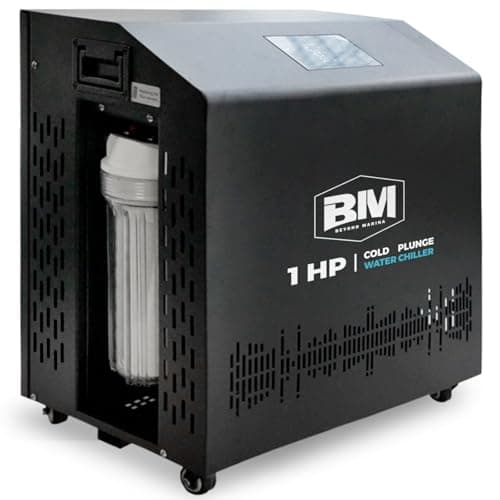 BEYOND MARINA 1 HP Hot and Cold Plunge Chiller Publishes a 32 to 113 F operating range, a cooling rate at two named volumes and a noise figure - and, like every dual-mode unit here, no electrical draw at all, only a heat-flow capacity that cannot be costed. | Not published | Published heat ceiling | 3.3 | $1,299.99 - Amazon |
| 2 | 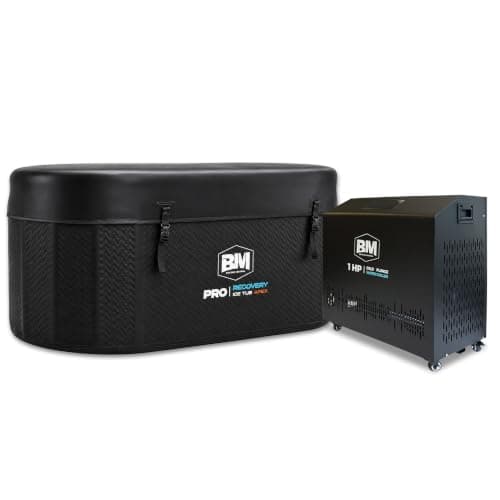 BEYOND MARINA Cold Plunge Tub with 1 HP Hot and Cold Chiller The only kit here that publishes a heating ceiling as well as a cooling rate - 108 F, with 53 gallons to 41 F in under 2.7 hours - in a 150-gallon drop-stitch tub with its port thread named. | Not published | One box, both temperatures | 4.0 | $1,595.99 - Amazon |
| 3 | 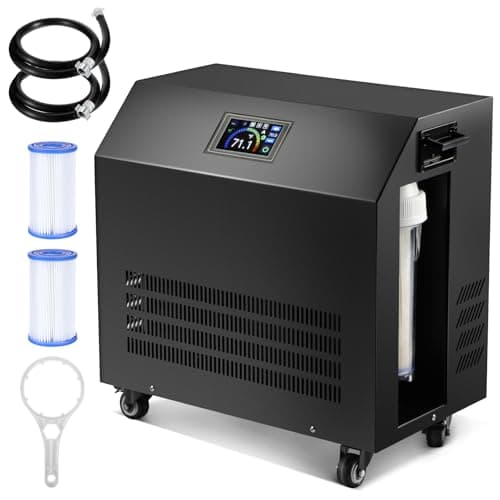 FEFLO 1 HP Hot and Cold Chiller with Ozone Rated to 260 gallons, which is the largest published volume on this site, with a 37 F floor, a 104 F ceiling, a 5 W ozone stage and component wattages for its pump and fan - but not for its compressor. | Not published | Largest published volume | 3.5 | $799.99 - Amazon |
| 4 | 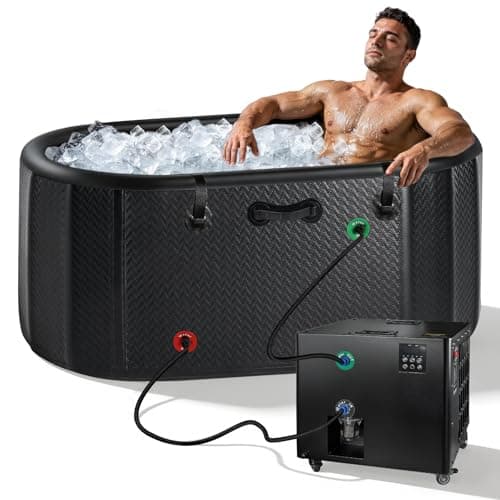 Drexo Cold Plunge Tub with 1 HP Hot and Cold Chiller A hot-and-cold kit that publishes an actual cooling rate rather than only a floor - and a title capacity that its own specification contradicts. | Not published | Published cooling rate | 3.8 | $899.00 - Amazon |
| 5 | 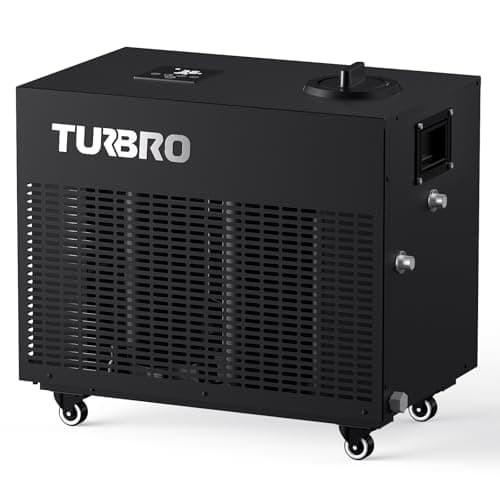 TURBRO FrostCore F85, 1 HP Cold Plunge Chiller The only chiller here that publishes a rated power, a BTU figure, a supply voltage, a temperature range and a cooling time - and it names its filtration in microns. | 1030 W | Most complete spec sheet | 5.9 | $1,399.00 - Amazon |
The short version
How we judged these, before any ranking
Four published figures, in this order:
- The heating ceiling. A number in Fahrenheit, not the word “heating”. This is the whole purchase.
- The cooling floor and a rate. A floor alone tells you where it can get to; a rate with a volume and a starting temperature tells you whether you will wait an hour or an afternoon.
- A volume rating. Gallons the unit is rated for, so you can match it to your tub rather than to a horsepower badge - the sizing method is here.
- Sanitation and noise, which matter more on a unit that holds warm water than on one that only holds cold.
We have not run any of these. Every figure below is read from the seller’s own listing on 2026-10-30, and where a listing does not publish something, the cell says so.
The finding: “hot” spans 86 F to 113 F
Look at the last row. The TURBRO is the best-specified chiller on this site - it is the only one publishing a BTU figure and a rated power - and its published range tops out at 86 F. Eighty-six Fahrenheit is a tepid bath; it is thirty degrees short of the warm end of contrast therapy. It is also, quite reasonably, described as having a heating function.
So the word tells you nothing and the number tells you everything. The three genuine dual-mode units publish 104, 108 and 113 F. For scale, a domestic hot tub usually runs at or below 104 F, so the top of this range is at the upper end of a heated soak rather than the middle of it.
The wattage on the box is not a running cost
The consequence is unavoidable and worth stating plainly: no running cost can be computed for any dual-mode unit on this page. Not an estimate, not a range. Our score gives both computed cost components zero for all three, which is why their numbers look low next to single-mode chillers that publish an honest draw - and that is a disclosure result rather than a verdict on the hardware.
One unit gets closer than the others. The FEFLO publishes an 88 W circulation pump, a 300 W fan and an 8 A internal fuse. Eight amps at 120 V is 960 VA, which is a ceiling on real power rather than a measurement of it, and we treat it the same way we treat a published amperage elsewhere on this site: as a bound, never as a bill. For context, the single-mode chillers that do publish a draw run from 190 W to 1,200 W, which is 3.5 to 22 cents an hour.
The rate is published here and almost nowhere else
Three of these units publish a cooling rate with a volume and a starting temperature attached, which across the rest of the site is close to unheard of. It is the most practically useful figure in the category, because it answers the question a floor temperature cannot: how long until I can get in?
The kit publishes it at two volumes, and the comparison is instructive: 53 gallons to 41 F in under 2.7 hours, and 106 gallons in 5.8 hours. Doubling the water more than doubles the time. That is the clearest published demonstration anywhere on this site that tub size is a chiller decision rather than a comfort decision.
What nobody publishes is a heating rate. Every rate on this page is for cooling, so how long these take to reach 108 or 113 F is unstated across the category - and on a 150-gallon tub that is not a small unknown.
One machine, one tub: the trade nobody mentions
A dual-mode chiller does not give you a hot tub and a cold plunge. It gives you one vessel that can be either, and the swing between them takes hours rather than minutes at the published rates. If your practice is alternating - a few minutes hot, a few minutes cold, repeated - a single tub cannot do it, and the protocol guide sets out what the structure actually requires.
Where dual mode genuinely wins is the rest of the year. A plunge tub that can be warmed is usable in February without a sauna, and a tub you use in February is a tub that earns its floor space. The economics against the two-appliance route are covered in cold plunge versus hot tub, with the caveat this page adds: on running cost that comparison is now one-sided, because hot tubs publish a draw and these do not.
Sanitation matters more when the water is warm
Cold water slows biological growth; warm water does the opposite. A tub that spends part of its life at 104 F is closer to a spa than a plunge in maintenance terms, and all three dual-mode units here publish a sanitation stage rather than filtration alone - ozone on all three, with the FEFLO naming a 5 W output, which is a figure almost nothing in this category attaches to the word.
Treat that as necessary rather than sufficient. None publishes a contact time, a dose or a test standard, so the stage is named rather than quantified - the same limitation we flag wherever ozone appears. The routine that actually keeps water usable, and the filter hardware that does the work, are in cold plunge maintenance and the filter roundup.
Noise, which two of these finally publish
For most of this site’s life, not one chiller on sale here published a decibel figure. Two of these do: under 65 dB on both BEYOND MARINA units and a 50 to 65 dB range on the FEFLO. Neither states a measurement distance, which is the same gap we flag on every EMF claim, so read them as claims with numbers rather than as measurements.
It still matters, because a dual-mode unit runs more of the year than a cold-only one. If the tub lives anywhere near a bedroom, the indoor page explains why an unpublished noise figure is the specification that quietly ends an indoor setup.
What none of these publishes
- An electrical draw, on any of the three dual-mode units. The single biggest gap, and the reason no running cost appears on this page.
- A heating rate. Every published rate is for cooling.
- A warranty term. Not one of the three states one, on units costing roughly $800 to $1,600.
- A volume rating, on two of them. The BEYOND MARINA units publish rates at named volumes but no maximum, so matching them to a large tub is extrapolation.
What we would buy
- BEYOND MARINA 1 HP chiller - the pick. The highest published ceiling at 113 F, a cooling rate at two volumes, under 65 dB, ozone and dual filtration, IPX4, and a published weight so you know what you are moving. Honest downside: no electrical draw, no volume rating and no warranty term, so you cannot cost it, size it by gallons, or hold anyone to it.
- BEYOND MARINA tub and chiller kit - buy this instead if you do not own a tub. Six of our eight checklist items published, a 150-gallon drop-stitch tub with an insulated thermal lid, a named 1/2 in NPT port thread, and 108 F heating. Honest downside: it costs meaningfully more than the chiller alone, the published weight is the tub rather than the chiller, and the running cost is just as uncomputable.
- FEFLO 1 HP chiller - the cheapest dual-mode unit we could verify, and the only one on this site rated above 230 gallons. Publishes a 5 W ozone output, a noise range, casters, and component wattages for its pump and fan. Honest downside: stock is thin, the 104 F ceiling is the lowest of the three, and its compressor draw is still unpublished.
- Drexo 248 kit - the other complete hot-and-cold setup, at a lower price than the BEYOND MARINA kit, with a 113 F ceiling and a published cooling rate. Honest downside: its own listing says 248 gallons in the title and 141 in the specification, and it admits the lid may not seal when the tub is full. The kits are compared here.
- TURBRO FrostCore F85 - not a dual-mode unit, and on this page as the counterexample: it publishes a BTU figure, a rated power and a real running cost, which none of the above do, and its range stops at 86 F. Honest downside: if you came here for a hot soak, 86 F is not it. The full review is here.
Every pick, in full
Each write-up below shows the score broken into its six components, the specs the listing actually publishes, and the running-cost arithmetic where a wattage exists to compute it from.
#1 - Published heat ceiling
BEYOND MARINA 1 HP Hot and Cold Plunge Chiller
Publishes a 32 to 113 F operating range, a cooling rate at two named volumes and a noise figure - and, like every dual-mode unit here, no electrical draw at all, only a heat-flow capacity that cannot be costed.
| Small-space fit | 12 / 20 |
|---|---|
| Electrical fit | 0 / 20 |
| Cost to run | 0 / 20 |
| Key-number disclosure | 15 / 15 |
| Spec completeness | 6 / 15 |
| Warranty | 0 / 10 |
| Total | 33 / 100 |
| Rated watts | Not published Not published |
|---|---|
| Water capacity | Not published Not published |
| Dimensions | 15.75 x 21.26 x 21.65 in Seller’s listing, read 2026-10-30 |
| Weight | 83.77 lb Seller’s listing, read 2026-10-30 |
| Cooling floor | 32 F, in a published 32 to 113 F range, 53 gal from 73.4 F to 41 F in 2.7 hours; 120 gal in under 3.5 hours Seller’s listing, read 2026-10-30 |
| Material | Not published Not published |
| Warranty (months) | Not published Not published |
No running cost can be computed. The listing does not publish a rated wattage, so there is no honest way to tell you what a session costs. We will not estimate one. How we compute running costs
This is the best-documented chiller in the registry on everything except the one figure our score needs. It publishes an operating range of 32 to 113 F, a cooling rate at two named volumes with the starting temperature attached, a noise figure of under 65 dB, an IPX4 rating, a built-in pump, ozone and dual filtration. Almost nothing in this category publishes a rate; two things now publish noise.
The 113 F ceiling is the number that matters, because it is what separates a dual-mode machine from a chiller with a warm setting. One hundred and thirteen Fahrenheit is a genuine hot bath. The best-documented single-mode chiller on this site publishes a range topping out at 86 F, which is lukewarm - and both get sold with the word heating attached.
What it does not publish is an electrical draw. The 2,405 W cooling and 3,600 W heating figures are capacities - heat moved, not power consumed - and the giveaway is arithmetic: 3,600 W of draw would be 30 A at 120 V, which no household outlet supplies. So no honest running cost exists for this unit, both computed cost components score zero, and we will not convert a capacity into a bill. No volume rating and no warranty term are published either.
Buy it if
Someone running contrast therapy in one tub who wants the hot ceiling, the cooling rate and the noise figure all on the record before buying.
Skip it if
You need to know what it costs to run. No electrical draw is published, so nobody can tell you.
#2 - One box, both temperatures
BEYOND MARINA Cold Plunge Tub with 1 HP Hot and Cold Chiller
The only kit here that publishes a heating ceiling as well as a cooling rate - 108 F, with 53 gallons to 41 F in under 2.7 hours - in a 150-gallon drop-stitch tub with its port thread named.
| Small-space fit | 14 / 20 |
|---|---|
| Electrical fit | 0 / 20 |
| Cost to run | 0 / 20 |
| Key-number disclosure | 15 / 15 |
| Spec completeness | 11 / 15 |
| Warranty | 0 / 10 |
| Total | 40 / 100 |
| Rated watts | Not published Not published |
|---|---|
| Water capacity | 150 Seller’s product title, read 2026-10-30 |
| Dimensions | 59 x 31.5 x 23.6 in Seller’s product title, read 2026-10-30 |
| Weight | 32.93 lb Seller’s listing, read 2026-10-30 |
| Cooling floor | 41 F, heating to 108 F, 53 gal to 41 F in under 2.7 hours; 106 gal in 5.8 hours Seller’s listing, read 2026-10-30 |
| Material | Double-layer PVC with drop-stitch insulation in tub and thermal lid Seller’s listing, read 2026-10-30 |
| Warranty (months) | Not published Not published |
No running cost can be computed. The listing does not publish a rated wattage, so there is no honest way to tell you what a session costs. We will not estimate one. How we compute running costs
This is the complete contrast-therapy setup in one purchase: a 150-gallon oval with drop-stitch insulation in both the tub and the thermal lid, and a 1 HP chiller that publishes both directions - 41 F cold with a rate attached, and warming to 108 F. Six of our eight checklist items are published, which ties the best tub in the registry, and the port thread is named as 1/2 in NPT with the brand's anti-rotation fittings, the same disclosure that made its sibling tub worth buying.
The rate is the part worth reading twice, because it is published at two volumes rather than one: 53 gallons to 41 F in under 2.7 hours, and 106 gallons in 5.8 hours. Doubling the water more than doubles the time, which is the clearest published illustration anywhere on this site of why tub size is a chiller decision rather than a comfort decision.
The gaps are the category's gaps. The 2,730 W cooling and 3,650 W heating figures are heat-flow capacities rather than electrical draws, so neither this kit's running cost nor its circuit requirement can be computed from the listing - and at 150 gallons heated to 108 F, the bill is the thing a buyer would most want to know. The published 32.93 lb weight is the tub, not the chiller. No warranty term appears anywhere.
Buy it if
Someone who wants hot and cold in one tub without matching a chiller to it themselves, and who will accept an uncostable running bill.
Skip it if
You already own a tub. The chiller alone from the same brand costs less and publishes the same figures.
#3 - Largest published volume
FEFLO 1 HP Hot and Cold Chiller with Ozone
Rated to 260 gallons, which is the largest published volume on this site, with a 37 F floor, a 104 F ceiling, a 5 W ozone stage and component wattages for its pump and fan - but not for its compressor.
| Small-space fit | 12 / 20 |
|---|---|
| Electrical fit | 0 / 20 |
| Cost to run | 0 / 20 |
| Key-number disclosure | 15 / 15 |
| Spec completeness | 8 / 15 |
| Warranty | 0 / 10 |
| Total | 35 / 100 |
| Rated watts | Not published Not published |
|---|---|
| Water capacity | 260 Seller’s listing, read 2026-10-30 |
| Dimensions | 20.3 x 20.9 x 13.8 in Seller’s listing, read 2026-10-30 |
| Weight | 99 lb Seller’s listing, read 2026-10-30 |
| Cooling floor | 37 F, heating to 104 F, 250 L in 4 to 5 hours Seller’s listing, read 2026-10-30 |
| Material | Not published Not published |
| Warranty (months) | Not published Not published |
No running cost can be computed. The listing does not publish a rated wattage, so there is no honest way to tell you what a session costs. We will not estimate one. How we compute running costs
Two reasons this is on the page. It is the cheapest dual-mode unit we could verify in stock, and at a published 260 gallons it is rated for more water than anything else on this site - the next largest publishes 230, and the biggest tub we track holds 216. If you own a full-size oval, this is the only dual-mode unit whose rating covers it.
It is also sold, in its own title, as an aquarium chiller for cold plunge tubs, which is the crossover we wrote about separately. Unlike the hydroponics units on that page it does publish a floor temperature, at 37 F, so the convention gap we flagged there is not universal. It publishes a 5 W ozone output, a 50 to 65 dB noise range, casters, an 8 A internal fuse and leakage protection.
The electrical picture is the same as the rest of this category and only slightly better. The 2,800 W cooling figure is a capacity rather than a draw, so it cannot be costed - but the published 88 W circulation pump, 300 W fan and 8 A fuse do bound the real load: 8 A at 120 V is 960 VA, which is a ceiling on power rather than a measurement of it, in the same way a published amperage is. We treat it as a bound and nothing more. No warranty term is published.
Buy it if
Anyone with a tub over 230 gallons, or anyone who wants dual mode at the lowest verified price.
Skip it if
You want a compressor draw you can budget against, or a unit that is not down to its last units of stock.
#4 - Published cooling rate
Drexo Cold Plunge Tub with 1 HP Hot and Cold Chiller
A hot-and-cold kit that publishes an actual cooling rate rather than only a floor - and a title capacity that its own specification contradicts.
| Small-space fit | 14 / 20 |
|---|---|
| Electrical fit | 0 / 20 |
| Cost to run | 0 / 20 |
| Key-number disclosure | 15 / 15 |
| Spec completeness | 9 / 15 |
| Warranty | 0 / 10 |
| Total | 38 / 100 |
| Rated watts | Not published Not published |
|---|---|
| Water capacity | 141 Seller’s listing, read 2026-10-25 |
| Dimensions | 59.1 x 31.5 x 32.7 in with the lid; 52.8 x 26 x 29.5 in inside Seller’s listing, read 2026-10-25 |
| Weight | Not published Not published |
| Cooling floor | 37.4 F, 79.3 gal from 82.4 F to 51.8-57.2 F in 2-3 hours Seller’s listing, read 2026-10-25 |
| Material | 3.15 in brushed PVC Seller’s listing, read 2026-10-25 |
| Warranty (months) | Not published Not published |
No running cost can be computed. The listing does not publish a rated wattage, so there is no honest way to tell you what a session costs. We will not estimate one. How we compute running costs
Almost nothing in this category publishes a cooling rate, and this does: 79.3 gallons from 82.4 F down to 51.8-57.2 F in two to three hours, with the starting temperature named and the caveat that it varies by volume and room temperature. That is a genuinely checkable claim, and it is more useful than a floor on its own.
Read it closely, though, because the rate stops well short of a plunge temperature. Two to three hours gets you to the mid fifties for a volume smaller than the tub holds; the 37.4 F floor is quoted separately with no time attached to it. The capacity is contradicted within the listing too - the title says 248 gallons and the specification says 141 gallons (643 L), which is the figure we record because it is the one with a unit and an inner dimension behind it.
The listing is also unusually candid about a defect: it states that when fully filled, slight barrel deformation from water pressure may cause minor gaps when the lid is closed. We would rather a seller said that than did not, and it is still a gap in the lid of a tub you are paying to keep cold. A UV disinfection stage, WiFi control and a 99-hour timer are published; no warranty term, weight or wattage is.
Buy it if
Someone who wants a published cooling rate and a hot mode, and will read the capacity figures carefully.
Skip it if
You need the title's capacity to be the real one, or a lid that seals when the tub is full.
#5 - Most complete spec sheet
TURBRO FrostCore F85, 1 HP Cold Plunge Chiller
The only chiller here that publishes a rated power, a BTU figure, a supply voltage, a temperature range and a cooling time - and it names its filtration in microns.
| Small-space fit | 12 / 20 |
|---|---|
| Electrical fit | 15 / 20 |
| Cost to run | 8 / 20 |
| Key-number disclosure | 15 / 15 |
| Spec completeness | 9 / 15 |
| Warranty | 0 / 10 |
| Total | 59 / 100 |
| Rated watts | 1030 Seller’s listing, read 2026-09-07 |
|---|---|
| Water capacity | 132 Seller’s listing, read 2026-09-07 |
| Dimensions | 21 x 24 in Seller’s listing, read 2026-09-07 |
| Weight | Not published Not published |
| Cooling floor | 36-86 F, 110 F to 36 F in about 5-6 hours Seller’s listing, read 2026-09-07 |
| Material | Not published Not published |
| Warranty (months) | Not published Not published |
| Rated draw | 1030 W |
|---|---|
| Cost per hour at full draw | 18.9 cents |
| Upper bound, running continuously | $137.82 per month |
A chiller cycles. It draws its rated power while the compressor runs and almost nothing while it does not, and how often it runs depends on ambient temperature, insulation, lid use and setpoint. We do not measure duty cycle, so we publish the two figures that need no assumption and no figure in between. Computed at 18.34 cents per kWh (June 2026). The method.
This is what a complete chiller spec sheet looks like: 1,030 W rated power, 9,553 BTU/h maximum cooling capacity, AC 110 to 120 V at 60 Hz, a 36 to 86 F range, and a stated cooling time with the starting temperature named. Every one of those is checkable, and together they let you predict what the unit will do in your room rather than hope.
The BTU figure is the one nobody else publishes and the one that actually lets you size a chiller properly. Horsepower is a compressor rating, not a cooling rating, and the relationship between the two varies by design. BTU per hour is the heat actually removed, which is the number that matters when you are deciding whether it can hold 132 gallons at 40 F in a warm garage.
At 1,030 W it is nineteen cents an hour at full draw - lower than both 1,200 W half-horse units here despite being a full horsepower, which is either better efficiency or a difference in how the figures were derived. The three-stage filtration is named by micron rating rather than described, and the ozone generator is a real sanitation method rather than a marketing word.
Buy it if
Someone who wants to size a chiller by arithmetic instead of by horsepower.
Skip it if
You want the smallest footprint. At 21 by 24 inches this is the largest unit here.
Questions people actually ask
Is there a cold plunge chiller that also heats?
Yes, and there are now several. The units on this page publish heating ceilings of 104 F, 108 F and 113 F, which are genuine hot-bath temperatures, and they cool to between 32 F and 41 F. Read the ceiling rather than the word: one well-documented single-mode chiller publishes a range that tops out at 86 F, which is lukewarm, and it is still sold with the word heating attached.
How hot does a hot and cold plunge chiller get?
Across the units we verified, the published ceilings are 104 F, 108 F and 113 F. For reference, a domestic hot tub usually runs at or below 104 F, so the top of this range is at the upper end of what a heated soak normally means. Anything that tops out in the eighties is a warm setting rather than a hot one.
What does the wattage on a hot and cold chiller mean?
It is almost always a capacity - heat moved - rather than the electricity the unit draws, and the two are not the same number. The giveaway is arithmetic: a 3,600 W draw would be 30 A at 120 V, and no household outlet supplies that. So the published cooling and heating capacities on these listings cannot be turned into a running cost, and we do not try. Not one dual-mode unit here publishes an electrical draw.
Do you need two machines for contrast therapy?
No, but one machine means one tub, and that is the real trade. A dual-mode chiller cycles the same water between cold and hot, so you wait for the swing rather than stepping between two vessels - and the published rates here are hours, not minutes. If your protocol depends on alternating quickly, two appliances or a sauna plus a plunge is the arrangement that supports it.
Is a dual-mode chiller cheaper than a hot tub and a cold plunge?
On purchase price, usually yes - the units here run from roughly $800 to $1,600 against a hot tub plus a plunge tub plus a chiller. On running cost, nobody can tell you, because no dual-mode listing publishes an electrical draw while hot tubs generally do. That is an uncomfortable answer and it is the honest one.
Can a dual-mode chiller heat a 200-gallon tub?
One of these publishes a volume rating that covers it, at 260 gallons, which is the largest published rating on this site. The others publish cooling rates at 53, 106 and 120 gallons without naming a maximum, so for a full-size oval you are extrapolating. Heating is the harder direction: the published rates are for cooling, and not one listing states how long it takes to warm anything.